The official site of bestselling author Michael Shermer The official site of bestselling author Michael Shermer

Good Rules Make Good Capitalists, Part 1

May 4, 2010

image via Wikipedia

As the SEC prepares its case against Goldman Sachs for allegedly intentionally defrauding the public with toxic securities that it created, sold, then bet against, I want to reflect for a moment on the need for rules in a free market society. Critics of capitalism believe that we libertarians want an essentially lawless society in which people are free to do whatever they want. That may be true for some libertarians, but I have come to believe through experience and science that free markets operate best within a system of clearly defined and strictly enforced rules and laws. Within the system itself markets should be as free as possible and people should be free to trade with whomever they want without interference from the state (think Chinese citizens trading ideas about democracy with each other and outsiders), but good rules make good capitalists.

Consider a sports analogy: In 1982, three other men and I founded the 3,000-mile nonstop transcontinental bicycle Race Across America (RAAM) from L.A. to New York, sponsored by Budweiser and televised on ABC’s Wide World of Sports. The rules were simple: each cyclist takes the same route, has a support vehicle and crew that follows behind providing food, drink, and equipment, and no drafting behind or hanging onto a vehicle is allowed. The race started on the Santa Monica Pier in California. The first cyclist to reach the Empire State Building in New York City would be declared the winner. That was the entire set of rules, which we didn’t even bother to write down.

All four of us finished the race and the next year dozens of cyclists wanted to compete so we began to outline some rules. During that first race, for example, it wasn’t clear what to do with a rider who went off course—can he get a ride in his support vehicle back to the route where he left it? (yes), can he be driven up the route the same distance he rode off course? (no). Although no drafting was allowed, it is often windy out on the open plains, and if there is a cross-wind from your left when your support vehicle comes alongside to hand off water bottles and food, there is a noticeable drafting effect. Not to mention that ten days is a long time to ride by yourself, so it is psychologically advantageous to have your support crew to talk to for long stretches. So we had to draft extensive rules defining how long a handoff can last (one minute), how many times an hour (four), with room for exceptions to the rule, such as if the temperature exceeds 100 degrees, in which case the number of handoffs is unrestricted.
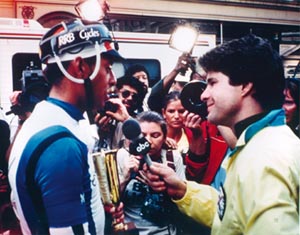
Lon Haldeman & Jim Lampley, Empire State Building, 1982

Once you start writing down what people can and cannot do, the list grows exponentially. As the years moved on and the race grew in popularity, the rulebook expanded with it. Women entered in 1984, so we added rules about gender divisions. Cyclists over 50 and 60 years of age wanted to race, so we added rules about age divisions. Four-man relay teams entered in 1989, so we created a new set of rules just for them, that subsequently had to be expanded to encompass two-person relay teams, men-and-women relay teams, age division relay teams, and even corporate relay teams. Every year something would happen that led to more rules. In the 1989 race one of the competitors was riding slowly up the long grade of Oak Creek Canyon from Sedonna to Flagstaff, Arizona, with his two vans and motorhome all caravanning behind him, preventing cars from safely passing. This went on for miles until someone called the police, but by the time the officers arrived they could only find the next rider back, whom they stopped on the side of the road, thereby disrupting his pace and costing him time, which we had to subtract from his overall finishing time. Another year, also in Arizona, we had a similar problem on a busy stretch of Highway 89, after which someone called the Arizona Department of Transportation to complain, resulting in a post-race ruling by the DOT that RAAM could only pass through Arizona during the day. As this would have obviated the nonstop nature of the race, I had to negotiate a deal with the Arizona DOT with a proviso in the rules that read: “The Follow Vehicle may not impede following traffic for more than one minute. The Follow Vehicle must pull off the road and let traffic pass when five or more vehicles are waiting to pass regardless of time. During the day the rider may proceed alone, with the Follow Vehicle catching up once traffic is clear. At night the rider must also pull off the road.”
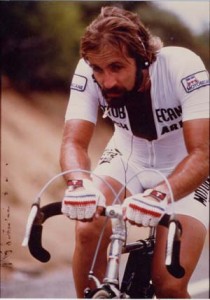
Shermer, 1982, listening on Sony Walkman (pre iPod)

One especially hot year one of the RAAM riders happened upon a small hotel pool while passing through a diminutive Western town, so he dismounted his bike and leaped into the pool, fully attired in cycling clothes, shoes, gloves, and helmet. Someone called the police, and once again by the time they arrived the pool perpetrator was gone, so they pulled over the next competitor that happened along, thereby disrupting his pace. This led to yet another rule, this one prohibiting competitors from swimming in public pools without permission from the owner. Most of the racers enjoy listening to music, either from small earbud phones or from speakers mounted on the roof of their following vehicle, which led to two additional problems: one, blasting music through tiny earphones jammed in your ears makes it difficult to hear oncoming traffic, ambulances, and the like; two, passing through small towns in the middle of the night blasting rock-n-roll music from loudspeakers tends to awaken the locals. Thus, two new rules were added, one restricting the use of only one earphone and the other curtailing the broadcasting of music during hours of darkness.
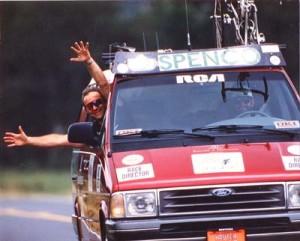
All of these new rules, of course, require the addition of appropriate punishments for violations, which we assessed in time penalties. However, an exhausted cyclist who is forced by an official to take time off the bike in the middle of the race may actually benefit from the penalty, so we had to write even more rules about where and when the penalties would be served, which we determined would be in a penalty “box” ten miles from the finish line (and, yes, we have had cyclists passed by competitors while sitting there on the side of the road). More rules and penalties mean more officials needed to assess them, and therefore more potential for subjective misjudgments on the part of officials (who are often sleep-deprived and exhausted themselves), so we had to add yet another set of rules that allow the cyclists to challenge the officials’ assessed penalties, and a set of guidelines for the Race Director to make a final evaluation before the end of the race if such a challenge is made, as well as a post-race board to hear one final appeal by the athlete if he or she feels that both the official and the Race Director made the wrong decision. Finally, we created a nonprofit governing body—the Ultra-Marathon Cycling Association (UMCA)—to oversee the entire sport, including and especially the development and adjudication of the rules.

The structure and development of this sporting event and the rules that govern it—as quotidian an example as it is—serves as an analogue for society at large. In its simplicity, sports can help clarify and illuminate the evolution and operations of more complex and nuanced social institutions. Just as good rules make good competitors, good walls make good neighbors and good laws make good citizens. People naturally want what is best for themselves, but most people also want what is fair for others. Without a structure in place to create and enforce firm and fair rules to meet both of these needs, people become more self-centered than other-centered, and if you go far enough down that path it degenerates into Hobbes’ bellum omnium contra omnes, “the war of all against all.”

Now, my libertarian friends, don’t panic thinking I’ve gone soft in the head liberal about creating obsessive government regulations in the economy. In this post I’ll demonstrate how industries naturally create their own set of rules from the bottom-up, and that these can serve as useful guidelines for top-down regulators.

topics:
Comments Off on Good Rules Make Good Capitalists, Part 1

Why We Are Hardwired for Belief in God

April 20, 2010

On April 10 the Wall Street Journal published a debate between myself and Gregory Paul on the question of whether or not belief in God is innate. Here are the links to the two articles:

http://tinyurl.com/y8n7qg6
http://tinyurl.com/y52ckwf

The online version was well edited but shorter than my original draft, which I present here just for the record. Enjoy.

According to Oxford University Press’s World Christian Encyclopedia, 84 percent of the world’s population belongs to some form of organized religion, which at the end of 2009 equals 5.7 billion people who belong to about 10,000 distinct religions, each one of which may be further subdivided and classified. Christians, for example, may be aportioned among 33,820 different denominations.1 Among the many bionomial designations granted our species (Homo sapiens, Homo ludens, Homo economicus), a strong case could be made for Homo religiosus. And Americans are among the most religious members of the species. In a 2007 Pew Forum survey of over 35,000 Americans, the following percentages of belief were found:

  • God or a universal spirit: 92%
  • Heaven: 74%
  • Hell: 59%
  • Scripture is word of God: 63%
  • Pray once a day: 58%
  • Miracles: 79%

So powerful is the belief that there must be something else out there that even 21% of those who identified themselves as atheists and 55% of those who identified themselves as agnostics expressed a belief in God or a universal spirit.2

Why do so many people believe in God? Although there is much cultural variation among different religious faiths, all have in common the belief in supernatural agents in the form of God, gods, or spirits who have intention and interact with us in the world. There are four lines of evidence pointing to the conclusion that such beliefs are hardwired into our brains.

Evolutionary Theory and God

Charles Darwin aged 51

In his 1871 book, The Descent of Man, Charles Darwin noted that anthropologists conclude that “a belief in all-pervading spiritual agencies seems to be universal; and apparently follows from a considerable advance in the reasoning powers of man, and from a still greater advance in his faculties of imagination, curiosity and wonder.”3 Why would religion and belief in God evolve? Darwin suggested that it might accentuate group cohesiveness in the competition against other groups: “There can be no doubt that a tribe including many members who, from possessing in a high degree the spirit of patriotism, fidelity, obedience, courage and sympathy, were always ready to aid one another, and to sacrifice themselves for the common good, would be victorious over most other tribes; and this would be natural selection (of the group).”4

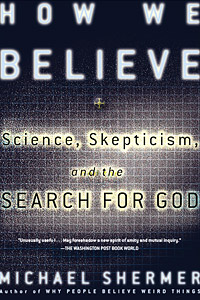
book cover

Picking up where Darwin left off, in my book How We Believe I developed an evolutionary model of belief in God as one of a suite of mechanisms used by religion, which I define as a social institution to create and promote myths, to encourage conformity and altruism, and to signal the level of commitment to cooperate and reciprocate among members of a community. Around 5,000 to 7,000 years ago, as bands and tribes began to coalesce into chiefdoms and states, even before the invention of government, religions were the first social institutions to codify moral behaviors into ethical principles, and God evolved as the ultimate enforcer of the rules.5

Human universals are traits shared by all peoples, such as tool use, myths, sex roles, social groups, aggression, gestures, grammar, phonemes, and many related to religion and belief in God, including: anthropomorphizing animals and objects, belief in the supernatural, beliefs and rituals about death, beliefs about fortune and misfortune, divination, folklore, magic, myths, and rituals. Although such universals are not totally controlled by genes alone (almost nothing is), there are good reasons to believe that there is a strong genetic predisposition for these traits to be expressed within their respective cultures. That is, your culture may dictate which God to believe in, but the belief in a supernatural agent who operates in the world is universal to all cultures because it is hard-wired in the brain, a conclusion enhanced by studies on identical twins separated at birth and raised in different environments.

Behavior Genetics and God

In one study of 53 pairs of identical twins reared apart and 31 pairs of fraternal twins reared apart, Niels Waller, Thomas Bouchard, and their colleagues in the Minnesota twins project looked at five different measures of religiosity and found that the correlations between identical twins were typically double those for fraternal twins, a finding suggesting that genetic factors account for approximately half of the observed variance in their measures of religious beliefs.6

This finding was corroborated by two much larger twin studies out of Australia (3,810 pairs of twins) and England (825 pairs of twins), that compared identical and fraternal twins on numerous measures of beliefs and social attitudes, concluding that approximately 55 percent of the variance in religious attitudes appears to be genetic.7 The scientists also concluded that people who grow up in religious families who themselves later become religious do so mostly because they have inherited a disposition, from one or both parents, to resonate positively with religious sentiments. Without such a genetic disposition, the religious teachings of parents appear to have few lasting effects.

Of course, genes do not determine whether one chooses Judaism, Catholicism, Islam, or any other religion. Rather, belief in supernatural agents (God, angels, and demons) and commitment to certain religious practices (church attendance, prayer, rituals) appears to reflect genetically based cognitive processes (inferring the existence of invisible agents) and personality traits (respect for authority, traditionalism). Why did we inherit this tendency?

Cognitive Psychology and God

Long long ago, in a Paleolithic environment far far away from the modern world, humans evolved to find meaningful causal patterns in nature to make sense of the world, and infuse many of those patterns with intentional agency, some of which became animistic spirits and powerful gods. I call these two processes patternicity (the tendency to find meaningful patterns in both meaningful and meaningless data) and agenticity (the tendency to infuse patterns with meaning, intention, and agency).

Imagine that you are a hominid on the planes of Africa and you hear a rustle in the grass. Is it a dangerous predator or just the wind? If you assume the rustle in the grass is a dangerous predator and it is just the wind, you have made a Type I error (a false positive), but to no harm. But if you believe the rustle in the grass is just the wind when it is a dangerous predator, you have made a Type II error (a false negative) and there’s a good chance you’ll be lunch and thereby removed from your species’ gene pool. Because we are poor at discriminating between false positives and false negatives, and because the cost of making a Type I error is much lower than making a Type II error, there was a natural selection for those hominids who tended to believe that all patterns are real and potentially dangerous. This is the basis for the belief not only in God, but in souls, spirits, ghosts, demons, angels, aliens, intelligent designers, and all manner of invisible agents intending to harm us or help us.

Gods are agents and agents are essences, and agenticity is everywhere. Subjects watching reflective dots move about in a darkened room (especially if the dots take on the shape of two legs and two arms) infer that they represent a person or intentional agent. Children believe that the sun can think and follows them around, and when asked to draw a picture of the sun they often add a smiley face to give agency to sol. Genital-shaped foods such as bananas and oysters are often believed to enhance sexual potency. A third of transplant patients believe that the donor’s personality or essence is transplanted with the organ, and studies show that most people say that they would never wear the sweater of a murderer, showing great disgust (probably an evolved emotion selected to avoid rotting food and disease-carrying substances), but that they would wear the cardigan sweater of the childrens’ television host Mr. Rogers, believing that it would make them better persons.

Neuroscience and God

Why God? In my analogy above, note that “wind” represents an inanimate force whereas “dangerous predator” indicates an intentional agent. There is a big difference between an inanimate force and an intentional agent. Most animals can make this distinction on the superficial life-or-death level, but we do something other animals do not do. As large-brained hominids with a developed cortex we have a Theory of Mind—the capacity to be aware of such mental states as desires and intentions in both ourselves and others. We “read minds” by projecting ourselves into someone else’s shoes (as in empathy) or by imagining someone out to get us (as in fear).

Theory of Mind is part of a larger mind-brain dualism, in which we tend to think of the mind as something separate from the brain. We speak of “my body” as if “my” and “body” are dissimilar. We revel in books and films that are dualistic, as in Kafka’s Metamorphosis in which a man falls asleep and wakes up as a cockroach with the man’s personality intact inside it, or in Freaky Friday where mother and daughter (Jamie Lee Curtis and Lindsey Lohan) trade bodies with their essences unbroken. This belief in mind and essence is a byproduct of the brain’s inability to perceive itself. Thus, we can “decenter” ourselves and imagine, say, being on a beach in Hawaii, which most people tend to see from above looking down on themselves as if out of their bodies. Out-of-body and Near-Death Experiences can both be triggered by electromagnetic fields bombarding the temporal lobes (just above the ears) of the brain, as well as through oxygen deprivation in pilot centrifuge training exercises. As well there is the well-known “third-man factor” in which solo sailors, mountain climbers, ultra-marathon athletes, and arctic explorers report a sensed presence of someone else on the expedition.

We believe in the supernatural because we believe in the natural and we cannot discriminate between the two. We create gods because we are natural-born supernaturalists, driven by our tendency to find meaningful patterns and impart to them intentional agency. The gods will always be with us because they are hard-wired into our brains.

References

  1. Barrett, D. B., G. T. Kurian, T. M. Johnson (Eds.). 2001. World Christian Encyclopedia: A Comparative Survey of Churches and Religions in the Modern World. 2 Vols. Oxford: Oxford University Press.
  2. http://religions.pewforum.org/pdf/report2religious-landscape-study-key-findings.pdf
  3. Darwin, C. 1871. The Descent of Man. London: John Murray, Vol. 2, 395.
  4. Ibid., Vol. 1, 166.
  5. Shermer, Michael. 1999. How We Believe. New York: Henry Holt/Times Books.
  6. Waller, N.G., B. Kojetin, T. Bouchard, D. Lykken, and A. Tellegen. 1990. “Genetic and environmental influences on religious attitudes and values: A study of twins reared apart and together.” Psychological Science 1(2): 138–42.
  7. Martin, N. G., L. J. Eaves, A. C. Heath, R. Jardine, L. M. Feingold, and H. J. Eysenck. 1986. Transmission of social attitudes. Proceedings of the National Academy of Science USA 83: 4364–68.
  8. Eaves, L. J., H. J. Eysenck, and N. G. Martin. 1989. Genes, culture and personality: An empirical approach. London and San Diego: Academic Press.
topics:
Comments Off on Why We Are Hardwired for Belief in God

Would I Ever Pray for a Miracle?

April 6, 2010

Watch ABC 20/20 Special on Miracles to Find Out…

photo

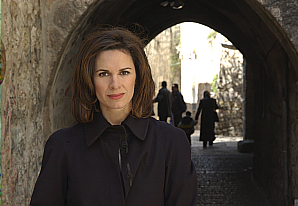
Elizabeth Vargas hosts 20/20 special on miracles

Last night ABC 20/20 aired a one-hour special on miracles (such topics are common faire on television during Christmas and Easter week) hosted by Elizabeth Vargas, this one featuring the usual array of “unexplained” recoveries from injury and disease, in this case a brain injury, cancer, and Parkinson’s disease. (See my interview segments at 26:34, 28:35, 38:15, 39:05.) The producers called me on Wednesday and asked for a skeptical perspective, outlining for me the details of the stories. It was good to know the details, but it doesn’t really matter what they are because the explanation follows no matter the specifics, because of the statistical analysis I provided applies to all such cases.

illustration

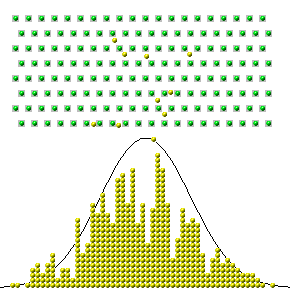
If you drop enough balls some will fall into the highly improbable outside slots. Such “miracles” are statistically guaranteed with large enough numbers.

Let’s say one million people have cancer in America (it’s much higher than this), and only one-tenth of one percent experience a spontaneous recovery (it’s actually higher than this). 1,000,000 x .001 = 1,000 people. Out of that cohort of 1,000 people, what are the chances that half a dozen of them have compelling narrative stories worthy of broadcast television? Pretty good! Here is a show you will never see on any television series: “Next, we examine the remarkable fact that 99.99 percent of people who were diagnosed with incurable cancer and were prayed for died anyway. Stay tuned, for you won’t want to miss these stark statistical realities.”

Of course you will never see such a show because of the confirmation bias, in which we look for and find confirmatory evidence for what we already believe and ignore or rationalize the disconfirmatory evidence. This is naturally what any religion or television production team is going to do when telling a story about miracles: they will pick and choose the most compelling cases that seemingly defy science and reason, and present those to the public, while blindly (and cruelly) ignoring all those devoutly religious people whose loved ones prayed in earnest for them and who died nonetheless. Why do religions and television production companies not call attention to them?

(In point of fact, recently the story broke that one of the “miraculous healings” featured on the show is now being challenged by the attending physician of the nun who was allegedly healed after a night of prayer to Pope John Paul II shortly after his death).

photo

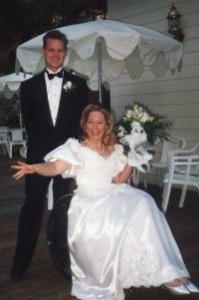
The real miracle here is Maureen’s courage to live a full life with a husband, children, and career.

Well, to their credit ABC 20/20 did just that in allowing me to be the voice of science, reason, and skepticism, and to state the above…and more. It’s the “and more” that seems to be troubling some of my hard-core atheist readers, who were dismayed that I seemingly gave some ground at the end. Watch it yourself at the 39:05 point. After a fairly lengthy interview, Elizabeth Vargas began pushing me to find out if I understood the emotional need people have for religion, faith, and belief in miracles, and she wanted to know if I ever prayed.

Of course I have, when I was a born-again Christian, and I even recounted a story for her that didn’t make the show because it was a little long (I tell the story at length in my next book): shortly after I became an atheist, my girlfriend at the time, Maureen Hannon, was in a horrific automobile accident and was paralyzed from the waist down, and one night in the ER in the midst of reality sinking in of what this meant for her life, I took a knee and asked God for a miraculous healing of the sweetest, smartest, most wonderful woman I ever knew for whom if anyone deserved a miracle it was her. Nothing happened, and Maureen is to this day a paraplegic.

photo

Being a parent is miraculous enough.

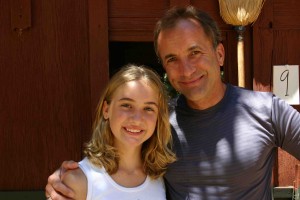
Elizabeth then surprised me by asking, as a father, would I ever do anything like that for my daughter, and I said what aired on the show; that is, that setting aside my role as a scientist and speaking purely as a father, “it is possible that I would do anything” and “as a person who loves someone else, who knows?”

So, take what you will from that. Anyone who is a parent knows exactly what I mean.

topics:
Comments Off on Would I Ever Pray for a Miracle?

Does the moon exist if there are no sentient beings to look at it?

March 23, 2010

In my last True/Slant post I explained why it is that quantum effects do not apply to the macro world because of the size difference between sub-atomic particles and (say) chemical reactions inside the neurons in your head, concluding:

During the debate Deepak claimed that the moon is nothing more than a soup of teaming quantum uncertainty. No. Subatomic particles may be altered when they are observed, but the moon is there even if no one looks at it.

Deepak wrote a thoughtful response to this blog (on his Blackberry while running on a treadmill with his agile thumbs no less!):

When you see an object, the moon being the example you chose, your eyes are not really “seeing” the moon. Your eyes are responding to photons that follow all the rules of wave-particle duality. The electro-chemical reaction in your rods and cones sends an electrical current to your brain, an action potential that goes to your occipital cortex where it is registered as a particular intensity and pattern of electrical firings in your synaptic networks. No image entered your eyes, no image enters your neural networks. Yet you see the moon in your consciousness. There was no moon till it was an experience in your consciousness. Your brain is not registering pictures of the moon. It is sensing a digital on-off code of photons or waves of electricity (same thing) The collapse of wave function that creates the moon is in your consciousness (that has no location because its non local) The moon exists in consciousness — no consciousness, no moon — just a sluggishly expanding wave function in a superposition of possibilities. All happens within consciousness and nowhere else. In fact, the sluggishly expanding possibility wave function is also within consciousness. The same principle applies to any macro object including your own body. That’s why I said on Larry King that you are not in your body, the body is in you. You are not in the world, the world is in you. You are not in your mind (thoughts are possibility waves till experienced in consciousness) the mind is in you. This “you” of course is not a person. It is what Stuart Hameroff (whom you quoted in your blog as generating heat but not light — alas they are the same thing — light and heat:)) says in an upcoming interview: “I think a fundamental field of protoconscious experience has been embedded all along — since the big bang — in the (quantum realm) and that biology evolved and adapted in order to access it and maximize the qualities and potentials implicit within it — this could be the basic fabric of the universe.” Take care.

Shermer
I agree with nearly everything you say here, except that the moon would exist even if there were no humans to observe it. If all life on earth were instantly eradicated by a rogue asteroid, the moon would continue on its merry way about what would be left of the shattered earth. In fact, even if there were no life anywhere in the cosmos, all those galaxies of stars would still be there. Do you disagree with that position? That reality exists separate from us observers? Otherwise, wouldn’t that just be solipsism?
Deepak
I disagree. Let’s take a simpler example. Let’s say your looking at a rose, a beautiful red one. What does it look like to a honey bee? The honey bee has no receptors for the usual wave lengths of light that you and I sense. It responds to ultraviolet so I don’t know what the experience of a rose to a honey bee but it has some experience, it is drawn to the flower and in fact makes honey out of it. What about a bat who can perhaps sense it as the echo of ultrasound. I don’t know what that experience is like either because I’m not a bat. What about a chameleon whose eyeballs swivel on 2 different axes? I can’t even remotely imagine what that object looks like to a chameleon. There are innumerable species who because of the nature of their sensory apparatus have a different experience of that rose. The senses do not see a rose. They register electricity! The neurons do not see a rose, they sense ionic shifts. What is the real look of the rose? There is no such thing! It depends on whose looking and also the instruments of observation — in this case the instrument of observation is the nervous system. (Of course that’s where you and I differ because you say you are your nervous system and I say you are the user of your nervous system.) Who is looking? A non-material observer. What is it looking at? It is looking at possibility waves that collapse as space time events in its own consciousness. That non-local observer is a single observer in all these different observations. Schroedinger: “Consciousness is a singular that has no plural.” You are the eyes of the universe looking at itself as a rose or the moon! Rumi: “Let the waters settle and you will see stars and the moon mirrored in your own being.” Every sentient biological entity is a singular consciousness looking at itself as a particular object. The observer and observed are the same being. The history of the cosmos is a history that is conceived in a particular way as if we were there or other biological organisms were there to observe it. But just as you cannot have an electrical current without a +ve and -ve terminal in place, you can’t have an object unless there is consciousness and a collapse of wave function to create that experience. There is now also a field called “time symmetric quantum mechanics” that says that information from the future fills in the indeterminacies of the present.” In other words the universe evolves teleologically.

Okay, Deepak, I think I understand the core of our disagreement: you are placing epistemology over ontology — how we know reality over reality itself. I think this is a result of your metaphysics and the worldview with which you begin. Since I privilege ontology over epistemology — reality over how we know reality — my conclusions will inevitably be different from your own.

On Larry King you stated: “There are traditions that say the in-body experience is a socially induced collective hallucination. We do not exist in the body. The body exists in us. We do not exist in the world. The world exists in us.” I wrote in my True/Slant blog that I didn’t understand this. Now I think I do after reading you more carefully. For you, the first-person “I” perspective is primary. As in your example with the rose, without rods and cones to transduce the photons of light bouncing off the rose into neuronal action potentials that register in a visual cortex, there is no rose. Of course, I could just as easily argue that without the rose there would be no photons to transduce into action potentials to register on a visual cortex.

photo

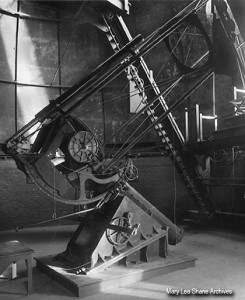
36-inch Crossley reflecting telescope at the Lick Observatory

So … which is the right perspective: reality first or I/self first? Reality takes precedence over self. Why? Here is one answer. Look at this photograph of the 36-inch Crossley reflecting telescope at the Lick Observatory, which I visited the day before our Caltech debate. It was through this telescope that the mysterious spiral nebulae were first imaged well enough for astronomers to conclude that they represent “island universes” (galaxies) far away from our own galaxy, and are not developing solar systems within the Milky Way. But the “imaged” nebulae did not register on anyone’s retina (or visual cortex): it was imaged on a spectrographic plate — a machine, not a brain. And those photons would register in that machine even if every human on earth disappeared that night.

topics:
Comments Off on Does the moon exist if there are no sentient beings to look at it?

Pentagon Gunman a Conspiracy Theorist & 9/11 Truther

March 10, 2010

What’s the harm in believing nonsense? I get asked this all the time: “Oh come on Shermer, let people have their delusions, what’s the harm?”

I have a laundry list of retorts to this challenge, from the value of living in a rational world that is based in reality to tales of people who have died from discredited medical practices, such as “Attachment Therapy” — in April, 2000, 10-year old Candace Newmaker was smothered to death in blankets by therapists who were helping “rebirth” her so that she could properly attach to her adopted parents. Death by theory. (I wrote about this in Scientific American.)

What’s the harm? Ask the victims of the anti-Government nutter Joseph Stack, who flew his plane into the IRS building in Austin, Texas. It is one thing to be skeptical of excessive government intervention into private lives and businesses, it is quite another to take matters into your own hands, especially if those hands hold a gun.

photo

John Patrick Bedell, Pentagon Gunman

Witness one John Patrick Bedell, the gunman who attacked guards at the entrance of the Pentagon yesterday (March 4), who now appears to have been a right wing extremist and 9/11 “truther,” who in an internet posting under the user name JpatrickBedell said that he intended to expose the truth behind the 9/11 “demolitions.” Apparently the delusional Bedell intended to shoot his way into the Pentagon to find out what really happened on 9/11.

Death by conspiracy.

More specifically, Bedell picked up the conspiracy theory about the alleged “murder” in 1991 of Marine Col. James Sabow, who was found dead in his California home in 1991. The police ruled it a suicide, but right-wing extremists and conspiracy theorists have suggested that he was murdered and that the case is a coverup by the federal government. Bedell posted that exposing the truth behind the Sabow case would be “a step toward establishing the truth of events such as the September 11 demolition.”

photo

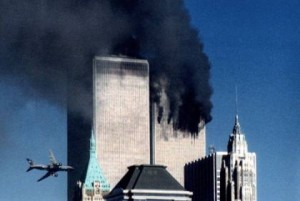
9/11 Truthers believe the WTC buildings were “demolished” by explosive devices. What’s that thing on the left about to hit the building?

Who is John Patrick Bedell? He was a 36-year old computer programmer from Hollister, California, a graduate of U.C. Santa Cruz (physics) who also attended San Jose State University (biochemistry). So he was a smart guy. As I’ve said before: intelligence is no prophylactic against magical thinking. If anything, smart people believe weird things because they are better at rationalizing beliefs that they’ve arrived at for nonsmart reasons.

Somewhere along the line — perhaps after his arrest for cultivating cannabis and resisting a police officer — Bedell decided that he wanted to expose “the truth of events such as the 9/11 demolitions and institutions such as the coup regime of 1963 that maintains itself in power through the global drug trade, financial corruption, and murder, among other crimes.”

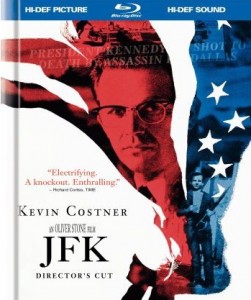
The “coup regime of 1963”? Yes, you know, the coup d’état that overthrew the U.S. government and replaced it with another government. You missed that one? Watch Oliver Stone’s film JFK. Lyndon Johnson and his cronies (Castro, the Russians, the CIA, the FBI, the mafia, et al.) had Kennedy assassinated.

Bedell continued in an Internet rant from 2006 associated with him:

cover

Oliver Stone’s fiction became fact for conspiracy theorists.

The sheer size of the United States economy … makes the United States government a tempting prize for any organisation or collection of bandits ruthless and clever enough to seize it. A criminal organisation able to conduct its activities from within the centre of power of the United States government would have powerful advantages over other criminal groups … This organisation … would see the sacrifice of thousands of its citizens, in an event such as the September 11 attacks, as a small cost in order to perpetuate its barbaric control. This collection of gangsters would find it in their interest to foment conflict and initiate wars throughout the world, in order to divert attention from their misconduct and criminality… This seizure of the United States government by an international criminal conspiracy is a long-established reality.

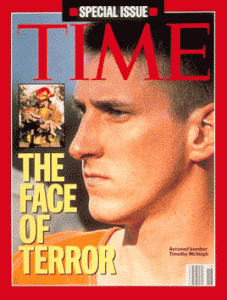
Time magazine cover

What’s the Harm? Beliefs drive behaviors.

Whose reality is this? Right wing militias. Back in the 1990s there was a surge in militias and extremists groups, which waned in the final years of the decade, but are now apparently making a comeback. According to the Southern Poverty Law Center, who tracks such groups, there were 42 paramilitary militias in 2008 and 127 in 2009. So-called “Patriot” groups also increased, from 149 in 2008 to 512 in 2009. According to an April 2009 report by the Department of Homeland Security, the current anti-government climate “parallels” what federal officials saw in the 1990s: “Rightwing extremists have capitalized on the election of the first African American president, and are focusing their efforts to recruit new members, mobilize existing supporters, and broaden their scope and appeal through propaganda, but they have not yet turned to attack planning.”

Not yet is the key phrase here.

What’s the harm? Now you know the answer.

topics:
Comments Off on Pentagon Gunman a Conspiracy Theorist & 9/11 Truther
PREVIOUS
 
NEXT