The official site of bestselling author Michael Shermer The official site of bestselling author Michael Shermer

The Pattern Behind Self Deception

June 15, 2010

Last week I blogged about lying: “Everyone Lies: Why?”

Deception is one thing, self deception is quite another. This week TED.com has posted my new TED talk, delivered at the last TED conference, in which I present material from my forthcoming book on the neuroscience of belief, tentatively entitled The Believing Brain, a central theme of which is how we are so easily deceived and how we deceive ourselves. Here is a brief summary of the thesis of the talk, although because it is so visual I strongly recommend watching the TED video.

Souls, spirits, ghosts, gods, demons, angels, aliens, intelligent designers, government conspiracists, and all manner of invisible agents with power and intention are believed to haunt our world and control our lives. Why?

The answer has two parts, starting with the concept of patternicity, which I define as the human tendency to find meaningful patterns in meaningless noise. The face on Mars, the Virgin Mary on a grilled-cheese sandwich, Satanic messages in rock music. Of course, some patterns are real: finding predictive patterns in changing weather, fruiting trees, migrating prey animals and hungry predators was central to the survival of Paleolithic hominids.

The problem is that we did not evolve a baloney-detection device in our brains to discriminate between true and false patterns. So we make two types of errors: a Type I error, or false positive, is believing a pattern is real when it is not; a Type II error, or false negative, is not believing a pattern is real when it is. If you believe that the rustle in the grass is a dangerous predator when it is just the wind (a Type I error), you are more likely to survive than if you believe that the rustle in the grass is just the wind when it is a dangerous predator (a Type II error). Since the cost of making a Type I error is less than the cost of making a Type II error, and since there’s no time for careful deliberation between patternicities in the split-second world predator-prey interactions, natural selection would have favored those animals most likely to assume that all patterns are real.

But we do something other animals do not do. As large-brained hominids with a developed cortex and a “theory of mind”—the capacity to be aware of such mental states as desires and intentions in both ourselves and others—we practice what I call agenticity: the tendency to believe that the world is controlled by invisible intentional agents. That is, we often infuse the patterns we find with agency, and believe that these intentional agents control the world, sometimes invisibly from the top down (as opposed to bottom-up causal randomness). Together, patternicity and agenticity form the cognitive basis of shamanism, paganism, animism, polytheism, monotheism, and all modes of Old and New Age spiritualisms.

Agenticity carries us far beyond the spirit world. The Intelligent Designer is said to be an invisible agent who created life from the top down. Aliens are often portrayed as powerful beings coming down from on high to warn us of our impending self-destruction. Conspiracy theories predictably include hidden agents at work behind the scenes, puppet-masters pulling political and economic strings as we dance to the tune of the Bildebergers, the Rothchilds, the Rockefellers or the Illuminati.

There is now substantial evidence from cognitive neuroscience that humans readily find patterns and impart agency to them, well documented in the University of Bristol psychologist Bruce Hood’s new book SuperSense (HarperOne, 2009). Examples: Children believe that the sun can think and follows them around and they often add smiley faces on sketched suns. Adults typically refuse to wear a mass murderer’s sweater, believing that “evil” is a supernatural force that imparts its negative agency to the wearer (and, alternatively, that donning Mr. Rogers’ cardigan will make you a better person). A third of transplant patients believe that the donor’s personality is transplanted with the organ. Genital-shaped foods (bananas, oysters) are often believed to enhance sexual potency. Subjects watching geometric shapes with eyespots interacting on a computer screen infer that they represent agents with moral intentions.

“Many highly educated and intelligent individuals experience a powerful sense that there are patterns, forces, energies, and entities operating in the world,” Hood explains. “More importantly, such experiences are not substantiated by a body of reliable evidence, which is why they are supernatural and unscientific. The inclination or sense that they may be real is our supersense.”

We are natural-born supernaturalists.
topics: , ,
Comments Off on The Pattern Behind Self Deception

Tony Blair’s Answer

June 1, 2010

The Force of Ideas Over the Force of Arms

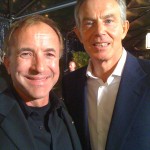
Shermer and Tony Blair

Last week I attended the Khosla Ventures summit at Cavello Point in Sausalito, California, an ex-army base converted to a posh resort, where the venture capitalist (he calls himself a “venture assistant”) Vinod Khosla brings together start-up CEOs and their venture backers who are together innovating new science and technologies for alternative and environmentally efficient energy sources. Vinod heard my TED talk in Long Beach in February 2010 (to be posted at TED.com in June) and invited me to explain why people believe weird things about money (“The Mind of the Market”, based on my book of the same title). Vinod hosted a fireside chat with Bill Gates and Tony Blair, and in the Q & A I raised my hand and asked Tony a question. By way of background…

Since I am in the business of spreading good ideas and debunking bad ideas, I ask this question all the time of a diverse range of people, in search of different answers to this difficult question. I believe in the power of ideas to free people and empower them—a fundamental principle that was born of the Enlightenment—but I also recognize that not everyone shares this belief, and since one of those Enlightenment principles is the freedom to disagree and the right to think and believe whatever you want as long as it does not interfere with my rights, then we can’t force people to embrace these Enlightenment values. On the other hand, we are tribal and we still live in a world with walls that are guarded by men with guns, and there are other tribes who would just as well terminate our existence or replace our Constitutional liberties with theocratic rule, we need a strong military. Thus my question for Tony Blair, and his eloquent and insightful answer:

Michael Shermer: “How can we spread liberal democracy, market capitalism, science, technology, education, the Internet, etc. globally, when there are people who are still essentially living in theocracies who, as you said, would just assume see us dead, who don’t believe in the education of women and children, who don’t believe in civil liberties and equal treatment under the law, etc., and how can we do so non-militarily? That is, how do we spread these ideas without imposing them on other people?”

Tony Blair: “It’s one of the great myths perpetrated in our own societies is that somehow people who live in oppressive or backward looking governments actually prefer it that way and that we just don’t understand their culture. You will often hear this in certain countries about the role of women when it is usually men talking about it, but any time you get the opportunity to talk to any women in those countries separated from those who might overhear them, believe it or not they tell you that they would prefer to be free and equal.”

“We have allies in this fight who are the people, most of whom want change. The thing is, however, you need the security means to stand up when you are confronted to answer back, and if you don’t you will get rolled over by them and there’s no use in thinking any different. However, the ultimate answer is not the force of arms but the force of ideas.”

“I think the 20th century was the century of fundamentalist political ideology, but the 21st century is going to be about religious or cultural ideology. The single most important thing we can do is also to provide a basis for peaceful co-existence. The best way of defeating these ideas is with better ideas. The better idea that we have in our way of life is not just about freedom and democracy, although I think those are important elements, it’s also about a basic concept of justice—the basic idea that anyone, no matter what their background, will get a chance to succeed.”

topics:
Comments Off on Tony Blair’s Answer

Science, Freedom and Trade

May 20, 2010

Michael Shermer enjoys two books that examine economics and politics from a scientific perspective — one explaining the experimental basis for democracy, another placing trade in an evolutionary context.

Reviews of The Science of Liberty: Democracy, Reason, and the Laws of Nature by Timothy Ferris, and The Rational Optimist: How Prosperity Evolves by Matt Ridley. This piece was published in Nature magazine on May 20, 2010.

In a 1963 lecture, Nobel-prizewinning physicist Richard Feynman opined on the nature of politics, arguing that the US governmental system “is new, it’s modern, and it is scientific”. Feynman reasoned that the way in which the system had been designed from scratch in the eighteenth century made it flexible enough to evolve as ideas were “developed and tried out and thrown away”. The writers of the Constitution, he noted, knew of the value of doubt.

Two new books discuss how science underpins democracy and trade. Timothy Ferris argues in The Science of Liberty that the experimental nature of liberal democracies is no accident, and in The Rational Optimist, Matt Ridley examines economics in the light of evolution.

Most science historians attribute the rise and success of the scientific enterprise to the Enlightenment values of reason, empiricism and anti-authoritarianism. Ferris reverses the causal vector. Most of the founding fathers were serious amateur scientists who deliberately adopted methods of data gathering, hypothesis testing and theory formation. Thomas Paine, for example, was an amateur astronomer who speculated that every star is a sun like our own, with orbiting planets. Assuming that science is universal, he believed that inhabitants of other worlds would discover the same natural and social laws as ours. “All the great laws of society are laws of nature,” Paine wrote in his 1791 treatise The Rights of Man. (continue reading…)

Comments Off on Science, Freedom and Trade

The Rules of Capitalism, Part 3

May 18, 2010

Liberty and The Man Who Shot Liberty Valance.

This is the third essay in a series on the relationship between rules, freedom, and prosperity.
Read part 1 on Skepticblog.org and part 2 over at True/Slant
.

photo

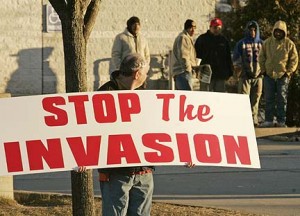
I believe that the following commentary on the necessity of law and order has some bearing on what is unfolding in Arizona—when the rules are not clearly written or consistently enforced, people will take the law into their own hands because society cannot run smoothly without law and order.

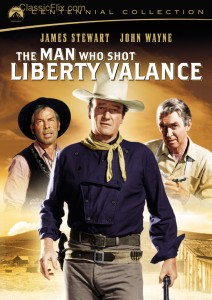
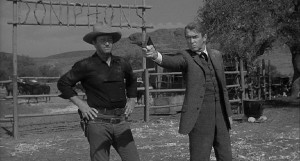
In Part 3 in my essay series on the relationship between rules, freedom, and prosperity, I want to turn to one of my favorite films, John Ford’s 1962 classic, The Man Who Shot Liberty Valance, in which a clash of moralities unfolds in the wild-west frontier town of Shinbone, Arizona. There in the dusty streets and ramshackle buildings two self-contained and self-consistent moral codes come into conflict. One moral code is the Cowboy Ethic, where trust is established through courage, loyalty, and personal allegiance to friends and family, and where disputes are settled and justice is served between individuals who have taken the law into their own hands. The other moral code is the Law Ethic, where trust is established through the transparent and mutually-agreed upon rule of law, and where disputes are settled and justice is served between all members of the society who, by virtue of living there, have tacitly agreed to obey the rules. Only one of these moral codes can prevail.

poster

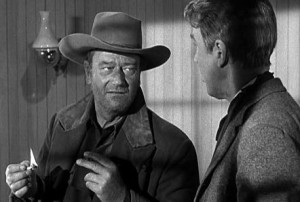
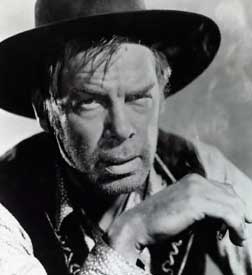
In The Man Who Shot Liberty Valance, the Cowboy Ethic is represented by two people, one good and the other evil. John Wayne’s character, Tom Doniphon, is a fiercely loyal and deeply honest gunslinger duty-bound to enforce justice on his own terms through the power of his presence backed by the gun on his hip. Lee Marvin’s title character, Liberty Valance, is a coarse and unkempt highwayman whose unruly behavior provokes fights with the locals, most of whom fear and loathe him.

The Law Ethic is represented by Jimmy Stewart’s character, Ransom Stoddard, an attorney hell bent on seeing his beloved Shinbone make the transition from cowboy justice to the rule of law. Employing the commonly-used flashback technique, John Ford opens his film at the end of the story with the funeral of Tom Doniphon, which is attended by an elderly Stoddard swamped by reporters inquiring why the now-distinguished U.S. Senator would bother returning to his native town just to be present at the memorial services of a down-and-out gunfighter.

When they were younger and coming of age in this western territory just slightly out of reach of the long arm of the law, Stoddard and Doniphon were of radically different minds when it came to how justice should be served, each believing that the other’s strategy is either outdated (Doniphon’s gun) or naïve (Stoddard’s law). Despite this difference, or perhaps because of it, they become faithful friends, both believing that in the end justice must prevail. When Liberty Valance arrives on the scene it is clear that he respects only one man, Tom Doniphon, because they share the Cowboy Ethic that men settle their disputes honorably between themselves. As Doniphon boasted, “Liberty Valance is the toughest man south of the Picketwire—next to me.” But Valance’s disdain for the milksop Stoddard and his naïve notions about the effectiveness of the law knows no bounds. Entering a restaurant where Stoddard is dining, for example, Valance berates him, taunts him, and finally trips the waiter, sending Stoddard’s dinner to the floor. As Stoddard meekly tries to avoid a confrontation, Doniphon enters and stares down Valance, who snaps back, “you lookin’ for trouble, Doniphon?” In his inimitable John Wayne drawl, Doniphon responds, “You aimin’ to help me find some?” Valance caves to Doniphon’s challenge and scurries out of the restaurant. “Well now; what do you supposed caused him to leave?” Doniphon wonders rhetorically. The sardonic response from a patron in reference to the impotency of Stoddard’s philosophy reveals which ethic is still dominant: “Why it was the specter of law and order rising from the gravy and the mashed potatoes.”

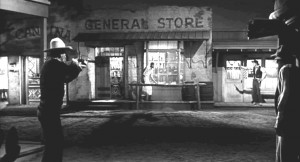
Despite Valance’s constant taunting, Stoddard holds to his belief that until Valance is caught doing something illegal there can be no justice. When Doniphon tells Stoddard “You better start pack’n a handgun,” Stoddard rejoins, “I don’t want to kill him. I just want to put him in jail.” At long last, however, Stoddard can take the derision no more, so he decides to take Doniphon’s advice that “out here a man settles his own problems,” and turns to him for gun-fighting lessons. When Valance challenges Stoddard to a dual, the overconfident naïf accepts and a late-night showdown ensues. In a darkened street, the two men square off. Stoddard is trembling in fear while Valance mocks and scorns him, shooting first too high and then too low. When Valance takes aim to kill, Stoddard shakily draws his weapon and discharges it. Valance collapses in a heap. Having felled one of the toughest guns in the west Stoddard goes on to become a local hero, building that image into political capital and working his way up from local politics to a distinguished career as a United States Senator. It appears that the Law Ethic prevailed over the Cowboy Ethic.

Not so fast. The man who shot Liberty Valance was Tom Doniphon. Knowing that Stoddard was no match for Valance, in a replay of the dual we see Doniphon lurking in the shadows and fingering a rifle, which he engaged to kill Valance at the crucially-timed moment when the two men drew their weapons. Holding to the cowboy ethic of loyalty and friendship, Doniphon takes the secret to his grave, where at the end of the story Stoddard is now paying his respect. When Stoddard finally reveals to a newspaper reporter the truth about who really shot Liberty Valance, the paper decides not to print the truth because, in what has become one of the most memorable lines in filmic history, “When the legend becomes fact, print the legend.”

Despite this being a typical shoot-em-up western film, The Man Who Shot Liberty Valance contains many moral subtleties. The philosopher Patrick Grim, who called my attention to the film as a tale of moral conflict, notes that both Stoddard and Doniphon violated their principles, but they did so because this was the only means by which one moral code could displace the other. By agreeing to a dual with Valance, Stoddard adopted a form of conflict resolution that he previously deemed illegal and immoral, and after discovering the truth about who really shot Liberty Valance, he chose to live a lie of omission then capitalized on his unearned heroism. For his part, Doniphon violated his moral code by ambushing Valance from the shadows instead of facing him man to man in the street, and then hiding the truth about what really happened, thereby tacitly endorsing Stoddard’s faux use of the Cowboy Ethic in order to help bring about the Law Ethic. In fact, both men violated both codes of morality, and with ample irony the only person who did not violate his moral code was the scurrilous Liberty Valance. But in the end, as Shinbone grew in size the transition from one moral code to the other had to happen, and in this moral homily it was friendship and loyalty that facilitated the change. It was the psychology of trust between individuals that enabled a society of trust among the collective to come to fruition.

The fictional Shinbone embodies any small community in transition from an informal to a formal moral code and system of justice. As long as population numbers are low and everyone in a community is either related to one another or knows one another through regular interactions, the code of the cowboy can work relatively well to keep the peace and ensure trust and social stability. But when communities expand and population numbers increase, the opportunities for unchecked violations of such informal codes expands exponentially, requiring the creation of such social technologies as codes, courts, and constitutions.

Continue reading part 4 over at True/Slant.

topics:
Comments Off on The Rules of Capitalism, Part 3

Meaning-Making Neurons

May 7, 2010

This review of The Brain and the Meaning of Life by Paul Thagard (Princeton University Press, Princeton, NJ, 2010. ISBN 9780691142722) appeared in Science Vol. 328, Issue 5979 in May 2010.

Twice I have spoken at the TED (Technology, Entertainment, Design) conference. Twice I have begrudgingly agreed to the strictly enforced 18-minute talk format—grumbling that “ideas worth spreading” (the TED motto) could not possibly be conveyed in such a constrained format. And twice have I been proven wrong. With discipline and diligence you really can say something of substance in a tight space, and more than 200 million downloads of endlessly entertaining and educational videos prove the principle of pithiness. (continue reading…)

topics: , , ,
Comments Off on Meaning-Making Neurons
PREVIOUS
 
NEXT