The official site of bestselling author Michael Shermer The official site of bestselling author Michael Shermer

The Passion of Saint Mel (Gibson that is)
August 3, 2010

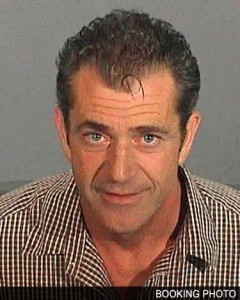
photo

To understand the lunatic rantings of Mel Gibson you need know only a few core characters of the man, starting with his first name, which comes from Saint Mel (or Moel), a fifth-century Irish saint who worked to evangelize Ireland in the name of the Papacy. Saint Mel is the patron saint of the Roman Catholic diocese of Ardagh, where Mel Gibson’s mother came of religious age.

The young (modern) Mel was brought up by his Traditionalist Catholic father, Hutton Gibson, where the doctrine of “Extra Ecclesiam nulla salus” (“Outside the Church there is no salvation”) was preached. Of course, what constitutes “the church” determines the circumference of the salvation circle, with religious liberals opting for those who accept Jesus as their savior as eligible for salvation, while religious fundamentalists, literalists, and apparently traditionalists holding to the strict dogma that if you are not Catholic you are not saved. Here is what Mel Gibson once said about his own (apparently long-suffering) wife Robyn, who is an Episcopalian: “There is no salvation for those outside the Church … I believe it. Put it this way. My wife is a saint. She’s a much better person than I am. Honestly. She’s… Episcopalian, Church of England. She prays, she believes in God, she knows Jesus, she believes in that stuff. And it’s just not fair if she doesn’t make it, she’s better than I am. But that is a pronouncement from the chair. I go with it.” The Chair. That’s refreshing. Here’s a bumper sticker for Saint Mel’s car: The Pope Said it, I believe it, That Settles it.
photo

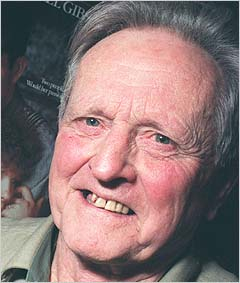
Portrait of Mel Gibson’s Father, Hutton Gibson. Photograph by Kylie Melinda Smith, Sun Herald

The intolerance of this dogma cannot be overstated, but to be fair the Papacy is merely channeling the gospel, in this case John 14:5-6: “Thomas said to him, ‘Lord, we do not know where you are going. How can we know the way?’ Jesus said to him, ‘I am the way, and the truth, and the life. No one comes to the Father except through me.’” And this means what for the Jews?

Speaking of the blood libel against the Jews, Saint Mel’s filmic opus, The Passion of the Christ, was one long argument (amplified with copious blood and raw flesh) for the justification of two millennia of anti-Semitism: the Jews killed our Lord. In point of fact it was the Romans who killed Jesus who, let’s not forget, was Jewish, so if the Jews were the perpetrators this would only mean that Jesus was killed by his own clan. (Do people really need to be reminded that before Christ there was no Christianity and there were no Christians? Apparently so.) And in any case, if the life of Jesus had to unfold as it did in order for him to transmogrify into the Christ (the Messiah)—which we are told had to happen for the atonement of original sin that would otherwise condemn all of us to eternity without God—then shouldn’t Christians be thanking the Jews for doing what, after all, they had to do? In any case, here is what the best extra-biblical source, the Roman historian Tacitus, said about it in chapter 15 of his Annals of Imperial Rome:
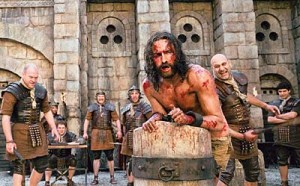
film still from The Passion of the Christ

Their originator, Christ, had been executed in Tiberius’ reign by the governor of Judea, Pontius Pilatus. But in spite of this temporary setback the deadly superstition had broken out afresh, not only in Judea (where the mischief had started), but even in Rome. All degraded and shameful practices collect and flourish in the capitol.

Skeptic magazine’s religion editor, Tim Callahan, concludes:

Here Tacitus, showing the same antagonism for Christianity evidenced in the Talmudic writers, says that it was temporarily checked when Pontius Pilate—not the Jewish authorities—executed Jesus. In summation, the trial before Ciaphas, the Barabbas episode, the reluctance of Pilate to condemn Jesus, and the Jewish mob demanding his death are, like every other aspect of the Passion and Resurrection narratives, pure fiction. The bare bones of the historical core of what is essentially grand myth is that Jesus was put to death by the Romans—not the Jews—for sedition.
photo

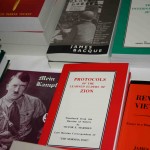
Anti-Semitism has roots running deep, and Mel’s go back to his father. Although today we do not hold to the moral precept that the son should suffer for the sins of the father, the Ten Commandments insists otherwise: “I. Thou shalt have no other gods before me. II. Thou shalt not make unto thee any graven image, or any likeness of any thing that is in heaven above, or that is in the earth beneath, or that is in the water under the earth. III. Thou shalt not bow down thyself to them, nor serve them: for I the LORD thy God am a jealous God, visiting the iniquity of the fathers upon the children unto the third and fourth generation of them that hate me.” Unfortunately for Mel, who claims to believe in all of the good book’s moral principles, his father had lots of doubts about the Holocaust but few doubts about the nefarious actions of the Learned Elders of Zion. Christopher Hitchens has read the Old Man’s anti-Semitic screeds, noting this gem from Hutton’s self-published book The Enemy is Still Here (the sequel to The Enemy is Here, just in case you didn’t get it the first time): “Our ‘civilization’ tolerates open sodomy and condones murder of the unborn, but shrinks in horror from burning incorrigible heretics—essentially a charitable act.” When Pope John Paul II said of the Jews in a conciliatory outreach across the theological divide, “You are our predilect brothers and, in a certain way, one could say our oldest brothers,” Gibson Senior penned this rejoinder: “Abel had an older brother.” Was he suggesting siblicide writ large?

This brings us to the Holocaust, which deniers publicly deny ever happened while privately wishing that it had (as in “Hitler didn’t implement the Holocaust but he should have”). Mel Gibson’s flirtations with Holocaust “revisionism” also stem from the Patriarch Hutton, who expressed his skepticism in a March, 2003 New York Times magazine article as to how the Nazis could have logistically exterminated six million Jews. “Go and ask an undertaker or the guy who operates the crematorium what it takes to get rid of a dead body. It takes one liter of petrol and 20 minutes. Now, six million?” From where did the six million figure come? “The entire catastrophe was manufactured” in a deal between Hitler and “financiers” to move Jews out of the Reich. Hitler “had this deal where he was supposed to make it rough on them so they would all get out and migrate to Israel because they needed people there to fight the Arabs.” Hutton’s wife added parenthetically: “There weren’t even that many Jews in all of Europe.” Hutton punctuated the point: “Anyway, there were more after the war than before.”

Here is what actually happened. In the 1930s the Nazis did try to get rid of the Jews by eliminating their civil liberties, then banning them from professions, then confiscating their property, then rounding them up into ghettos, then locking them up in concentration camps. In the early and successful (for the Nazis) years of the Second World War, the Third Reich grew in size with each territorial conquest, which meant that the number of Jews grew, along with the measures the Nazis were willing to take to reach their ultimate goal, which by 1942 had morphed from elimination to extermination.

To this combustionable cocktail of wrong-headed ideas and evil intent, add three more characteristics to bring Saint Mel into full light: a hot head temper with a hair trigger mouth and a propensity to drink.

This post originally appeared at TRUE/SLANT.
topics:
Comments Off on The Passion of Saint Mel (Gibson that is)

My Dinner (and Drinks) with Christopher (Hitchens that is)

July 20, 2010

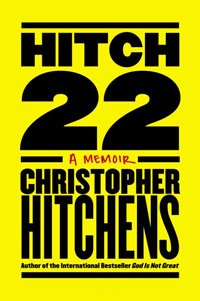
HITCH 22 (book cover)

The conjunction of reading Christopher Hitchens’ new memoir, Hitch 22, and the news of his treatment for esophageal cancer, reminded me that I should share my (admittedly limited) experiences of dining (and drinking) with one of the greatest literary masters and creative thinkers of our age.

First, I’m half way through listening to the unabridged audio book of Hitch 22, which I wholeheartedly recommend because Christopher reads it himself in that inimitable classically-educated British accent with his style of flowing quiet narrative punctuated with occasional bursts of accented emphasis. In other words, Hitchens sort of mumbles modestly along, then suddenly his voice rises into crystal clarity when he wants you to get the point hard and fast. Hitch 22 is a literary masterpiece, an absolute joy to listen to. I’ll leave it to his literary/politico peers to critique the ideas within (see, for example, the latest issue of The New York Review of Books with Ian Buruma’s review, as well as David Horowitz’s insightful analysis of Hitchens’ evolving political beliefs.

Although I’m a self-professed libertarian (fiscally conservative and socially liberal), I’m really not much of a politico or social commentator, especially when it comes to foreign affairs, about which I am woefully ignorant compared to Hitchens’ vast database he has accumulated throughout his many travels abroad. So I’m just enjoying the ride listening to Christopher’s many amusing stories. (One funny anecdote is when Hitchens explained that in an early writing job for a publication, his editor said something to him that, as he explained it, made it simply impossible for him to continue employment there. It turned out that the editor told him “you’re fired.”)

My intersection with Hitchens is through our mutual concern about the influence of religion on science. Hitchens, of course, has many other worries about the effects of religious beliefs on political, economic, and social conditions around the world (particularly the Middle East), but he was kind and generous enough to provide a back-jacket blurb for my book, Why Darwin Matters ($10 hardcovers at Shop Skeptic), and noted in his letter to me that contained said blurb that he had found a couple of minor errors in the book, adding parenthetically (in case I missed it) that this meant that he did, indeed, actually read the book. (In the book publishing business it is common practice for authors who are friends and colleagues to blurb each other’s books, and sometimes I suspect this means that the blurb was generated based on a cursory scan of the manuscript. To his credit and energy—considering how many blurb requests he must receive—Christopher really did read the entire manuscript.

I first met Christopher in Hollywood in 1997 at a preview showing of the film FairyTale: A True Story, starring Harvey Keitel as Harry Houdini and Peter O’Toole as Sir Arthur Conan Doyle, which recounted the story of the two giants’ intersection over the fake fairy photographs that Doyle fell for and Houdini did not. Hitch and I had dinner (well lubricated with adult beverages) before the preview, and although I was a bit distressed at the ending of the film that implied that fairies may actually be real (after showing that Doyle was duped), I rather enjoyed the film. Christopher’s review in Vanity Fair, which included a thoughtful and much appreciated endorsement of the Skeptics Society and Skeptic magazine, was much deeper and more insightful than anything I thought of during the viewing. Even though I’m a professional skeptic, for some reason when I watch a film I willing suspend disbelief in order to enjoy the process, and this sometimes interferes with my critical thought processes.

A decade later, in 2007, as I was meandering through the sensory overloaded Las Vegas airport on my way to The Amazing Meeting 5 and Freedom Fest, both conferences at which Hitchens and I were speaking, we encountered each other in search of our respective limo drivers, so we ended up sharing a ride to the hotel. Checking in early (it was around 11:00 am) our rooms were not yet ready, so Hitch suggested that we put the time to good use at the bar. Before. Noon. So there we were, my nursing a Corona with lime for as long as I could socially get away with it while Hitchens ordered a Johnny Walker Black, a red wine, and a bottle of water to mix with JWB in what appeared to be a well-choreographed routine. A couple of rounds later Hitch seemed completely unfazed, while my empty-stomach imbibing on that single beer left me feeling less than adequate to keep up with the conversation. (Hey, when you drink with a professional come prepared. I didn’t have the training miles I’m afraid.) When the bill came I had the singular honor of buying Christopher Hitchens’ drinks because (1) his wallet was in his baggage with the bellman, and (2) the room keys were not yet activated to put it on his room. I didn’t mind a bit—blurb reciprocity and all that, you know.

After hammering down two rounds of the Hitch Mix, Christopher was nearly (but not quite) ready for his noon-time luncheon speech, so he ordered a third round to go. At the podium where Hitch stood, before him were a glass of whiskey, a red wine, and a bottle of water. (Just as we cyclists always ride with water bottles filled with fluid replacement drinks, Christopher apparently never speaks without his Hitch Mix to top off his energy needs.) I can’t for the life of me remember what his speech was about (politics I’m sure) but I recall that Hitchens was extemporaneous, clever, and worldly.

That night the host of Freedom Fest, Mark Skousen, invited Christopher and myself to join a group of Big Thinkers at an exclusive (and quite expensive I’m sure) dinner at one of the posher restaurants in Las Vegas (no prices on the menu is all you need to know). Even though everyone at the table was someone of some import and standing, it was clear throughout the evening that Hitch was Sol and we were his orbiting planets gathering up the warmth of his verbal rays. He told stories—lots and lots of stories—about his travels, his encounters with names we would all surely know, and especially about his ideological battles with this and that ideologue. Other people’s comments were, for the most part, stimulants for another Hitch story. I can see why some people might find that this rubs them the wrong way, but for some reason—at least for me—that was how it should have been. If you invite Christopher Hitchens to your dinner, expect to be entertained, and the more the waiter poured expensive wine, the more histrionic Hitchens became, until four hours and who-knows-how-many-drinks later I detected a slight slowing of his verbal and cognitive skills…so there are limits after all.

The next time I saw Hitch was at a party in Washington D.C., when I was touring for the release of my book, The Mind of the Market ($8.95 hardcovers at Shop Skeptic). Reason magazine kindly arranged for a book party at a bar and restaurant that was so crowded and so loud that it was physically uncomfortable. After an obligatory drink and a few stories to entertain the troops, Hitchens leaned in and said “Michael, why don’t we retire to a restaurant down the street where they know me?” Exiting the cacophony, we walked a few blocks to what turned out to be one of Hitches’s regular haunts. “The usual place, Mr. Hitchens?” the maitre’d inquired. We were escorted to a quite corner of the restaurant, where Hitch positioned himself to be able to scan the room, and soon we were joined by his wife and an occasional passerby who recognized him and dropped in for a story (and drink) or two.

Shortly after the waiter took our drink orders (“the usual?” was all Hitch needed to hear, to which he nodded affirmatively), the Hitch Mix was on the table, followed by a fabulous dinner and, of course, lots of stories, none of which were repeated from my previous dinner (at least that I could remember—I too imbibed). After a couple hours at the restaurant, Hitch invited me to his home not far from the restaurant, where I was treated to a visual delight: mountains of books, oceans of books, a sea of books—pick your geographical metaphor. As the recipient myself of bound galleys and newly published volumes sent to Skeptic magazine for review, I know how quickly a mass accumulates on my desk that then migrates to the floor and eventually peaks above the desk again. But these are just science books. As a literary polymath Hitch receives books for review from virtually every category in the Dewey Decimal System. And he actually seems to read the books he reviews.

But the library is not where we adjourned for the evening. It wasn’t long before I found myself at a rectangular table in the dining room chockablock full of whiskey bottles from around the world. I’m not a whiskey connoisseur so I couldn’t tell you the brand names, but even a teetotaler like me could tell from the labels and bottle designs that here was a collection of the very best whiskeys that money can buy from all over the world, and I suspect that Hitch didn’t have to buy many of them, since such gifts seem to naturally flow his way. So I sampled and sipped and sauced my way into a late-night bliss that I paid for dearly the next day. I think I had an interview for an early morning television show, but I honestly don’t remember because I barely recall even having a next day.

Was it worth it? I once had an opportunity to ride my bike 50 miles on a fundraising event next to the great Belgian champion Eddy Merckx, considered the greatest cyclist of all time. I was so nervous about crashing and taking him down that I just concentrated on the bumper in front of us that we were drafting behind at 30 miles per hour. But just the experience of riding side by side with one of the greatest athletes to ever grace the planet was enough for me. That’s how I felt drinking and dining and delighting in the presence of Christopher Hitchens.

topics:
Comments Off on My Dinner (and Drinks) with Christopher (Hitchens that is)

On Fact and Fraud

July 14, 2010

Cautionary Tales from the Front Lines of Science

A review of On Fact and Fraud: Cautionary Tales from the Front Lines of Science by David Goodstein. This review appeared in the American Journal of Physics on July 14, 2010.

In 1609 Galileo turned toward the heavens a modified version of the telescope first invented by the Dutch spectaclemaker Hans Lippershey, and there he observed that satellites were orbiting Jupiter, that Venus had phases, and that there were mountains on the moon and spots on the sun. His claims challenged Aristotelian cosmology, which held that all objects in space must be perfectly round and perfectly smooth. After observing Saturn, however, Galileo wrote to Johannes Kepler, “Altissimum planetam tergeminum observavi” (“I have observed that the farthest planet is threefold”). He continued: “This is to say that to my very great amazement Saturn was seen to me to be not a single star, but three together, which almost touch each other.” Galileo saw Saturn not as a planet with rings as we see it today in even the tiniest of home telescopes, but as one large sphere surrounded by two smaller spheres.

Why did Galileo make this mistake? Two reasons: (1) Data—Saturn is twice as far away as Jupiter; thus what few photons of light there were streaming through the cloudy glass in his little tube made resolution of the rings problematic at best; and (2) theory—there was no theory of planetary rings. It is at this intersection of nonexistent theory and nebulous data that the power of belief is at its zenith and the mind fills in the blanks. (continue reading…)

topics: , , , , , ,
Comments Off on On Fact and Fraud

Nash Equilibrium, the Omerta Rule, and Doping in Cycling

July 13, 2010

The Tour de France is underway and it is already shaping up to be one of the grandest and most epic races in the event’s century-long history. If you haven’t seen a stage yet be sure to tune into the Versus Network that covers it every day, with repeat airings all day and evening. Lance is still in contention even after several crashes. In fact, I’ve never seen so many crashes in a Tour before. This event is so hard it is not surprising that, as usual, allegations and suspicions of doping have surrounded the race even before it began. Unfortunately, it appears that doping has long been a part of this — and many other — sports. Here is my explanation for why athletes in general and cyclists (my sport) in particular dope, why race organizations have such a hard time enforcing the rules, and what can be done about it.

In criminal organizations such as the Cosa Nostra in 19th century Sicily and the Mafia in 20th century southern Italy, the “omerta rule” is the code of silence, a tacit agreement among cohort members that the collective violation of the law means if you get caught you keep your mouth shut and under no circumstances cooperate with the authorities. The penalty for an omerta betrayal is ultimate and final — death.

Something like the omerta rule operates in the dark and dirty underbelly of doping in sports, or the employment of performance enhancing drugs (PEDs) against the rules (and in some cases the law), in which a positive test leads to an obligatory statement of shock and denial by the guilty party, followed by a plausible explanation for how the drug mysteriously appeared in the blood or urine, ending in fines paid and/or time served and eventual return to the sport, no names named and no further questions asked.

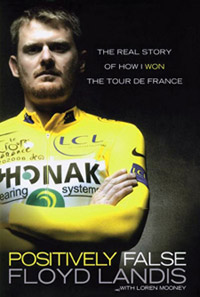
After testing positive for steroids following his 2006 Tour de France victory, Floyd Landis obeyed the omerta rule, albeit in grander style than most, publishing a bestselling book, Positively False: The Real Story of How I Won the Tour de France, raising upwards of $600,000 for a legal defense fund, and taking his case to sports arbitration. The three-time Tour de France champion Greg LeMond told me in a phone conversation during the arbitration trial that Landis consulted him about what to do next, at which point LeMond encouraged him to come clean. “What would I gain doing that?,” LeMond recalled Landis saying. “You would clear your conscience and help save cycling,” LeMond replied.

Three years later Landis has apparently decided to take LeMond’s advice, confessing during the recent Tour of California that the “real story” of how he — and Lance Armstrong — won the Tour de France is drugs, lots and lots of PEDs: recombinant Erythropoietin (r-EPO) to artificially stimulate the production of oxygen carrying red blood cells, steroids and human growth hormone for recovery and the development of lean muscle mass, and blood boosting, or withdrawing your own blood early in the season and then re-injecting it during the Tour de France to boost red blood cell count with your own blood (thereby sidestepping the test for EPO while gaining a comparable advantage). In published emails Landis defiantly slapped the omerta rule across the face, naming names and providing details:

“I was instructed on how to use Testosterone patches by [Team Director] Johan Bruyneel”

“Mr Armstrong was not witness to the [blood] extraction but he and I had lengthy discussions about it on our training rides during which time he also explained to me the evolution of EPO testing and how transfusions were now necessary due to the inconvenience of the new test.”

Armstrong “tested positive for EPO at which point he and Mr Bruyneel flew to the UCI headquarters and made a financial agreement with Mr. Vrubrugen to keep the positive test hidden.”

“During that Tour de France I personally witnessed George Hincapie, Lance Armstrong, Chechu Rubiera, and myself receiving blood transfusions. Also during that Tour de France the team doctor would give my room mate, George Hincapie and I a small syringe of olive oil in which was disolved andriol, a form of ingestible testosterone on two out of three nights throughout the duration.”

It’s a good thing for Landis that the penalty for an omerta rule violation in sports is not what it is in the Mafia, or else he’d be the Luca Brasi of cycling and sleeping with the fishes. Why did Landis break the code of silence? The answer to this question, along with the larger question of why athletes dope, comes from game theory and something called Nash equilibrium, discovered by the Nobel Prize-winning mathematician John Nash (of Beautiful Mind fame), in which two or more players in a contest reach an equilibrium where neither one has anything to gain by unilaterally changing strategies. If each player has selected a tactic such that no player can benefit by changing tactics while the other players hold to their plans, then that particular arrangement of strategy choices is said to have reached a point of equilibrium.

Here’s how it works in sports. The point of an athletic contest is to win, and players will do whatever they can to achieve victory, which is why well-defined and strictly enforced rules are the sine qua non of all sports. The rules clearly prohibit the use of PEDs, but because the drugs are extremely effective and the payoffs for success are so high, and because most of the drugs are difficult if not impossible to detect, or the tests can be beat with countermeasures, or the governing body of the sport itself doesn’t fully support a comprehensive anti-doping testing program (as in the case of Major League Baseball and the National Football League), the incentive to dope is powerful. Once a few elite athletes in a sport defect to gain an advantage over their competitors, they too must defect (even if they only think others are doping), leading to a cascade of defection down through the ranks.

If everyone is doping there is equilibrium if and only if everyone has something to lose by violating the tacit omerta agreement. Disequilibriums can arise when not everyone is doping, or when the drug testers begin to catch up with the drug takers, or when some cheaters have nothing to lose and possibly something to gain by turning state’s evidence.

Which brings us back to Floyd Landis and Lance Armstrong, who for a decade have been in a state of relative Nash equilibrium. But when Landis lost his savings, his home, his marriage, and his livelihood, he reached a state of disequilibrium, and when he was turned down from even riding in the Tour of California after, according to Armstrong, making threats to the race organizers to let him in “or else,” he apparently decided to make good on his threat.

There is nothing more important for a sporting organization to do than to enforce the rules. If you don’t, athletes will cheat. Anyone who believes otherwise does not understand sports or human nature. As Landis explained in his confessional: “I don’t feel guilty at all about having doped. I did what I did because that’s what we [cyclists] did and it was a choice I had to make after 10 years or 12 years of hard work to get there, and that was a decision I had to make to make the next step. My choices were, do it and see if I can win, or don’t do it and I tell people I just don’t want to do that, and I decided to do it.”

Solutions

The only hope of salvaging professional sports is to change the game matrix. To that end I have five recommendations:

  1. Immunity for all athletes pre-2010. Since the entire system is corrupt and most competitors have been doping, it accomplishes nothing to strip the winner of his title after the fact when it is almost certain that the runners’ up were also doping. Immunity will enable retired athletes to work with governing bodies and anti-doping agencies for improving the anti-doping system.
  2. Increase the number of competitors tested, in competition, out-of-competition, and especially immediately before or after a race to prevent counter-measures from being employed. Sport sanctioning bodies should create a baseline biological profile on each athlete before the season begins to allow for proper comparison of unusual spikes in performance in competition.
  3. An X-Prize type reward to increase the incentive of anti-doping scientists to develop new tests for presently undetectable doping agents, in order to equalize the incentive for drug testers to that of drug takers.
  4. Increase substantially the penalty for getting caught. A 50-game ban on Manny Ramirez last year was a joke. No Major League player will take that seriously as a deterrent. Professional cycling has a two-year ban, which is a good start. But it’s not enough.
  5. A return of all salary paid and prize monies earned by the convicted athlete to the team and/or its sponsors and investors, and extensive team testing of their own athletes.

Cycling is ahead of all other sports in implementing these and other preventative measures, and still some doping goes on, so vigilance is the watchword for fairness along with freedom.

topics: ,
Comments Off on Nash Equilibrium, the Omerta Rule, and Doping in Cycling

‘I didn’t know the mic was on’: Public Talk v. Private Talk

June 29, 2010

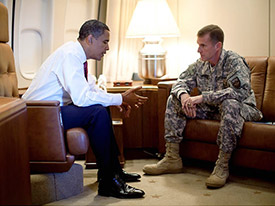
The recent flap over the inopportune comments by General Stanley McChrystal and his staff in the presence of and even directly to a Rolling Stone magazine journalist, and the ensuing hue and cry “off with their heads” for what amounts to something akin to alcohol-fueled barroom B.S.ing and locker-room boys-will-be-boys jock talk, affords an opportunity to distinguish between public talk and private talk.

(Credit Image: © Pete Souza/The White House/ZUMApress.com)

Private talk is what we say in private to our spouses, family, friends, and colleagues when there is a presumption of privacy such that one’s comments will not go public. Public talk is what we say when we want to make a formal statement or declaration with the intention of and responsibility for what was said. Too often we confuse these two very different forms of expression. Everyone is treating the private talk of McChrystal and his staff as if it were intended for public consumption. It is almost as if McChrystal had held a press conference and issued a formal public statement that Joe Biden’s new name is “bite me.” Surely we should recognize the vast gulf that exists between these two types of talk, and no one would want to insist that all private talk be held as if there were a microphone in the room that was on and broadcasting. Locker rooms and barrooms would go deadly silent.

photo

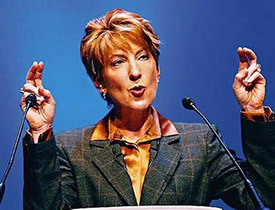
Something similar happened to California Senatorial candidate Carly Fiorina the day of the primary election, when she was caught mocking the hair of her rival Sen. Barbara Boxer when she thought that her microphone was off, continuing with her private talk about Fox’s Sean Hannity and the cheeseburgers she wished she had eaten the night before.

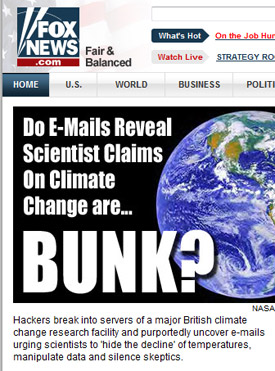
And let’s not forget last year’s “climategate” flap in which the public discovered that scientists—shock of all shocks—are people who in private talk like everyone else, making fun of colleagues they don’t like, dissing rivals and competitors, and speaking colloquially as if they were not scientists investigating one of the most politically charged scientific issues of the past century—anthropogenic global warming.

screenshot

On the other hand, if you are a General in charge of executing a war, a Senatorial candidate with aspirations of being one of the handful of people who can actually influence public policy, or a scientist who data and theory could alter entire economies for decades or even centuries, your private talk is not the same as that of everyone else’s. McChrystal knew he was talking to a Rolling Stone reporter, so as the head of hundreds of thousands of combat troops under the ultimate direction of the Commander-in-Chief at 1600 Pennsylvania Ave., he should have been able to filter out his private talk. Ditto Carly Fiorina who, if she wins the Senate seat of a state whose economy rivals that of most countries, is bound to sit before microphones on almost a daily basis, so if she cannot discriminate between public and private talk now, had damn well better learn the difference. Likewise scientists whose opinions on climate change are used by politicians and policy makers worldwide to shape the direction of economic reform, have an obligation to presume that much of their private talk will be used publicly against them (and their recommendations) by those who disagree.

In other words, if you are in a position of power and influence, assume that the microphone is on.

topics:
Comments Off on ‘I didn’t know the mic was on’: Public Talk v. Private Talk
PREVIOUS
 
NEXT