


The official site of bestselling author Michael Shermer The official site of bestselling author Michael Shermer

Touching History

October 12, 2010
photo

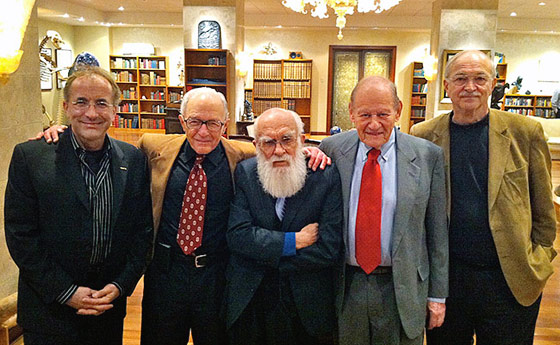
Skeptical Luminaries right to left: paranormal investigator Joe Nickell, Center for Inquiry founder Paul Kurtz, the Amazing One himself, and psychologist and magician Ray Hyman

On Sunday, October 3, a group of skeptics gathered in Falls Church, Virginia to celebrate James Randi’s 82nd birthday. What an amazing meeting it was … er, an astonishing evening I mean, as Randi prefers to retain the “amazing” adjective for his moniker, James “The Amazing” Randi. Take a look at just a few of the giants present in the above photo — the legends of skepticism (from right to left: paranormal investigator Joe Nickell, Center for Inquiry founder Paul Kurtz, the Amazing One himself, and psychologist and magician Ray Hyman).
photo

click any of the following thumbnail images to enlarge

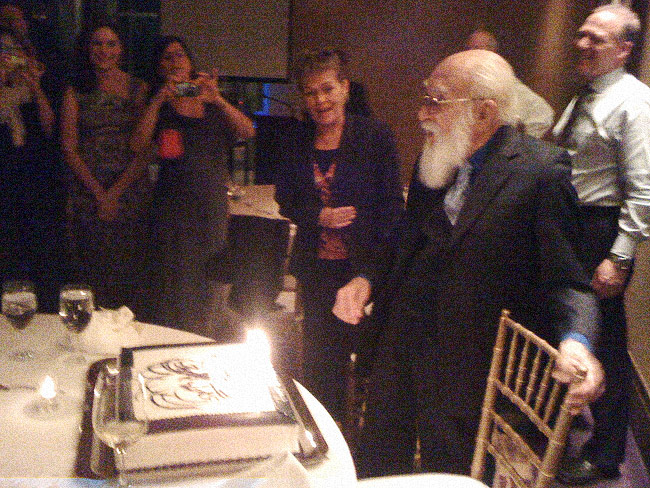
Also in attendance were Richard Dawkins, the magician Jamy Ian Swiss, the President of the James Randi Educational Foundation (JREF) D. J. Grothe, and many other skeptical luminaries from around the world, many of whom sang Randi’s praises in the tribute portion of the evening. Randi was presented with a beautiful birthday cake with his inimitable likeness on the icing, and something well short of 82 candles on top to blow out, which he managed successfully.

photo

After dinner we all adjourned to the private library of a good friend of Randi and benefactor of JREF, who kindly allowed us to peruse his collection of some of the rarest books in the history of science, along with other spectacular items of considerable interest. It is, in short, the finest collection I have ever seen anywhere in the world. Any single volume on any of the shelves would be an item worthy of possession as one’s most cherished belonging, and here there were hundreds of such treasures.

photo

How’s this for starters?: The Archimedes Palimpsest, purchased at auction for $2.2 million. Check out the two sets of lines on this page: one set of bold lines in Latin that was a medieval prayer book, and the other lighter lines in Greek that was nothing less than one of the most important treatises ever published by the ancient Greek mathematician Archimedes. I highly recommend the book, The Archimedes Codex, by Reviel Netz and William Noel, that uncovers the mystery story of how this book came to auction, and the scientific detective story of how Archimedes ancient words were coaxed back to life. (Quality paper for publishing was so rare in the Middle Ages that older books were reused by scraping off the text and reprinting over it.)

photo

If that isn’t awe inspiring enough, check out the photo of a page from an ancient Egyptian Book of the Dead that Joe Nickell and I are examining. Because papyrus paper is so delicate this one is under glass (so we couldn’t “touch history” directly in this case), but Joe and I were trying to find Randi’s name in there somewhere…
photo

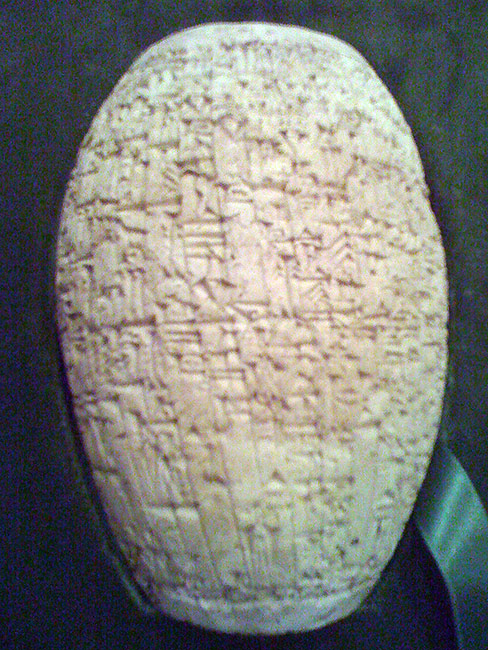
Talk about touching some old stuff, look at this many millennia-old Babylonian cylinder with cuneiform writing on it, apparently an ancient calculator of sorts (if memory serves … it was a heady evening trying to take in all these treasures).

Going back tens of thousands of years, look at the magnificent Wholly Mammoth tusk, and guess what that is in my hand: yes, that’s Wholly Mammoth hair. Is there a lab somewhere in the world who could take the DNA from that hair and clone a mammoth back to life? Forget Jurassic Park; I’d settle for Paleolithic Land.

photo

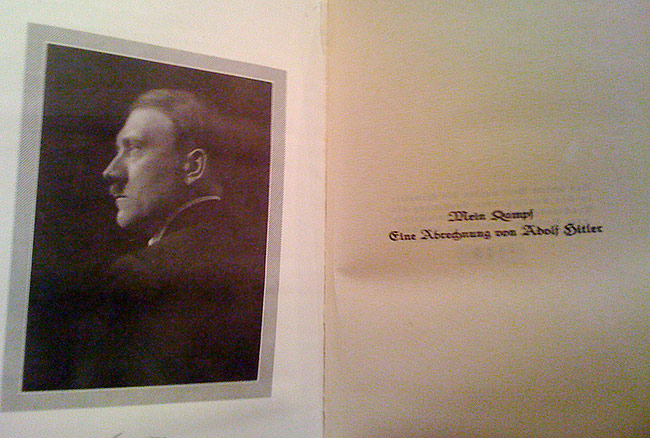
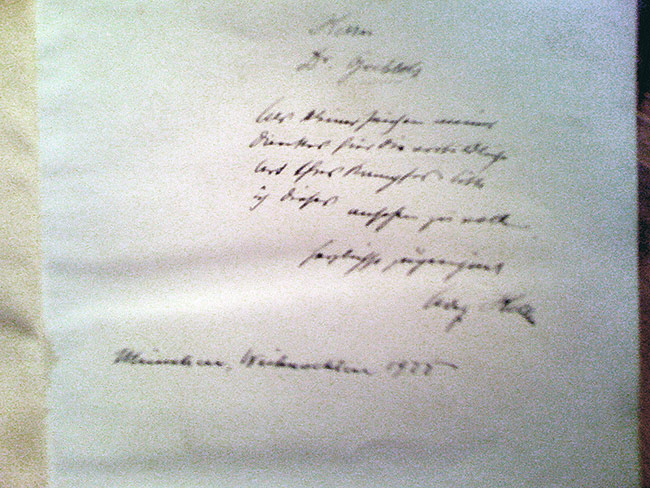
Given my interest in World War II and all things Nazi, which I had to learn in researching my book Denying History (about the Holocaust deniers), this item made the hair on the back of my neck stand up: it’s a first edition of Mein Kampf. This one in particular was signed by Adolf Hitler to “Dr. Goebbels”, 1925. Next to it is another first edition addressed in Hitler’s hand to Hermann Goering.

As well, the library contains two Nazi enigma code machines, designed and built for encryption and decryption of messages and was used during the Second World War. The cracking of the enigma code encryption algorithms by the British led project ULTRA is said to have shortened the war by at least two years, if not being the single most important step toward victory.

photo

There is something about touching history in this way that almost beggars description. It’s visceral. Running my fingers over the cuneiform clay cuts in the cylinder while imagining some ancient Babylonian accountant or scribe holding it in one hand while pressing into the wet clay with a small writing stick in the other draws one back in time. Rubbing the tips of my fingers over the parchment paper of medieval manuscripts brings to my inner ear a Gregorian chant wafting through the cold, dank halls of a European monastery with monks keeping alive ancient wisdom through their endless hours of copying the masters.
photo
photo

Visiting this library, in fact, is like a time machine, transporting you back anywhere into the past you like just by touching the spine of a book and pulling it off the shelf. I know, this all sounds so … well … New Ageish. I am a materialist, a monist — someone who does not believe that there is something immaterial like a soul or spirit or essence of a thing that carries on beyond the physical material of its original pattern. But to hold an item of such antiquity and such rarity and originality overwhelms the senses and enthuses the emotions beyond what meager words such as these can convey.

I touched the past and it lived again.

topics: , , ,
Comments Off on Touching History

God 2.0: Is the deity a nonlocal quantum mind?

September 21, 2010

The “Quantum Flapdoodle” of Deepak Chopra and his notion of the deity as a nonlocal quantum mind

Do you believe in God? In most surveys, about nine out of ten Americans respond in the affirmative. The other ten percent provide a variety of answers, including a favorite among skeptics and atheists, “which God?,” spoken in a smarmy manner and followed by a litany of deities: Aphrodite, Amon Ra, Apollo, Baal, Brahma, Ganesha, Isis, Mithras, Osiris, Shiva, Thor, Vishnu, Wotan, and Zeus. “We’re all atheists of these gods,” goes the denouement, “some of us go one god further.”

I have debated many a theologian who make the traditional arguments for God’s existence: the cosmological argument (prime mover, first cause), the teleological argument (the universe’s order and design), the ontological argument (if it is logically possible for God to exist then God exists), the anthropic argument (the fine-tuned characteristics of nature), the moral argument (awareness of right and wrong), and others. These are all reasons to believe if you already believe; if you do not already believe these reasons ring hollow and have been refuted by philosophers from David Hume to Daniel Dennett.

This last spring, however, I participated in a debate with a theologian of a different species—the New Age spiritualist Deepak Chopra—whose arguments for the existence of a deity take a radically different tact. Filmed by ABC’s Nightline and viewed by millions, Deepak hammered out a series of scientistic-sounding arguments for the existence of a nonlocal spooky-action-at-a-distance quantum force. Call it Deepak’s God 2.0.

In the Middle Ages scholars drew correspondences between the microcosm (the earth) and the macrocosm (the heavens), finding linkages between bodily organs, earthly minerals, and heavenly bodies that made the entire system interlocking and interdependent. Gold corresponds to the Sun, which corresponds to the Heart. Silver corresponds to the Moon, which corresponds to the Brain. Mercury corresponds to the planet Mercury, which corresponds to the Gonads. The four elements of Earth, Water, Air, and Fire were astrologically coupled to the four humor-based personality traits of melancholic, phlegmatic, sanguine, and choleric. In its essence Deepak’s New Age theology is a Middle Ages-inspired correspondence between macrocosm world events and microcosm quantum effects, an upgrade from God 1.0 to God 2.0, well captured in the following chart (inspired by my friend and colleague Stephen Beckner):

God 1.0 God 2.0
omnipresent
fully man/fully God
miracles
leap of faith
transubstantiation
Council of Rome
supernatural forces
heaven
hell
eternity
prayer
the Godhead
the Trinity
forgiveness of sin
virgin birth
resurrection
non-local
wave/particle duality
wave-function collapse
quantum leap
Heisenberg uncertainty principle
Copenhagen interpretation
anti-matter
dark energy
dark matter
space/time continuum
quantum entanglement
general relativity
special relativity
quantum erasure
quantum decoherence
virtual reality

Deepak believes that the weirdness of the quantum world (such as Heisenberg’s uncertainty principle) can be linked to certain mysteries of the macro world (such as consciousness). This supposition is based on the work of the tandem team of Roger Penrose and Stuart Hameroff, whose theory of quantum consciousness has generated much heat but little light in scientific circles.

Inside our neurons are tiny hollow microtubules that act like structural scaffolding. The conjecture is that something inside the microtubules may initiate a wave function collapse that leads to the quantum coherence of atoms, causing neurotransmitters to be released into the synapses between neurons and thus triggering them to fire in a uniform pattern, thereby creating thought and consciousness. Since a wave function collapse can only come about when an atom is “observed” (i.e., affected in any way by something else), “mind” may be the observer in a recursive loop from atoms to molecules to neurons to thought to consciousness to mind to atoms to molecules to neurons to….

In reality, the gap between microcosm quantum effects and macrocosm world events is too large to bridge. In his 1995 book The Unconscious Quantum (Prometheus Books) the University of Colorado particle physicist Victor Stenger demonstrates that for a system to be described quantum mechanically the system’s typical mass m, speed v, and distance d must be on the order of Planck’s constant h. “If mvd is much greater than h, then the system probably can be treated classically.” Stenger computes that the mass of neural transmitter molecules, and their speed across the distance of the synapse, are about three orders of magnitude too large for quantum effects to be influential. There is no microcosm—macrocosm connection. Subatomic particles may be altered when they are observed, but contrary to what Deepak believes, the moon is there even if no one looks at it.

Deepak’s use and abuse of quantum physics is what the Caltech quantum physicist and Nobel laureate Murray Gell-Mann calls “quantum flapdoodle,” which is when you string together a series of terms and phrases from quantum physics and assume that explains something in the regular macro world in which we live. “The mind is like an electron cloud surrounding the nucleus of an atom,” Chopra writes in his 2006 book Life After Death. “Until an observer appears, electrons have no physical identity in the world; there is only the amorphous cloud. In the same way, imagine that there is a cloud of possibilities open to the brain at every moment (consisting of words, memories, ideas, and images I could choose from). When the mind gives a signal, one of these possibilities coalesces from the cloud and becomes a thought in the brain, just as an energy wave collapses into an electron.”

Baloney. The microscopic world of subatomic particles as described by the mathematics of quantum mechanics has no correspondence with the macroscopic world in which we live as described by the mathematics of Newtonian mechanics. These are two different physical systems at two different scales described by two different types of mathematics. The hydrogen atoms in the sun are not sitting around in a cloud of possibilities waiting for a cosmic mind to signal them to fuse into helium atoms and thereby throw off heat generated by nuclear fusion. By the laws of physics of this universe, a gravitationally collapsing cloud of hydrogen gas will, if large enough, reach a critical point of pressure to cause those hydrogen atoms to fuse into helium atoms and give off heat and light in the process, and it would do so even if there were not a single mind in the entire cosmos to observe it.

God 2.0 has no more basis in scientific fact than God 1.0, no matter how many observers believe it is so.

topics: , , , , ,
Comments Off on God 2.0: Is the deity a nonlocal quantum mind?

What I Believe (about Markets and Morals)

September 7, 2010

A reply to Jerry Coyne

In his endearingly titled blog, “Michael, we hardly knew ye,” the venerable evolutionary biologist and slayer of creationist dragons Jerry Coyne (author of Why Evolution is True) wonders if I’ve gone ‘round the bend over capitalism and sold my skeptical soul to the Templeton Foundation, the alleged evil subsidizers of religious and capitalist propaganda. Allow me to set the record straight (again) for all my critics out there (and in reading the comments to Jerry’s blog there’s more than I thought, and many of them are darned right caustic!).

First, on the Templeton Foundation, I was invited to write a monthly column for their new magazine, Big Questions Online, and as with my work for them in years past, I’m allowed to write just about anything I like. It is interesting that Jerry and his commentators would hone in on this, my second column, ignoring my first column, which was a stinging rebuke of religion in general and Deepak Chopra’s New Age spirituality in particular. No one could possibly read my list comparing God 1.0 to God 2.0 (omnipresent—nonlocal; fully man/fully God—wave/particle duality; miracle—wave function collapse, etc.) and conclude that I’m the pay of a religious propaganda machine. And if that doesn’t seal the deal for ya, the God critique was originally my second column, but the BQO editors liked it so much that they bumped it up to number 1, and it was, in fact, the most popular article on the site for the entire month. So there!

Second, I think I made a mistake in mentioning “capitalism” at the beginning of the column on markets and morality, because (1) the article is really about trade, not capitalism per se; and (2) that word seems to set some people off into MichaelMoorish-like paroxysms of rage, engaging the limbic system full throttle and governing back the prefrontal cortex, resulting in red-faced, spittle-spewing tirades about Gordon Gekko and Bernie Madoff. In fact, as I depict trade (especially in my book The Mind of the Market, which, curiously, few of my critics have actually read), it should be something embraced by all liberals because trade empowers individuals over corporate entities of all types (from governments and religions to actual corporations). By trade I just mean the exchange of ideas, products, or services between two or more people, and by free trade I just mean that people can engage in such exchanges without hindrance from third parties (thieves, thugs, highwaymen, bribe takers, tax collectors, and the like)—think eBay, or a flea market, or a farmer’s market. My main point in citing all those primate studies is to show the evolutionary continuity between nonhuman primates and ourselves in the evolved sense of fairness in all such exchanges (grooming, food sharing, etc.), and especially that trade helps attenuate the pervasive xenophobia between strangers, the result of our natural-born tribalism. I’m not claiming that trading hunter-gatherers were early capitalists; no, groups traded for assorted reasons having more to do with forming political coalitions against other dangerous groups (the enemy of my enemy is my friend) than in increasing primitive GDP.

Third, as for modern capitalism, I’m not a naïf—I think of it as akin to professional sports—competitors will cheat if they can get away with it, and so in order for the system to work there needs to be a clearly defined set of rules that are strictly enforced with severe consequences for violations. And I agree with Ralph Nader that there is far too much corporate welfare (what Adam Smith called rent seeking), in which companies will try to game the system by getting special privileges, handouts, tax breaks, and the like in order to gain an unfair advantage over competitors, especially over foreign competitors, which Adam Smith warned his readers about in The Wealth of Nations.

Fourth, Coyne raises an important objection when he asks rhetorically: “Is Apple moral? Is General Motors moral? The questions make no sense. These corporations may act morally by donating money to good causes and so on, but it’s ludicrous to claim that selling cars or computers promotes morality.” Therefore, he concludes: “I don’t see capitalism as innately conducive to morality. It is, at best, orthogonal to it. It may make us more prosperous, but it doesn’t make us better people.”

This gets to the point of my work in evolutionary economics (the subject of The Mind of the Market). The evolved psychology behind trade does, in fact, makes us better people. Nonzero exchanges between strangers (“you give me that which I want and I’ll give you this which you want”) has measurably positive effects on subjects in experiments, such as those conducted by neuroeconomist Paul Zak, who discovered a significant boost in oxytocin in subjects making fair exchanges in the Ultimatum Game and other experimental conditions, and even reversed the causal vector by giving some subjects hits of oxytocin through a nose spray (normally used to induce labor), which resulted in those subjects being more generous and fair in exchange games (that involve real money).

Trade makes us less likely to kill our potential trading partners. As Jared Diamond once told me about his research on Papua New Guinea hunter-gatherers: “Should you happen to meet an unfamiliar person in the forest, of course you try to kill him or else to run away. Our modern custom of just saying hello and starting a friendly chat would be suicidal.” And yet something happened in the 1960s to bring about more peaceful interactions. Initially, peace was imposed upon the native New Guineans by fiat from the Western colonial government that ruled over the territory, but officials then insured continued peace by providing goods that the people needed, as well as the technologies to enable them to continue producing more resources on their own. In less than one generation, New Guinean hunter-gatherers who were fighting each other with stone tools were suddenly New Guinean consumer-traders operating computers, flying planes, and running their own small businesses. Where goods crossed New Guinea frontiers, New Guinea armies did not.

This is an example from my book of what I call Bastiat’s Principle, from an observation by the 19th-century French economist Frédéric Bastiat: “Where goods do not cross frontiers, armies will.” Although trade is not a sure-fire prophylactic against between-group conflict (there are exceptions to Thomas Friedman’s observation that two countries with MacDonalds don’t fight, but as a first order approximation it is accurate), it is an integral component to establishing trust between strangers that lessens the potential volatility that naturally exists whenever groups come into contact with one another, especially over the allocation of scare resources that have alternative uses, the very definition of economics.

And that brings us back full circle to trade, markets, and morality.

topics: , , , ,
Comments Off on What I Believe (about Markets and Morals)

The Free Exercise of Stupidity Dr. Laura, the Ground Zero Mosque, and the 1st Amendment

August 24, 2010

Recently, two of the biggest media story brouhahas were Dr. Laura’s N-word gaff and the Ground Zero mosque, both of which commentators insist are First Amendment issues. They are not. Here’s why. First, let’s review the First…

Congress shall make no law respecting an establishment of religion, or prohibiting the free exercise thereof; or abridging the freedom of speech, or of the press; or the right of the people peaceably to assemble, and to petition the Government for a redress of grievances.

(Most people forget that there are actually five freedoms protected in the First Amendment: religion, speech, press, assembly, petition.)

Laura Schlessinger says that she is quitting her job as the biggest female radio show host in the galaxy because, she told Larry King: “I want to regain my First Amendment rights. I want to be able to say what is on my mind.” Sarah Palin chimed in on Twitter that Schlessinger’s First Amendment rights “ceased 2exist thx 2activists trying 2silence her.”

Wrong. The First Amendment applies only to what the government can and cannot do. No government agency is demanding that Dr. Laura step down. No laws are being passed to silence radio talk show hosts (at least not yet—recall last year’s cultural scuffle over whether liberals should be given equal time on all radio shows, including conservative talk radio). This is not a First Amendment issue in the least. Dr. Laura is free to exercise her First Amendment rights to say what is on her mind, including her stupefyingly ignorant opinion that blacks are being hypersensitive when called the N-word by whites. In turn, blacks, whites, and anyone else not from another planet are free to remind Dr. Laura what has transpired over the past half century here on Earth since she’s been away on Mars.

The Ground Zero Mosque issue is equally clearly not a First Amendment issue because, near as I can figure, it is not being built on government land, it is not being funded by tax-payers dollars, and it is not a public building. To that extent, it’s none of the government’s business what the owners and financers of the building want to do with their private property, so they are free to build a mosque near Ground Zero (it’s two blocks away, by the way, not “at” Ground Zero), and by the 4th right of the First Amendment, people are free to peacefully assemble to remind said private land holders and building builders what happened in that neighborhood a scant nine years ago next month.

The government is not—and never should be—in the business of regulating stupidity or making laws respecting the free exercise thereof.

topics: , ,
Comments Off on The Free Exercise of Stupidity Dr. Laura, the Ground Zero Mosque, and the 1st Amendment

Was Jesus a Conservative or a Liberal?

August 17, 2010

The ancient art of cherry picking passages from the Bible to support this or that argument has found new life in recent decades as conservatives claim Jesus as their political ally and in the past year with the Tea Party movement invoking Christ’s conservativism. What Would Jesus Do? (WWJD?) has morphed into Who Would Jesus Vote For? (WWJVF?) Was Jesus a conservative? I don’t think so, but the entire enterprise of politicizing historical figures with modern labels is fraught with fallacy.

Employing modern political terms such as “liberal” and “conservative” to someone who live 2,000 years ago is an absurd game to play because those terms as they are used today do not even apply to people who lived a scant few centuries ago. The original meaning of “liberal,” for example, was what we would today call a “classical liberal,” or someone who believes in laissez faire capitalism and small government. Followers of Adam Smith were liberals, but today are called classical liberals, or conservatives, because they want to conserve the political and economic principles of classical Enlightenment thought. Those who are vehemently opposed to these conservative principles are sometimes today called progressives, who want to progress beyond—instead of conserving—classical liberalism, and their type specimen is Franklin D. Roosevelt, who originally had the support of pro-laissez faire capitalists until he launched the New Deal. One of FDR’s ideological descendents was Bill Clinton, who turned out to be one of the strongest Democratic proponents of free markets in history, which makes him, what? A conservatively classical progressive liberal? You can see how odious such label making becomes even for modern figures.

Jesus was, for the most part, apolitical. There were a number of political factions in his time, yet there is no evidence that he joined or even endorsed any of them. He emphasized the “Kingdom of God” over the kingdom of man, and heaven over earth, and his central message was to love God and to love one another. When Jesus was asked, “Teacher, which is the great commandment in the Law?” he replied, “You shall love the Lord your God with all your heart and with all your soul and with all your mind. This is the great and first commandment. And a second is like it: You shall love your neighbor as yourself. On these two commandments depend all the Law and the Prophets.” (Matthew 22:34–40). In the next chapter in Matthew (23:9–12) Jesus punctuated the point by comparing earthly fathers to the heavenly father: “And call no man your father on earth, for you have one Father, who is in heaven. Neither be called instructors, for you have one instructor, the Christ. The greatest among you shall be your servant. Whoever exalts himself will be humbled, and whoever humbles himself will be exalted.”

Lacking clear political leanings we have to examine the moral teachings of Jesus to see if they more closely fit the moral principles of liberals or conservatives. As I read the record, Jesus sounds like a liberal when he admonishes us to turn the other cheek and practice forgiveness, not to judge lest ye be judged, to show great compassion for the poor, and especially when he admonishes the money changers and tells his followers to give up their belongings, abandon their families, and follow his religious movement. Remember, it was Jesus who said, “it is easier for a camel to go through the eye of a needle than for a rich man to enter the kingdom of God.”

And let’s not forget the Beatitudes from the sermon on the mount (Matthew 5: 3-9), which do more closely echo the sentiments of liberals instead of conservatives:

“Blessed are the poor in spirit, for theirs is the kingdom of heaven.”
“Blessed are those who mourn, for they shall be comforted.”
“Blessed are the meek, for they shall inherit the earth.”
“Blessed are those who hunger and thirst for righteousness, for they shall be satisfied.”
“Blessed are the merciful, for they shall receive mercy.”
“Blessed are the pure in heart, for they shall see God.”
“Blessed are the peacemakers, for they shall be called sons of God.”

Matthew 7: 1–5 is the classic statement of liberal tolerance:

Judge not, that ye be not judged. For with what judgment ye judge, ye shall be judged: and with what measure ye mete, it shall be measured to you again. And why beholdest thou the mote that is in thy brother’s eye, but considerest not the beam that is in thine own eye? Or how wilt thou say to thy brother, Let me pull out the mote out of thine eye; and, behold, a beam is in thine own eye? Thou hypocrite, first cast out the beam out of thine own eye; and then shalt thou see clearly to cast out the mote out of thy brother’s eye.

Indeed, would any red-blooded, gun-totting, Hummer-driving, hard-drinking, Bible-totting conservative today saying anything like this? (Matthes 5:43-44): “You have heard that it was said, ‘You shall love your neighbor and hate your enemy.’ But I say to you, Love your enemies and pray for those who persecute you….”

Even on the current hot-button issue driving the Tea Party train—taxes—when asked if it was proper to pay taxes, Jesus famously said (Matthew 22:21): “Render therefore unto Caesar the things which are Caesar’s; and unto God the things that are God’s.”

Of course, I’m cherry picking passages myself here, but I found the process much more conducive to fitting Jesus into left-leaning politics than into the right. I suppose the following passage from the Messiah (Matthew 5:27-30) might be construed as Jesus’s expression of conservative values, but I’m not sure anyone in their right mind would endorse such a moral principle:

You have heard that it was said to those of old, ‘You shall not commit adultery.’ But I say to you that whoever looks at a woman to lust for her has already committed adultery with her in his heart. If your right eye causes you to sin, pluck it out and cast it from you; for it is more profitable for you that one of your members perish, than for your whole body to be cast into hell. And if your right hand causes you to sin, cut it off and cast it from you; for it is more profitable for you that one of your members perish, than for your whole body to be cast into hell.

Speaking of the 7th commandment, I found one webpage dedicated to this matter of the Messiah’s politics in which the author wrote:

At times, Jesus blended His Liberal and Conservative sides in perfect balance. One example was when He asked the woman accused of adultery, “Where are your accusers? Has no one condemned you?”, and the woman answered, “No one, Lord.” Jesus told her, “Neither do I condemn you; from now on, sin no more.” The Liberal Jesus did not condemn the woman, but the Conservative Jesus called her behavior “sin”, which she needed to stop.

So … are we to infer from this interpretation that liberals would not call adultery a sin that should be avoided, and if committed need not be stopped? All married liberals reading this column raise your hands if you think an act of adultery on the part of your spouse is acceptable. That’s what I thought. In point of fact, adultery is a sin because it deeply injures a loved one, it breaks the bonds of trust so essential to the deepest of all human relations, and it leads to the breakdown of families. And you don’t need the Bible to understand this simple fact. Adultery as a sin is an evolved characteristic of our species.

We evolved as pair-bonded primates for whom monogamy, or at least serial monogamy (a sequence of monogamous marriages), is the norm. Adultery is a violation of a monogamous relationship and there is copious scientific data (and loads of anecdotal examples) showing how destructive adulterous behavior is to a monogamous relationship. In fact, one of the reasons that serial monogamy (and not just monogamy) best describes the mating behavior of our species is that adultery typically destroys a relationship, forcing couples to split up and start over with someone new. Thus, adultery is immoral because of its destructive consequences no matter what God or the patriarchs said about it. And evolutionary theory provides a deeper reason for adultery’s immoral nature that is transcendent because it belongs to the species. If there is a God, and if He does condemn adultery as an immoral act, it is because evolution made it immoral.

This post originally appeared at TRUE/SLANT.

topics: , ,
Comments Off on Was Jesus a Conservative or a Liberal?
PREVIOUS
 
NEXT