The official site of bestselling author Michael Shermer The official site of bestselling author Michael Shermer

Pentagon Gunman a Conspiracy Theorist & 9/11 Truther

March 10, 2010

What’s the harm in believing nonsense? I get asked this all the time: “Oh come on Shermer, let people have their delusions, what’s the harm?”

I have a laundry list of retorts to this challenge, from the value of living in a rational world that is based in reality to tales of people who have died from discredited medical practices, such as “Attachment Therapy” — in April, 2000, 10-year old Candace Newmaker was smothered to death in blankets by therapists who were helping “rebirth” her so that she could properly attach to her adopted parents. Death by theory. (I wrote about this in Scientific American.)

What’s the harm? Ask the victims of the anti-Government nutter Joseph Stack, who flew his plane into the IRS building in Austin, Texas. It is one thing to be skeptical of excessive government intervention into private lives and businesses, it is quite another to take matters into your own hands, especially if those hands hold a gun.

photo

John Patrick Bedell, Pentagon Gunman

Witness one John Patrick Bedell, the gunman who attacked guards at the entrance of the Pentagon yesterday (March 4), who now appears to have been a right wing extremist and 9/11 “truther,” who in an internet posting under the user name JpatrickBedell said that he intended to expose the truth behind the 9/11 “demolitions.” Apparently the delusional Bedell intended to shoot his way into the Pentagon to find out what really happened on 9/11.

Death by conspiracy.

More specifically, Bedell picked up the conspiracy theory about the alleged “murder” in 1991 of Marine Col. James Sabow, who was found dead in his California home in 1991. The police ruled it a suicide, but right-wing extremists and conspiracy theorists have suggested that he was murdered and that the case is a coverup by the federal government. Bedell posted that exposing the truth behind the Sabow case would be “a step toward establishing the truth of events such as the September 11 demolition.”
photo

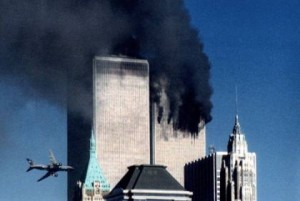
9/11 Truthers believe the WTC buildings were “demolished” by explosive devices. What’s that thing on the left about to hit the building?

Who is John Patrick Bedell? He was a 36-year old computer programmer from Hollister, California, a graduate of U.C. Santa Cruz (physics) who also attended San Jose State University (biochemistry). So he was a smart guy. As I’ve said before: intelligence is no prophylactic against magical thinking. If anything, smart people believe weird things because they are better at rationalizing beliefs that they’ve arrived at for nonsmart reasons.

Somewhere along the line — perhaps after his arrest for cultivating cannabis and resisting a police officer — Bedell decided that he wanted to expose “the truth of events such as the 9/11 demolitions and institutions such as the coup regime of 1963 that maintains itself in power through the global drug trade, financial corruption, and murder, among other crimes.”

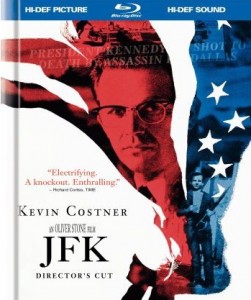
The “coup regime of 1963”? Yes, you know, the coup d’état that overthrew the U.S. government and replaced it with another government. You missed that one? Watch Oliver Stone’s film JFK. Lyndon Johnson and his cronies (Castro, the Russians, the CIA, the FBI, the mafia, et al.) had Kennedy assassinated.

Bedell continued in an Internet rant from 2006 associated with him:
cover

Oliver Stone’s fiction became fact for conspiracy theorists.

The sheer size of the United States economy … makes the United States government a tempting prize for any organisation or collection of bandits ruthless and clever enough to seize it. A criminal organisation able to conduct its activities from within the centre of power of the United States government would have powerful advantages over other criminal groups … This organisation … would see the sacrifice of thousands of its citizens, in an event such as the September 11 attacks, as a small cost in order to perpetuate its barbaric control. This collection of gangsters would find it in their interest to foment conflict and initiate wars throughout the world, in order to divert attention from their misconduct and criminality… This seizure of the United States government by an international criminal conspiracy is a long-established reality.
Time magazine cover

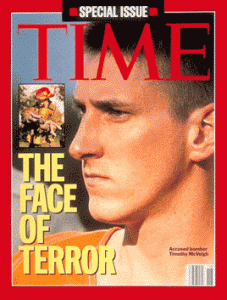
What’s the Harm? Beliefs drive behaviors.

Whose reality is this? Right wing militias. Back in the 1990s there was a surge in militias and extremists groups, which waned in the final years of the decade, but are now apparently making a comeback. According to the Southern Poverty Law Center, who tracks such groups, there were 42 paramilitary militias in 2008 and 127 in 2009. So-called “Patriot” groups also increased, from 149 in 2008 to 512 in 2009. According to an April 2009 report by the Department of Homeland Security, the current anti-government climate “parallels” what federal officials saw in the 1990s: “Rightwing extremists have capitalized on the election of the first African American president, and are focusing their efforts to recruit new members, mobilize existing supporters, and broaden their scope and appeal through propaganda, but they have not yet turned to attack planning.”

Not yet is the key phrase here.

What’s the harm? Now you know the answer.
topics:
Comments Off on Pentagon Gunman a Conspiracy Theorist & 9/11 Truther

My Dinner with Bill (Gates that is)

February 23, 2010
photo

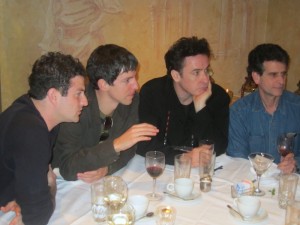
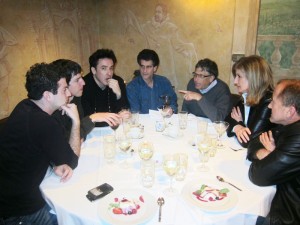
left to right: Jared Cohen, Dave Morin, John Cusack, Dean Kamen, Bill Gates, Arianna Huffington, Michael Shermer. (All photos in this post were taken by John Brockman.)

No, it wasn’t exactly My Dinner with Andre—the classic 1981 filmed conversation between Wallace Shaun and Andre Gregory (directed by Louis Malle) that ranged across a diversity of existential topics—but listening to Bill Gates hold forth on matters of business, economics, finance, world health, education, and nutrition and physical fitness in a dinner arranged by John Brockman’s Edge.org during last week’s TED gathering in Long Beach was a memorable experience nonetheless.

Richard Dawkins once said that John Brockman has the most stellar rolodex in all of science, and periodically Brockman organizes an Edge.org event that brings them all together for some serious dialogue about the great issues of our time. There were around 80 people in all, which soon broke up into small groups of schmoozing and social networking. Check out the roster and accompanying photos.

When it was time to sit down for dinner there was a spot open at the Gates table (we’ll call it), that included some heavyweights such as Facebook’s Dave Morin, the Segway inventor Dean Kamen, the actor John Cusack, Jared Cohen from the U.S. State Department, Michael Tchao, VP of Apple’s new iPad division, Arianna Huffington of HuffingtonPost, Bill Gates, and your humble servant.

This was unlike any dinner I’ve ever attended. Usually no matter how many heavyweight bigshot superstars are present there always seems to be a relatively fluid conversation around the table that unfolds organically as different people make different contributions. Not so here. Bill Gates was the star and we were tiny planets in orbit around him, sitting there like acolytes at the feet of the guru, asking him questions and listening to his lengthy and thoughtful answers. You can see it in the faces of the guests in the second photo, oriented toward Gates who is just off camera to the right, as Gates (in the third photo) offers his thoughts on the various queries put to him. (All photos by John Brockman. See the entire set.)

photo

left to right: Jared Cohen, Dave Morin, John Cusack, Dean Kamen

Seriously, this was one weird dinner. After spending two hours at this table I can honestly say that I haven’t any idea what the other folks sitting there are like. The actor John Cusack, for example, strikes me as a thoughtful and intelligent man, but I never got to talk to him because there was next to no other conversations. Ditto the others, although Arianna did unlock her Gate-gaze long enough to give me one of her business cards, encouraging me to blog about the dinner at HuffPo (but I’m committed to True/Slant now even though I occasionally hop over to her mostly-liberal site to give them a dose of my libertarian bias).

I knew Bill Gates was smart, but in my estimation after listening to him for two hours is that he is really smart, off-the-charts smart, super bright, even brilliant. He is obviously well-read on those matters important to him, and he seems to have a steel-trap memory for regurgitating what he has read in great detail. Discussing world health and nutrition led me to ask him about diets and health and what he does personally, to which he answered that he runs 90 minutes a day on a treadmill. Since I do a fair amount of exercise myself (cycling is my poison) I asked him if he listens to audio books, which he said he does but is especially keen on listening to Teaching Company courses while working out, most especially the economics courses taught by Professor Timothy Taylor. Since I have taken all of these courses myself (you can download them into an iPhone and listen to them while driving, cycling, running, hiking, etc.), it was interesting to listen to Gates reiterate what was in them in the course of the evening as we asked him questions about the economy. I could tell that he could call forth from memory intricate details from those courses but in a completely different context in answer to a separate question.

photo

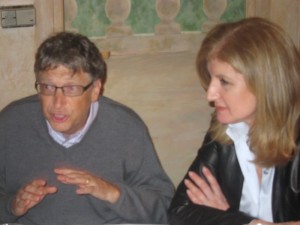
Bill Gates and Arianna Huffington

I asked Gates “Isn’t it a myth that some companies are ‘too big to fail’? What would have happened if the government just let AIG and the others collapse.” Gates’ answer: “Apocalypse.” He then expanded on that, explaining that after talking to his “good friend Warren” (Buffet), he came to the conclusion that the consequences down the line of not bailing out these giant banks would have left the entire world economy in tatters.

Arianna Huffington asked Gates about Obama’s various jobs programs to stimulate the economy. Gates answered: “Let me tell you about what leads companies to create more jobs: demand for their products. My friend Warren owns the world’s largest carpet manufacturing company. Their business has dried up because the demand for carpets has declined dramatically due to the drop off in the construction of new homes and office buildings. If you want to create more jobs you need to create more demand for products that the jobs are created to fulfill. You can’t just make up jobs without a real demand for them.” I believe that was the last thing Arianna said for the evening.

This led me to ask Gates this: “If the market is so good at determining jobs and wages and prices, why not let the market determine the price of money? Why do we need the Fed?” Gates responded: “You sound like Ron Paul! We need the Fed to steer the economy away from extremes of inflation and deflation.” He then schooled us with a mini-lecture on the history of economics (again, probably gleaned from Timothy Taylor’s marvelous course for the Teaching Company on the economy history of the United States) to demonstrate what happens when fluctuations in the price of money (interest rates, etc) swing too wildly. I believe that was the last question I asked Gates for the evening! What do I know? I run a tiny nonprofit science education organization with six employees. I’m just hoping to be able to cover my daughter’s college tuition next year. Gates is the world’s richest man who founded a giant multi-national corporation and heads a powerful nonprofit organization that is trying to save the third world. He surely understands economics and business and finance better than I do, right? I sure hope so!

Anyway, thanks to Edge.org for a splendid evening that resulted in a handful of people getting schooled in finance by the smartest guy in the room. Let’s hope he’s right about the bailout and that the economic apocalypse is behind us.

topics:
Comments Off on My Dinner with Bill (Gates that is)

One one-thousand … two one-thousand … 3.8 trillion one-thousand

February 8, 2010

President Barack Obama has unveiled his new budget for fiscal year 2011 at $3.8 trillion dollars. Staggeringly huge. Brobdingnagianly big. Almost inconceivable. Just how much is a trillion dollars? Here are some comparisons.

The brain consists of about a hundred billion neurons, which is about the same as the number of stars in the Milky Way galaxy. A hundred billion is 1011, or a 1 following by 11 zeros: 100,000,000,000. That’s about what Obama plans to spend on Veterans Affairs ($57 billion) and Homeland Security ($43 billion) combined. It’s a huge number. It is literally an astronomical number. But that’s nothing. A trillion is a thousand billion. How much is a trillion?

Start counting seconds as “one one-thousand, two one-thousand, three one-thousand…” and when you get to 86,400 that’s the number of seconds in a day. When you reach 31,546,000 that’s the number of seconds in a year. When you get to 315,460,000 you will have been counting for ten years, but you are still not even close. Add another 0 to get to 100 billion, and another 0 still to get to 1,000 billion, and you will have finally reached one trillion seconds. If you make it that long you will have been counting for about 30,000 years. Now, do that 3.8 times and you will have counted out the number of dollars that the Federal government plans to spend in just one year.

To count in seconds the number of dollars in the 2011 Federal budget, you will have to count “one one-thousand, two one-thousand, three one-thousand…” for 114,000 years, which if you were counting backward in time would thrust you back to the time when humans first migrated out of Africa and began to spread across the globe, still living as hunter-gatherers with fairly crude stone tools, competing with Neanderthals and other hominids for survival, and just beginning to show signs of symbolic communication.

If ever there was a symbol to communicate that has no corresponding link to a tangible asset in the real world (such as gold or other precious metals), it is money. That’s why it is called “fiat money.” The government just declares money to be legal tender, based on the good faith of the federal government itself.

If that doesn’t jolt us all back in our chairs, consider the fact that at this rate of spending, in ten years the country will be $8.5 trillion in debt more than it already is, which amounts to $34,018 for every man, woman, and child in the country.

All this almost makes me hope that the 2012 doomsday predictions come true.

topics:
Comments Off on One one-thousand … two one-thousand … 3.8 trillion one-thousand

Charles Darwin … the Movie

January 26, 2010

A review of Creation: The True Story of Charles Darwin. Starring Paul Bettany and Jennifer Connelly. Jon Amiel Director, Jeremy Thomas Producer, John Collee writer. Recorded Picture Company with BBC Films and Ocean Pictures. Based on Randal Keynes’s book Annie’s Box. In general release January 22, 2010.

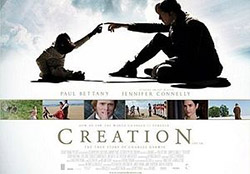
Creation movie poster

Creation is one of the most beautifully produced, artfully directed, factually accurate, and powerfully acted biopic films ever made. Full stop. It stars Paul Bettany as the Charles Darwin almost no one knows (and looking almost eerily similar if you match him to portraits of Darwin at that time), and Jennifer Connelly as the Emma Darwin almost invisible to history (and whose stunning Hollywood beauty is forgotten as she morphs into a realistic portrayal of a 19th century Englishwoman). The script is based on Randal Keynes’s biographical work, Annie’s Box, a moving portrait of the middle-aged Darwin—after the five-year voyage of the Beagle and before the white-bearded sage of Down basked in scientific triumph—as he struggled intellectually and emotionally to put the pieces of natural history together into a cogent theory. It is also about Charles Darwin the man, husband and father, besieged by health problems that curtailed his work days to only a few hours, stressed by the normal strains of marriage, and agonizing over the death from a mysterious disease of his beloved 10-year old daughter.

The film opens with the capture and return of indigenous natives of Tierra del Fuego, in the hopes that such “savages” could be saved by culture (British of course) and seeded to their native lands to spread the Queen’s English (and manners) and save their souls for God and country. (Of course, the Fuegians promptly ripped their clothes off and returned to the lifestyle appropriate for their culture.) Thankfully, the film wisely steers wide of the myth that Darwin discovered natural selection in the Galapagos Islands, and instead reveals what really happened (and what almost always happens in science) in Darwin’s halting and desultory steps to putting all the pieces of his theory together over many years after his return to England.

The hindsight bias that dictates so much of historical reconstruction—where every step along the way is pregnant with meaning for what we know is coming—is mercifully absent in Creation. Instead we find a Darwin unsure of himself. He doesn’t know what we know, and the films takes us on the intellectual journey of discovery with Darwin, as he also tries to balance work with family life and his incessant physical problems that finds him on regular visits to the town of Malvern to undergo James Manby Gully’s water cure therapy—what we would today call quack science—involving a naked Darwin standing in a shower-like stall being bombarded by waves of water. Presumably the shock to the system would shake up his innards enough to cure him. It didn’t.

The leitmotif of Creation, however, is not evolution so much as it is life and death and love. The love of a man and a woman, the love of a father and a child, and the life and death of an idea (God) and a child (Annie). Darwin has many children (almost everyone did in his time), but he was especially fond of his eldest daughter Annie, and one part of the leitmotif is Darwin’s recounting to her of the story of the death of Jenny, a young orangutan captured in Borneo and transported to the London Zoo, where it subsequently died of pneumonia in the arms of her caretaker. It’s a metaphor, of course, for Annie dying in the arms of her father, in a hotel room in Malvern when Darwin took her there for a worthless water cure therapy treatment. Since I have a daughter about whom I feel the same way Darwin did for his beloved Annie, the scene where Darwin subsequently returns to the Malvern hotel room and sobs uncontrollably on the bed where Annie died was so empathically painful that I could barely sit through it. And the portrayal of the strain Annie’s death puts the Darwin marriage through is surely not an exaggeration.

The other stress in Darwin’s marriage was his science and Emma’s religion. Darwin knew that people would think that his theory, in Thomas Huxley’s words, “killed god,” and he also knew that this fact would pain his wife, who worried for her husband’s soul to the point that she wrote him letters to that effect. It is, in fact, the likeliest reason why Darwin avoided the growing conflict between science and religion. Toward the end of his life he received many letters querying him on his religious attitudes. Darwin’s long-silence gave way to a few revelations. In one letter penned in 1879, just three years before he died, Darwin explained: “In my most extreme fluctuations I have never been an Atheist in the sense of denying the existence of God. I think that generally (and more and more as I grow older), but not always, that an Agnostic would be the more correct description of my state of mind.”

A year later, in 1880, Darwin clarified his reasoning to the British socialist Edward Aveling, who solicited Darwin’s endorsement of a group of radical atheists. Darwin declined the offer, elaborating his reason: “It appears to me (whether rightly or wrongly) that direct arguments against christianity & theism produce hardly any effect on the public; & freedom of thought is best promoted by the gradual illumination of men’s minds which follow[s] from the advance of science. It has, therefore, been always my object to avoid writing on religion, & I have confined myself to science. I may, however, have been unduly biased by the pain which it would give some members of my family, if I aided in any way direct attacks on religion.” Emma was a deeply religious woman, so out of love and respect for her, Darwin kept the public side of his religious skepticism in check, an admirable feat of self-discipline by a man of high moral character.

Go see this beautiful film about such an estimable man, an honorable woman, and an enduring love.

topics:
Comments Off on Charles Darwin … the Movie

In the Name of God: The Neuron Bomb of Terrorism

January 12, 2010

Nothing fuels religious extremism more than the belief that one has found the absolute moral truth. Islamic terrorism, for example, has gradually shifted from secular motives in the 1960s to religious motives today. A 2000 study by the state department that resulted in the publication Patterns of Global Terrorism, found that in 1980 there were only two out of sixty-four militant Islamic groups whose mission was religiously based. In 1995 that figure had climbed to nearly half. The figure is undoubtedly higher today. (http://fpc.state.gov/documents/organization/54249.pdf)

It is a type of fuel that can lead to what Clay Farris Naff, Executive Director of the Center for the Advancement of Rational Solutions in Lincoln, Nebraska, cleverly calls the “neuron bomb,” after its cold-war counterpart, the “neutron bomb,” designed to kill people while leaving buildings and infrastructure in tack. A schematic of the neuron bomb looks like this:

  • Arming Device: Belief that God’s enemies must be defeated or destroyed
  • Concealment: Can be implanted in any human mind
  • Cost: Practically nothing
  • Explosive Materials: Anything at hand
  • Destructive Potential: Unlimited

As Naff explains, the arming device is difficult to defuse: “Unlike the cold war stability brought on by MAD—the doctrine of mutual assured destruction—in this situation we cannot count on knowing whom to blame. We cannot negotiate treaties with them. We cannot count on their will to live. There is simply no limit to what some people will do in God’s name.”

Salman Rushdie minced no words in his analysis of the problems between India and Pakistan, two religiously-based political systems poised intermittently on the brink of nuclear holocaust:

The political discourse matters, and explains a good deal. But there’s something beneath it, something we don’t want to look in the face: namely, that in India, as elsewhere in our darkening world, religion is the poison in the blood. So India’s problem turns out to be the world’s problem. What happened in India has happened in God’s name. The problem’s name is God.

To be more accurate, India’s problem—and the world’s—is extremism in the name of God, even in the industrial and democratic West. “All faiths that come out of the biblical tradition—Judaism, Christianity and Islam—have the tendency to believe that they have the exclusive truth,” writes Rabbi David Hartman of the Shalom Hartman Institute in Jerusalem. “When the Taliban wiped out the Buddhist statues, that’s what they were saying. But others have said it too.” (Quoted in Kristof, N. D. 2002. “All-American Osamas,” The New York Times, June 7, A27.)

And it’s not just an Islamic problem. Listen to the words of the current Pope, who when he said them in August 2000 was Cardinal Ratzinger: “With the coming of the Saviour Jesus Christ, God has willed that the Church founded by Him be the instrument for the salvation of all humanity. This truth of faith … rules out, in a radical way…the belief that ‘one religion is as good as another.’” (Quoted in Kristof, cited above.)

Yes, some religions are better than others, and some are worse. How can we tell the difference? Here’s a test: if I am not a member of your religion, or if I don’t believe in your God—indeed if I don’t belong to any religion or believe in any gods—will my liberties or my life be taken away from me? If your answer is “no,” then your religion is better than any religion who encourages or insists that it’s members deprive nonbelievers of life or liberty.

Better according to what standard? Is there a moral standard that stands above all the world’s religions that is based on some transcendent source? There is. And it isn’t supernatural.

topics:
Comments Off on In the Name of God: The Neuron Bomb of Terrorism
PREVIOUS
 
NEXT