The official site of bestselling author Michael Shermer The official site of bestselling author Michael Shermer

9/11 Truthers Foiled Again

December 29, 2009

Hey 9/11 Truthers, CNN is reporting that al Qaeda just took credit for the Northwest Airlines terrorist attack:

Be prepared to suffer because the killing is coming and we prepared you men who love death just as you love life and by God’s permission, we will come to you with more things that you have never seen before. Because, as you kill, you will be killed and tomorrow is coming soon. The martyrdom brother was able to reach his objective with the grace of God but due to a technical fault, the full explosion did not take place.

—al Qaeda in the Arabian Peninsula

Still think that al Qaeda did not orchestrate 9/11? Still think this is all an “inside job” by the Bush administration? Just who do you think Umar Farouk Abdulmutallab worked for? George Bush? Abdulmutallab’s own father ratted him out after he was radicalized by Muslim extremists — was that all part of the “inside job” as well? What was that sewn up in his underwear, the same superthermite that Bush operatives used to bring down the World Trade Center buildings with planted explosive devices?

Will someone from the 9/11 Truth camp please wake up and accept the fact that when al Qaeda takes credit for 9/11, says that they would do it again, and then tries, we should take them at their word.

topics:
Comments Off on 9/11 Truthers Foiled Again

Design Inference, or the Difference Between DNA and a PDA

December 15, 2009

Intelligent Design creationist Stephen Meyer and his online followers are upset that in our big debate I did not specifically address his claims about inferring design in complex structures such as DNA. I will do so now. By way of background, they note:

Intelligent design scientists like Meyer argue in favor of design theory based on the recognition of things like the digital information in DNA and the complex molecular machines found in cells. As Meyer patiently explained to Shermer in the debate, they do so because invariably we know from experience that complex systems possessing such features always arise from intelligent causes.

As Meyer explains (“Word Games: DNA, Design, and Intelligence.” Touchstone, Vol. 12, No. 4, 44-50): “Design theorists infer a prior intelligent cause based upon present knowledge of cause-and-effect relationships. Inferences to design thus employ the standard uniformitarian method of reasoning used in all historical sciences, many of which routinely detect intelligent causes.” Archaeologists, for example, employ criteria to discriminate between natural-made and human-made artifacts. “Intelligent agents have unique causal powers that nature does not. When we observe effects that we know only agents can produce, we rightly infer the presence of a prior intelligence even if we did not observe the action of the particular agent responsible.” DNA, for example, was no more naturally designed than the pyramids. If it looks intelligently designed, it was.

I have four objections to this argument:

  1. The inference to design is subjective. Sometimes it is obvious, other times it is not. There is an obvious difference between the face on Mars that is an eroded mountain and a face on Mount Rushmore that is an intelligently designed (carved) President’s face. But the difference between, say, a rock and a chipped-stone tool made by an Australopithicene three million years ago is not obvious.
  2. The inference to design is specific to each claim. In the chipped-stone problem, a rock that has been chipped on both sides in a symmetrical fashion is more likely to be intelligently designed than naturally flaked. Nevertheless, archaeologists infer many false positives, and there is no sure-fire design inference algorithm that applies to all archaeological problems, let alone one that applies to all scientific fields. The set of criteria used by archaeologists to determine whether a stone was chipped by chance or design is completely different from the set of criteria used by astronomers to determine whether a signal from space is natural or artificial.
  3. We perceive nature to be intelligently designed because of our experience of human artifacts that we know are intelligently designed since we can observe them being made and we have vast experience with human artificers. We know an intelligently designed PDA (Personal Digital Assistant) when we see one. By contrast, we have no experience with an intelligent designer outside of the human realm, and no experience with a supernatural agent outside of inferring his existence through gaps in our knowledge of mysteries as yet unexplained. What experience do we have of structures such as DNA being created by which we could construct an a design inference algorithm? None.
  4. We must be cautious about inferring design because our experience with intelligently-designed artifacts in our culture biases us to see intelligent design where none exists (for example, Virgin Mary apparitions on glass panes). Long before Darwin debunked William Paley’s watchmaker argument, the Enlightenment philosopher Voltaire satirized this problem in his classic novel Candide through his character Dr. Pangloss, a professor of “metaphysico-theology-cosmolonigology”: “Tis demonstrated that things cannot be otherwise; for, since everything is made for an end, everything is necessarily for the best end. Observe that noses were made to wear spectacles; and so we have spectacles. Legs were visibly instituted to be breeched, and we have breeches.”
topics:
Comments Off on Design Inference, or the Difference Between DNA and a PDA

From Faitheist to Fundagnostical

December 1, 2009

Last week, while I was giving thanks for an abundance of family, friends, and food, a brouhaha was brewing over an invited opinion editorial I wrote for CNN celebrating the 150th anniversary of the publication of Charles Darwin’s On the Origin of Species (on Tuesday, November 24).

The title, “Religion, Evolution can Live Side by Side,” was written by the CNN editors, but it does capture the thrust of the piece which I concluded by noting that if you are a believer in an eternal god, what difference does six zeros make on when the creation happened — 10,000 or 10,000,000,000 years ago — or by what method of creation was used: spoken word or big bang?

Well, this set off a mild firestorm among some observers of the science-and-religion debate, most prominently the estimable Jerry Coyne, the author of one of the best books ever written on the subject, Why Evolution is True, in his website of the same title called me an “accommodationist” and even a “faitheist” (“faith atheist”?)

I responded to Jerry on my TRUE/SLANT blog, and had a good horselaugh (which according to Martin Gardner trumps 10,000 syllogisms) at the comment by Lewis Grossberger (who also blogs at True/Slant): “As far as I’m concerned, there’s only one thing worse than a faitheist — and that’s a fundagnostical. I hope you’re not one of those.”

Continuing in the neologistic theme, “Furcas” says that my writing is “faitheistic accommodationism in its purest and most disgusting form.”

Another good horselaugh was provided by a physicist
“>at his own blog
: “Michael Freakin’ Shermer’s heart is not pure enough for Jerry Coyne. If Jerry Falwell’s circle of orthodoxy was, say, 1 meter in radius, then His Worshipfulness The Right Reverend Jerry Coyne’s circle of orthodoxy has a radius of, roughly, a Planck Length.”

This comment well captured my position and needs no further comment:

What Shermer is trying to make peace with are sensible moderate theists, not fundamentalists. It is the people in the middle, not those on the fringes, who will, ultimately, determine the virulence of religion and irreligion. Shermer is trying to reduce religion’s virulence, not embracing fundamentalist ownership of the Bible, and it’s ridiculous interpretations of it. Shermer is right to reclaim the Bible as part of the Western cultural patrimony, and not leave it to fundamentalists to tell us what it means, and the implications to be drawn from it.

How one responds to theists all depends on the context and goals of the response. I think we nonbelievers have fallen into black-and-white thinking on the question of “what is the ‘right way’ to respond?” The answer is that there is more than one way. There are multiple ways, all of which work, depending on the context. Sometimes a head-on, take-no-prisoners, full-frontal assault á la Richard Dawkins, Christopher Hitchens, or Jerry Coyne is the way to go. Sometimes a more conciliatory approach á la Carl Sagan, Stephen Jay Gould, or your humble servant is best. It all depends on the context and what you are trying to accomplish.

By the way, agreeing with my alleged critics for a moment, I do not actually think that Dawkins and Hitchens are rude or disrespectful. If you read their works or listen to them in public lectures and debates, they are forceful, clear, and unwaivering, but they are not disrespectful. Watch, for example, the recent body slam Hitchens and Stephen Fry gave the Catholic Church for its stance on women’s rights, birth control, and 3rd-world poverty. It was focused and direct, but not disrespectful.

It is my goal, and the goal of the Skeptics Society, to educate as many people as possible about the power and wonders of science and to employ science to solve social, political, economic, medical and environmental problems. As such, we need as many people as we can get on board with a common goal, whatever it may be (starvation in Africa, disease in India, poverty in South America, global warming everywhere … pick your battle). My concern is that if we insist that people of faith renounce every last ounce of their beliefs before they are allowed to join the common fight against these scourges of humanity, we have just alienated the vast majority of the world’s population from our project.

Sometimes religion is the problem — and when it is let’s not hesitate to call it out. I did so myself on the day before Thanksgiving on Hugh Hewitt’s radio show in a debate with Dinesh D’Souza when Hewitt insisted that we thank God for our abundance and that believing in God leads to a prosperous nation like America. I pointed out — without accommodationism, faitheism, or fundagnosticalism — that 99% of everyone in Peru is Christian and yet they are dirt poor. Why? Because of warring political factions, governmental corruption, lack of education, resource depletion, currency debasement, inflation, and especially the lack of property rights and the rule of law.

So let’s not accommodate or pander in those areas where religion is clearly a problem or unmistakably mistaken. But not all (or even very many) social problems are caused by religion, so let’s pick our battles carefully and choose our strategies wisely.

FOLLOW Michael Shermer on TWITTER | FACEBOOK | TRUE/SLANT

topics:
Comments Off on From Faitheist to Fundagnostical

Junior Skeptic Goes Rogue

November 17, 2009

Welcome Daniel Loxton to the Pantheon of Skeptical Bloggers

Another person north of the border goes rogue this week, and I don’t mean Sarah Palin. I am pleased to announce that Daniel Loxton, the editor and illustrator for Junior Skeptic magazine, the artist and designer for many Skeptic magazine covers, the author of the forthcoming (in February) of the best damn evolution book for kids ever, period, will now be blogging at Skepticblog.com — joining myself, Phil Plait, Steve Novella, and the other skeptics who enlighten us each week with their timely and cogent observations on all things skeptical.

I came up with the idea for Junior Skeptic magazine in 1997, inspired by an episode of The Simpsons. The episode was entitled “The Springfield Files” — a parody of X-Files in which Homer has an alien encounter in the woods (after imbibing 10 bottles of Red Tick Beer) — and Leonard Nimoy voices the intro as he once did for his post-Spock run on the television mystery series In Search of…: “The following tale of alien encounters is true. And by true, I mean false. It’s all lies. But they’re entertaining lies, and in the end isn’t that the real truth? The answer is no.”

As the little skeptic of the show herself, Homer’s daughter Lisa quotes to him from “Junior Skeptic magazine,” which I think was inspired by Skeptic magazine itself since I’ve met Matt Groening and some of their writers are subscribers to Skeptic. Either way, though, I thought the timing was right to launch a new magazine, but since we could not afford to publish and distribute it as a separate magazine we decided to tip it into the back of every issue of Skeptic magazine, where it still resides today. The early issues were fun to do, but all of us struggled to find the right voice for Junior Skeptic magazine amidst our already too busy work schedule of just trying to get the regular magazine out in time. But then along came Daniel Loxton, who locked up the voice of Junior Skeptic magazine as his own.

Daniel is a clear and concise writer who really knows how to communicate any topic with clarity, wit, and detail to accuracy. Of the thousands of articles that I have edited over the decades, Daniel’s are among the best ever written and in need of the least amount of editing. There’s no attempt at fancy schmancy literary hocus pocus that you often find in academics who wannabe lit crit deconstructionists (what Dawkins calls “obscurantists”). Daniel cuts to the chase of a topic and weaves the facts into a compelling narrative story. You know, the kind that kids like to read…and adults: one of the most common letters we receive is from our adult readers almost (but not quite) too embarrassed to admit that they prefer reading Junior Skeptic magazine to Skeptic magazine.

So, starting next Tuesday, Daniel and I will alternate weeks posting here at Skepticblog, and I am going to start posting more regularly — probably two times a week — over at TRUE/SLANT, a relatively new site that I find especially appealing at the scope and breadth of their topics and bloggers. This will give me a chance to reach new people and bring the skeptical message to new audiences. We can’t just preach to the choir, which I fear I do too much of, and even though I occasionally blog at HuffingtonPost, there I am lost in a sea of celebrities and television hosts (you know who I mean!) and over 2,000 other bloggers, which ends up feeling like a complete waste of time.

Thus, I would encourage everyone to check out TRUE/SLANT, where you will find me posting, starting today, at: http://trueslant.com/michaelshermer/

And please say hi to Daniel and welcome him into the skeptical blogosphere, and if you have any suggestions on topics you’d like him to cover just drop your suggestions into the comments box that goes with this blog.

• FOLLOW MICHAEL SHERMER ON TWITTER
• FOLLOW DANIEL LOXTON ON TWITTER

topics:
Comments Off on Junior Skeptic Goes Rogue

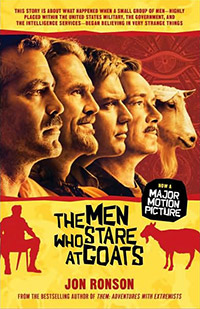
Staring at Men Who Stare at Goats

November 10, 2009

men-who-stare-at-goats-cover

The Men Who Stare at Goats had so much potential as a film given the bizarre and comical nature of the weird things the United States government believed about the paranormal in its two-decade long secret psychic spy program, so wonderfully captured by the British investigative journalist John Ronson in his book of the same title. Give Hollywood some credit for at least keeping his book title (a rarity indeed in Hollywood because, you know, producers and directors always know what’s best for your book). Unfortunately, if you saw the trailer for the film, you saw most of the funniest bits, with only a few more gems scattered throughout. This is a shame because with four major stars in the film it could have done much better than the $13.3 million it grossed in its opening weekend. This was slightly better than the UFO thriller The Fourth Kind ($12.5 million), and Paranormal Activity ($8.6 million), although the latter film was produced for about $15,000 and has accumulated a staggering 45-day gross of $97.4 million, empirical evidence that the paranormal still pays, and pays very well!

At the very end of the credits of The Men Who Stare at Goats, as Boston’s foot-stomping song “More Than a Feeling” blasts along, a disclaimer rolls by at eye-blurring speed, basically saying that most of the characters and plot line in the film are entirely made up and have next to no connection to Ronson’s book or what really happened in the psychic spy program. Ain’t that the truth. The premise is so contrived as to be almost painful (if only it were funny, which it wasn’t): the wife of Ewan McGregor’s journalist character leaves him for his senior editor, a one-armed creepo with a black handed prosthetic that was apparently attractive to the smitten wife, and so he sets out to prove his journalistic/husbandly manhood by trying to get embedded in the U.S. army during the Iraqi invasion. Along the way he runs into George Clooney’s army psychic spy character and gets pulled into doing a story about what the U.S. government did back in the 1970s and 1980s. The bit about men staring at goats to try to kill them is true. The part about playing the theme song from Barney the purple dinosaur as a torture weapon is also true. The army officer who tried to run through walls also happened, with precisely the same result as in the movie: the wall’s atoms repelled his atoms with the predictable result. (And why, oh why, would they not use the real name of that officer: Major General Albert Stubblebine III? You couldn’t make up a better name!) I think that’s about it. Oh, guys did wear their hair longer then and had mustaches.

It is with some irony, then, that at the beginning of the film a line appears: “More of this is true than you would believe.” Okay, so what is true and what isn’t? Here is what I know. In 1995, the story broke that for the previous 25 years the U.S. Army had invested $20 million in a highly secret psychic spy program called Star Gate (also Grill Flame and Scanate), a Cold War project intended to close the “psi gap” (the psychic equivalent of the missile gap) between the United States and Soviet Union. The Soviets were training psychic spies, so we would as well. Forget the film. Read the book. In The Men Who Stare at Goats Jon Ronson tells the story of this program, how it started, the bizarre twists and turns it took, and how its legacy carries on today.

In a highly readable narrative style, Ronson takes readers on a Looking Glass-like tour of what U.S. Psychological Operations (PsyOps) forces were researching: invisibility, levitation, telekinesis, walking through walls, and even killing goats just by staring at them (the ultimate goal was killing enemy soldiers telepathically). In one project, psychic spies attempted to use “remote viewing” to identify the location of missile silos, submarines, POWs, and MIAs from a small room in a run-down Maryland building. If these skills could be honed and combined, perhaps military officials could zap remotely viewed enemy missiles in their silos, or so the thinking went.

Initially, the Star Gate story received broad media attention — including a spot on ABC’s Nightline — and made a few of the psychic spies, such as Ed Dames and Joe McMoneagle, minor celebrities. As regular guests on Art Bell’s pro-paranormal radio talk show, the former spies spun tales that, had they not been documented elsewhere, would have seemed like the ramblings of paranoid cultists.

But Ronson has brought new depth to the account by carefully tracking down leads, revealing connections, and uncovering previously undisclosed stories. For example, Ronson convincingly connects some of the bizarre torture techniques used on prisoners at Guantanamo Bay, Cuba, and Iraq’s Abu Ghraib prison, with similar techniques employed during the FBI siege of the Branch Davidians in Waco, Texas. FBI agents blasted the Branch Davidians all night with such obnoxious sounds as screaming rabbits, crying seagulls, dentist drills, and Nancy Sinatra’s “These Boots Are Made for Walking.” The U.S. military employed the same technique on Iraqi prisoners of war, instead using the theme song from the PBS kids series Barney and Friends — a tune many parents concur does become torturous with repetition.

One of Ronson’s sources, none other than Uri Geller (of bent-spoon fame), led him to one Maj. Gen. Albert Stubblebine III, who directed the psychic spy network from his office in Arlington, Virginia. Stubblebine thought that with enough practice he could learn to walk through walls, a belief encouraged by Lt. Col. Jim Channon, a Vietnam vet whose post-war experiences at such new age meccas as the Esalen Institute in Big Sur, California, led him to found the “first earth battalion” of “warrior monks” and “jedi knights.” These warriors, according to Channon, would transform the nature of war by entering hostile lands with “sparkly eyes,” marching to the mantra of “om,” and presenting the enemy with “automatic hugs.” Disillusioned by the ugly carnage of modern war, Channon envisioned a battalion armory of machines that would produce “discordant sounds” (Nancy and Barney?) and “psycho-electric” guns that would shoot “positive energy” at enemy soldiers.

Although Ronson expresses skepticism throughout his narrative, he avoids the ontological question of whether any of these claims have any basis in reality. That is, can anyone levitate, turn invisible, walk through walls, or remote view a hidden object? Inquiring minds (scientists) want to know. The answer is an unequivocal no. Under controlled conditions remote viewers have never succeeded in finding a hidden target with greater accuracy than random guessing. The occasional successes you hear about are due either to chance or suspect experiment conditions, like when the person who subjectively assesses whether the remote viewer’s narrative description seems to match the target already knows the target location and its characteristics. When both the experimenter and the remote viewer are blinded to the target, all psychic powers vanish.

Herein lies an important lesson that I have learned in many years of paranormal investigations and that Ronson gleaned in researching his illuminating book: What people remember rarely corresponds to what actually happened. Case in point to return to the title theme: A man named Guy Savelli told Ronson that he had seen soldiers kill goats by staring at them, and that he himself had also done so. But as the story unfolds we discover that Savelli is recalling, years later, what he remembers about a particular “experiment” with 30 numbered goats. Savelli randomly chose goat number 16 and gave it his best death stare. But he couldn’t concentrate that day, so he quit the experiment, only to be told later that goat number 17 had died. End of story. No autopsy or explanation of the cause of death. No information about how much time had elapsed; the conditions, like temperature, of the room into which the 30 goats had been placed; how long they had been there, and so forth. Since Ronson was skeptical, Savelli triumphantly produced a videotape of another experiment where someone else supposedly stopped the heart of a goat. But the tape showed only a goat whose heart rate dropped from 65 to 55 beats per minute.

That was the extent of the empirical evidence of goat killing, and as someone who has spent decades in the same fruitless pursuit of phantom goats, I conclude that the evidence for the paranormal in general doesn’t get much better than this.

They shoot horses, don’t they?

• FOLLOW MICHAEL SHERMER ON TWITTER

topics:
Comments Off on Staring at Men Who Stare at Goats
PREVIOUS
 
NEXT