The official site of bestselling author Michael Shermer The official site of bestselling author Michael Shermer

A Skeptical Triumph Over Medical Flim-Flam

November 3, 2009

Skeptic Bruce Flamm, M.D. is vindicated in his drawn-out court case

On Friday, October 24, 2009, a California Court of Appeals vindicated Dr. Bruce Flamm, an OBGYN physician and professor at the University of California, Riverside, and member of the Skeptics Society, by throwing out a defamation lawsuit filed against him by a man who claimed to have proven that prayer can increase pregnancy rates in women trying to conceive.

Back in 2001, the Journal of Reproductive Medicine published a study by three Columbia University researchers claiming that prayer for women undergoing in-vitro fertilization resulted in a pregnancy rate of 50 percent, double that of women who did not receive prayer (i.e., a 100% increase in pregnancy rates!). Media coverage was extensive. ABC News medical correspondent Dr. Timothy Johnson, for example, reported, “A new study on the power of prayer over pregnancy reports surprising results; but many physicians remain skeptical.” One of those skeptics was a University of California Clinical Professor of Gynecology and Obstetrics named Bruce Flamm, who not only found numerous methodological errors in the experiment, but also discovered that one of the study’s authors, Daniel Wirth (AKA “John Wayne Truelove”), is not an M.D., but an M.S. in parapsychology who has since been indicted on felony charges for mail fraud and theft, for which he pled guilty. The other two authors have refused comment, and after three years of inquires from Flamm the journal removed the study from its website and Columbia University launched an investigation.

What they discovered, thanks to the vigilance of Dr. Flamm, was that Cha’s other co-author, Columbia University’s Rogerio Lobo, later revealed that he had not participated in the research and withdrew his name from the published findings. Even with one of his co-authors in federal prison and the other disgraced, Korean fertility specialist Kwang Yul Cha stood by the results of was is essentially a supernatural claim in that the presumption is that the deity intervened on behalf of infertile women to help them conceive. One wonders why the prayers do not seem to work in the other direction; that is, all those women who, due to alcohol or other external influences, engaged in sexual activity with no intention of conceiving and thus, over the course of the next several days, prayed like mad for pregnancy prevention, to no avail. But I digress…

Angered by Dr. Flamm’s skeptical persistence, Cha eventually filed a defamation lawsuit against Flamm, especially after he published several articles questioning the validity of the original pregnancy study. The lawsuit, filed in Los Angeles Superior Court in August 2007, was thrown out of court in April, 2008. However, in June, 2008 Cha took the case to the California Appellate Court. Finally, on October 24, 2009, the Court of Appeals, “affirmed in full” the Superior Court decision and thus ruled that Superior Court Judge James Dunn had acted appropriately in tossing out the lawsuit.

In response to the ruling, Dr. Flamm issued the following statement:

Today’s ruling is a victory for science and evidence-based medicine. Scientists must be allowed to question bizarre claims. Cha’s mysterious study was designed and allegedly conducted by a man who turned out to be a criminal with a 20-year history of fraud. A criminal who steals the identities of dead children to obtain bank loans and passports is not a trustworthy source of research data. Cha could have simply admitted this obvious fact but instead he hired a team of lawyers to punish me for voicing my opinions. Physicians should debate their opinions in medical journals, not in courts of law. Judges have better things to do with their time and taxpayers have better things to do with their money.

Amen, brother! And congratulations Dr. Flamm, on a cause well chosen and a battle well fought. Your stamina, persistence, and skeptical vigilance are to be commended. We honor you.

• FOLLOW MICHAEL SHERMER ON TWITTER

topics:
Comments Off on A Skeptical Triumph Over Medical Flim-Flam

Farewell to Norman Jay Levitt (1943-2009)

October 27, 2009

It is with much sadness that we report the death of Norman Jay Levitt on Saturday, October 24, 2009, due to heart failure. His wife of 38 years, Renee Greene Levitt, reported the news to friends and colleagues of Norman, and announced that a memorial service will be held on Sunday, November 1 at 1:30 PM at Plaza Jewish Community Chapel, 630 Amsterdam Avenue at 91 St. She also asked that in lieu of flowers, memorial contributions be sent to the National Center for Science Education, 420 40th Street, Suite 2, Oakland, CA 94609. Our deepest condolences to Renee and to Norman’s family and extended family.

Norman Levitt received his Ph.D. from Princeton University in 1967 and taught mathematics, specializing in topology, for forty years at Rutgers before retirement. He was a frequent contributor on public attitudes toward science, as well as the follies of academic life that arise in connection with misunderstanding of science, regularly contributing review essays for Skeptic, The New York Review of Books, and many other publications. His books include Higher Superstition: The Academic Left and its Quarrels with Science (with Paul R. Gross) in 1994, The Flight from Science and Reason in 1997, and Prometheus Bedeviled: Science and the Contradictions of Contemporary Culture in 1999. In 1989 he published a technical work entitled Grassmannians and the Gauss Maps in Piecewise-Linear Topology.

Norman was best known, however, for his relentless defense of science, particularly against those in the academy — generally labeled as social constructivists, deconstructionists, or postmodernists — who tended to lump science in with other cultural traditions as “just another way of knowing” that is no better than any other tradition, and thereby reduce the scientific enterprise to little more than culturally-determined guess work at best and hegemonic power mongering at worst. In the pages of Skeptic, for example, he reviewed a number of books by such academics, most recently tearing into the British sociologist of science Steve Fuller for his expert testimony at the Dover trial in which Fuller defended Intelligent Design creationism as a legitimate science that deserves equal treatment with evolutionary theory. Already schedule for publication in the next issue of Skeptic was Dr. Levitt’s review essay entitled “Science: A Four Hundred Page Hissy-Fit,” a review of Science: A Four Thousand Year History by Patricia Fara, which we have pre-published in eSkeptic in tribute to one of the finest writers to ever grace the pages of Skeptic. Editing Norman Levitt was unlike editing any other author in the 17-year history of the magazine. His vocabulary was unparalleled and his command of literature, history, and culture was second to none in the sciences. I give you just one typical example, from the aforementioned essay. As you can see, Norm did not suffer foolish authors gladly:

Mutatis mutandis, the British historian of science Patricia Fara has written a book that treats its own vast subject — science and the history of its development — in a similarly contemptuous and condescending way. Fara’s case reposes on the twin shaky pillars of epistemological relativism and self-ascribed political righteousness. It is outlandishly Pecksniffian in tone and substance. She has an appallingly cavalier attitude toward evidence and documentation. She argues by means of flat assertion and unsupported generalization, sins, one assumes, she would never let her callowest undergraduates get away with. When I read a book, however closely, my marginal notations are usually brief and infrequent. Not so in the case of Science: A Four Thousand Year History; my copy is crammed with notes to myself, most of them pointing out the author’s grotesque gaffes. Imprecision reigns on every page; inaccuracies, irrelevancies, omissions, anachronisms, errors, and outright howlers go galumphing through the text with the author’s blithe acquiescence.

Norm, we shall miss you terribly. Your literal voice may be gone, but your literary voice will live on forever.

• FOLLOW MICHAEL SHERMER ON TWITTER

topics:
Comments Off on Farewell to Norman Jay Levitt (1943-2009)

An Open Letter to Bill Maher on Vaccinations

October 20, 2009

(Note: this post originally appeared on the Huffington Post on October 16, 2009)

Dear Bill,

Years ago you invited me to appear as a fellow skeptic several times on your ABC show Politically Incorrect, and I have ever since shared your skepticism on so many matters important to both of us: creationism and intelligent design, religious supernaturalism and New Age paranormal piffle, 9/11 “truthers”, Obama “birthers”, and all manner of conspiratorial codswallop. On these matters, and many others, you rightly deserved the Richard Dawkins Award from Richard’s foundation, which promotes reason and science.

However, I believe that when it comes to alternative medicine in general and vaccinations in particular you have fallen prey to the same cognitive biases and conspiratorial thinking that you have so astutely identified in others. In fact, the very principle of how vaccinations work is additional proof (as if we needed more) against the creationists that evolution happened and that natural selection is real: vaccinations work by tricking the body’s immune system into thinking that it has already had the disease for which the vaccination was given. Our immune system “adapts” to the invading pathogens and “evolves” to fight them, such that when it encounters a biologically similar pathogen (which itself may have evolved) it has in its armory the weapons needed to fight it. This is why many of us born in the 1950s and before may already have some immunity against the H1N1 flu because of its genetic similarity to earlier influenza viruses, and why many of those born after really should get vaccinated.

Vaccinations are not 100% effective, nor are they risk free. But the benefits far outweigh the risks, and when communities in the U.S. and the U.K. in recent years have foregone vaccinations in large numbers, herd immunity is lost and communicable diseases have come roaring back. This is yet another example of evolution at work, but in this case it is working against us. (See ScienceBasedMedicine.org for numerous articles answering every one of the objections to vaccinations.)

Vaccination is one of science’s greatest discoveries. It is with considerable irony, then, that as a full-throated opponent of the nonsense that calls itself Intelligent Design, your anti-vaccination stance makes you something of an anti-evolutionist. Since you have been so vocal in your defense of the theory of evolution, I implore you to be consistent in your support of the theory across all domains and to please reconsider your position on vaccinations. It was not unreasonable to be a vaccination skeptic in the 1880s, which the co-discovered of natural selection — Alfred Russel Wallace — was, but we’ve learned a lot over the past century. Evolution explains why vaccinations work. Please stop denying evolution in this special case.

As well, Bill, your comments about not wanting to “trust the government” to inject us with a potentially deadly virus, along with many comments you have made about “big pharma” being in cahoots with the AMA and the CDC to keep us sick in the name of corporate profits is, in every way that matters, indistinguishable from 9/11 conspiracy mongering. Your brilliant line about how we know that the Bush administration did not orchestrate 9/11 (“because it worked”), applies here: the idea that dozens or hundreds pharmaceutical executives, AMA directors, CDC doctors, and corporate CEOs could pull off a conspiracy to keep us all sick in the name of money and power makes about as much sense as believing that Bush, Cheney, Rumsfeld, and their bureaucratic apparatchiks planted explosive devices in the World Trade Center and flew remote controlled planes into the buildings.

Finally, Bill, please consider the odd juxtaposition of your enthusiastic support for health care reform and government intervention into this aspect of our medical lives, with your skepticism that these same people — when it comes to vaccinations and disease prevention — suddenly lose their sense of morality along with their medical training. You excoriate the political right for not trusting the government with our health, and then in the next breath you inadvertently join their chorus when you denounce vaccinations, thereby adding fodder for their ideological cannons. Please remember that it’s the same people administrating both health care and vaccination programs.

One of the most remarkable features of science is that it often leads its practitioners to change their minds and to say “I was wrong.” Perhaps we don’t do it enough, as our own blinders and egos can get in the way, but it does happen, and it certainly happens a lot more in science than it does in religion or politics. I’ve done it. I used to be a global warming skeptic, but I reconsidered the evidence and announced in Scientific American that I was wrong. Please reconsider both the evidence for vaccinations, as well as the inconsistencies in your position, and think about doing one of the bravest and most honorable things any critical thinker can do, and that is to publicly state, “I changed my mind. I was wrong.”

With respect,
Michael Shermer

• FOLLOW MICHAEL SHERMER ON TWITTER

topics:
Comments Off on An Open Letter to Bill Maher on Vaccinations

Capitalism—A Propaganda Story

October 13, 2009

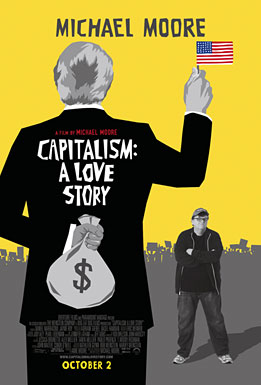
Capitalism - A Love Story (movie poster)

Michael Moore is the Leni Riefenstahl of our time. Or, perhaps he would be better characterized as a Bizzaro World Leni Riefenstahl, because while she propped up with propaganda the political powers of her time, Moore uses the same techniques to bring down the powers of our time, be it GM (Roger and Me), the gun lobby (Bowling for Columbine), the government (Fahrenheit 911), the health care industry (Sicko), or free enterprise (Capitalism: A Love Story).

In this latest installment in his continuing series of what’s wrong with America, Michael Moore takes aim at his biggest target to date, and the result is a disaster. The documentary is not nearly as funny as his previous films, the music selections seem contrived and flat, and the edits and transitions are clumsy, wooden, and not nearly as effective as what we’ve come to expect from the premiere documentarian (Ken Burns notwithstanding) of our time. And, most importantly, the film’s central thesis is so bad that it’s not even wrong.

First, let me confess that even though I have disagreed with most of Michael Moore’s politics and economics throughout his career, I have thoroughly enjoyed his films as skilled and effective works of art and propaganda, never failing to laugh — or be emotionally distraught — at all the places audiences are cued to do so. My willing suspension of disbelief that enables me to take so much pleasure from works of fiction, does not always serve me well when pulled into the narrative arc of a documentary. Thus it is that with his past films I have exited the theater infuriated at the same things Moore is … until I rolled up my sleeves and did some fact checking of my own, at which point Moore’s theses unravel (with the possible exception of Bowling for Columbine, his finest work in my opinion). But with Capitalism: A Love Story, Moore’s propagandistic props are so transparent and contrived that I never was able to suspend disbelief.

What was especially infuriating about Capitalism: A Love Story was the treatment of the people at the bottom end of the economic spectrum. The film is anchored on two eviction stories contrived to pull at the heart strings. One family filmed the eviction process themselves and sent the footage to Moore in hopes he’d use it (many are called, few are chosen), and the other was filmed by Moore’s crew. The message of both is delivered with a sledge hammer: Greedy Evil Soul-Sucking Bankers (think Lionel Barrymore’s villainous Mr. Potter in It’s a Wonderful Life) are tossing out onto the streets of America poor innocent families who are victims of circumstances not of their making. Why? First, because this is what Greedy Evil Soul-Sucking Bankers do for fun on weekends. Two, because the economic crisis caused solely by said bankers has made it impossible for families to make the payments on those subprime loans they were tricked into taking by those same bankers, who themselves were suckered into a Ponzi-like scheme cooked up by Alan Greenspan and his Wall Street/Federal Reserve buddies to take back the homes fully owned by (first) the elderly and (then) the poor. In the fine print that the bankers carefully slipped past the elderly and the poor for these second mortgages and subprime loans, the contracts said that the rates on variable rate loans could go up, and that the house was collateral for the loan such that if the loan payments are not made the home is subject to foreclosure and repossession by the bank (which is what the bankers are hoping happens).

In Michael Moore’s worldview, a goodly portion of the American people are ignorant, uneducated, clueless pinheads too stupid to realize the fundamental principle of a loan: you have to have collateral to secure the loan! No collateral, no loan. You say to the banker “I would like to take out a loan.” The banker says to you “what do you have for collateral?” What happened in the housing boom was that bankers relaxed their standards for what they would require for collateral (and income, assets, etc.) because (1) the government told them to do so and promised to cover their losses if it didn’t work out, and (2) they wanted to make more money; and borrowers wanted in on the cash cow that everyone was milking, from individual house flippers looking for a quick buck, to ordinary families wanting extra cash for remodeling, tuition, or whatever, to mortgage giants wanting corporate expansion. And all were driven by the same motive: greed!

Yes, greed. Those evicted families knew perfectly well what they were doing when they freely chose to climb onto the housing bubble and take it for a ride. I have a much higher view of the American public than does Michael Moore. I don’t think the American people are so stupid or uneducated that they didn’t know what they were doing. This wasn’t rocket science. It was even on television, the ne plus ultra of pop culture! I well remember watching A & E’s television series Flip This House, and reading all those magazine articles and get-rich-quick books on how to make a fortune in the real estate market, and thinking “wow, everyone’s getting rich except me; how can I get in on the action?”

What I felt is, I’m sure, what lots of people felt. I looked into securing a second mortgage on my home in order to build a second home on an undeveloped portion of my hillside property, and then selling it to turn a tidy profit. Everyone was doing it. What could go wrong? Well, for starters I thought, what if it takes longer to build the home than I projected? We all know how slow construction projects can be. Could I make the payments on the second mortgage for an additional six months to a year? And what if I couldn’t sell that second home? Could I make the payments on the new loan indefinitely? What if my income decreased instead of increased, like it was at the time (and, subsequently, did … dramatically!). And what would happen if I couldn’t make the payments? The answer was obvious, and it wasn’t in the fine print: I could lose my primary home.

Forget that! Making a profit on a second home would be nice, but losing my first home would hurt well more than twice as much as making a profit on the second home would feel good. That’s a basic principle of risk aversion: losses hurt twice as much as gains feel good. Now, I’m not really a risk-averse guy (I gave up a secure career as a college professor for an insecure career as a writer and publisher), but even I could see the inherent risks involved when the home you live in could be taken away. My hillside remains sagebrush and wild grass.

What about the people on the other end of the economic spectrum — the bankers and Wall Street moguls? Why aren’t they being evicted. Now, given that I’m a libertarian, you might expect me to come to the defense of Corporate America. Not so. Here I am in complete agreement with Michael Moore that, as I’ve been saying since the day it was first pronounced, “too big to fail” is the great myth of our time. None of these giant corporations — GM, AIG, Bank of America, Goldman Sachs, et al. — should have been bailed out. In fact, they should have been allowed to fail, their stocks go into the toilet, their employees tossed out on to the gilded streets of lower Manhattan, and their CEOs dispersed to work as greeting clerks at Walmart. They gambled and lost on all those securities, bundled securities, derivatives, credit default swaps, and other “financial tools” that I’ll bet not one in a hundred Wall Street experts actually understands. If you really believe in free enterprise, you must accept the freedom to lose everything on such gambles. These CEOs and their corporate lackeys are nothing more than welfare queens who adhere to the motto “in profits we’re capitalists, in losses we’re socialists.” Sorry guys, you can’t have it both ways without corrupting your morals, which you have, along with the politicians you’ve bribed, cajoled and otherwise coerced to your bidding.

The solution? I have some suggestions of my own, but Michael Moore’s solution is beyond bizarre: replace capitalism with democracy. Uh? Replace an economic system with a political system? Even the über liberal Bill Maher was baffled by that one when he hosted Moore on his HBO show. How does a democracy produce automobiles and computers and search engines? It doesn’t. It can’t.

Capitalism: A Love Story, ends with a remarkable film clip that Moore discovered of President Franklin Roosevelt reading from his never proposed second Bill of Rights (he died shortly after and the document died with him). Included in the list are:

  • The right to a useful and remunerative job in the industries or shops or farms or mines of the nation;
  • The right to earn enough to provide adequate food and clothing and recreation;
  • The right of every farmer to raise and sell his products at a return which will give him and his family a decent living;
  • The right of every businessman, large and small, to trade in an atmosphere of freedom from unfair competition and domination by monopolies at home or abroad;
  • The right of every family to a decent home;
  • The right to adequate medical care and the opportunity to achieve and enjoy good health;
  • The right to adequate protection from the economic fears of old age, sickness, accident, and unemployment;
  • The right to a good education.

That’s nice. To this list I would add a computer in every home with wireless Internet access. I’m sure we could all think of many more things “under which a new basis of security and prosperity can be established for all — regardless of station, race, or creed,” in Roosevelt’s words. But there is one question left unstated: Who is going to pay for it? If there is no capitalism, from where will the wealth be generated to pay for all these wonderful things? How much does a “decent” home costs these days, anyway?

Do you see the inherent contradiction? Of course you do. So does Michael Moore, who elsewhere in the film longs for the good old days when the “rich” were taxed 90% of their earnings. So did Willie Sutton, who answered a similar question after being nabbed by the FBI during the Great Depression and asked by a reporter why he robs banks: “Because that’s where the money is.”

• FOLLOW MICHAEL SHERMER ON TWITTER

topics:
Comments Off on Capitalism—A Propaganda Story

The Revolution Will Be Tweeted

October 6, 2009

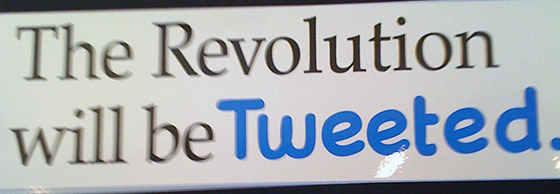
At the Atheist Alliance International conference this past weekend in Burbank, California, the Skeptics Society had a booth in the vendor’s section of book sellers and the like, the latter of which included a table full of bumper stickers. One struck me as a poignant proxy for what I predicted will happen at the end of my book, The Mind of the Market: the Internet as a form of trade will enable freedom to find a way. The bumper sticker reads: The Revolution Will be Tweeted. I presume the reference is to the Iranian elections, the suppression of the protests of the corruption of which were tweeted.

The Revolution will be Tweeted.

This concept allows me to expand to my blog readers here what I mean by “free trade.” Most of you have pounced on me for using terms like “libertarian” or “capitalism.” But what I mean by free trade is much broader and encompassing: the free exchange of products, services, and ideas between people anywhere in the world anytime they want. To show how broadly I go with this concept, when Chimp A grooms Chimp B, and subsequently when Chimp A is attacked by an alpha male, Chimp B is more likely to come to his aid because they have formed a bond, an attachment, a trading relationship. Grooming in this example is a form of free trade.

Why does this happen? In The Mind of the Market I introduced Bastiat’s Principle, based on an observation by the 19th-century French economist Frédéric Bastiat: “Where goods do not cross frontiers, armies will.” Its corollary elucidates one of the principle steps toward conflict reduction: where goods do cross frontiers, armies will not.

This is a principle, not a law, since there are exceptions both historically and today. Trade — the free exchange of products, services, and ideas between people — will not prevent war, but it attenuates its likelihood. Thinking in terms of probabilities instead of absolutes, trade between groups increases the probability that peaceful and stable relations will continue and decreases the probability that instabilities and conflicts will erupt.

As an example, Yanomamö hunter-gatherers are not only the “fierce people,” as Napoleon Chagnon characterized them, they are also willing traders. Following the political dictum “the enemy of my enemy is my friend,” Yanomamö inter-village trade and reciprocal food exchanges serves as a powerful social glue in the creation of political alliances. As in my Chimp example above, Yanomamö Village A cannot go to Village B and announce that they are worried about being conquered by the more powerful Village C, since this would reveal their own weakness. Instead, Village A forms an alliance with Village B through trade and reciprocal feasting, and as a result they not only gain military protection but also encourage inter-village peace. As a by-product of this politically-motivated economic exchange, even though each Yanomamö band could produce all the products it needs for survival, they often set up a division of labor and a system of trade. The unintended consequence is an increase in both wealth and products. The Yanomamö trade not because they are innate altruists or nascent capitalists, but because they want to form political alliances. “Without these frequent contacts with neighbors,” Chagnon explains, “alliances would be much slower in formation and would be even more unstable once formed. A prerequisite to stable alliance is repetitive visiting and feasting, and the trading mechanism serves to bring about these visits.” Where goods cross Yanomamö frontiers, Yanomamö armies do not.

Bastiat’s Principle holds not only for hunter-gatherers but for consumer-traders as well. Note, for example, that in the modern world of consumer-trading nation states, economic sanctions are among the first steps taken by a nation against another when diplomatic conflict resolution attempts break down. Often such sanctions are imposed for purely economic reasons in a mercantilist mode, as when the United States imposed import tariffs on steel purchased from China and Russia in 2002, which the World Trade Organization declared to be illegal. Economic sanctions are also imposed for political reasons, as when the United States enforced them on Japan after its invasion of China in the 1930s, and these became a prelude (among other factors) to Japan’s retaliatory bombing of Pearl Harbor in 1941 and our involvement in the greatest war in history. Or more recently, economic sanctions were imposed by the U.S. and Japan on India following its 1998 nuclear tests, by the U.S. on Iran because of the latter’s state sponsorship of terrorism, and by the United Nations on Iraq as a tool to force the Iraqi government to comply with U.N. weapons inspectors’ search for weapons of mass destruction.

Economic sanctions send this message: if you do not change your behavior we will no longer trade with you. And by Bastiat’s Principle, where our goods do not cross your frontiers, our armies will. Not inevitably, of course, but often enough in history that the principle retains its veracity. Economic sanctions are not a necessary or even sufficient cause of war, but they are almost always a prelude to war.

In The Mind of the Market I also introduce the Starbucks’ corollary to Bastiat’s Principle: Where Starbucks cross frontiers, armies will not. That is, the free trade of products between peoples, and open access to services across geographic borders, obsoletes the necessity of political borders and thereby decreases the probability that armies will cross them. To the Starbucks corollary I add the Google theory of peace: Where information and knowledge cross frontiers, armies will not. That is, the free trade of information between peoples, and open access to knowledge across geographic borders, obsoletes the necessity of political borders and thereby decreases the probability that armies will cross them.

A stirring example can be seen in Europe. Since the formation of the Treaty of Rome and the European Union — which integrated disparate and historically divided European nations under one economic umbrella — where once invasions and wars were commonplace throughout a thousand years of European history, they are now unthinkable. Try it. Imagine Germany invading France and waging war upon her, or picture France motoring its armies through the Chunnel and then marching them into London to declare the country French. What once made for dramatic literature now sounds like pulp fiction.

The Wikification of the economy adds to the Google theory of peace the entire world economy as practiced by and participated in by billions of people. Wikipedia is the right analogue for this emerging economic phenomenon. It is an open-sourced, peer-produced, mass-collaborated, bottom-up, self-organized, emergent property of millions of people choosing to build the modern equivalent of the Alexandrian library whose purpose it was to make the sum of the world’s knowledge available to everyone in one location. Granted, the ancient Alexandrian Greeks had far less knowledge to store than we do today — by many orders of magnitude — but we have the World Wide Web.

In the long run, no dictator, demagogue, priest, president, or any other pretender to power will be able to control the Googlefication, Wikification, eBayification, MapQuestification, YouTubeification, MySpaceification of information, knowledge, geography, personal relationships, markets, and the economy. Chinese bureaucrats can attempt to put all the firewalls and controls they want on a billion potential Chinese web surfers, but in the long run they will never be able to prevent knowledge, products, and people from finding their way to those who seek them. And to this list we can now add the Twitterfication of information. The revolution will be tweeted. And…

Freedom finds a way.

• FOLLOW MICHAEL SHERMER ON TWITTER

topics:
Comments Off on The Revolution Will Be Tweeted
PREVIOUS
 
NEXT