The official site of bestselling author Michael Shermer The official site of bestselling author Michael Shermer

Chill Out — An economic triage for global climate change

September 29, 2009

Are you a global warming skeptic, or are you skeptical of the global warming skeptics? Your answer depends on how you answer these five questions:

  1. Is the earth getting warmer?
  2. Is the cause of global warming human activity?
  3. How much warmer is it going to get?
  4. What are the consequences of a warmer climate?
  5. How much should we invest in altering the climate? Here are my answers.

Global warming is real and primarily human caused. With questions 3 and 4, however, estimates include error bars that grow wider the further out we run the models because complex systems like climate are notoriously difficult to predict. I provisionally accept the estimate of the United Nations’ Intergovernmental Panel on Climate Change (IPCC) that the mean global temperature by 2100 will increase by 4.7 degrees Fahrenheit, and that sea levels will rise by about one foot (about the same as they have risen since 1860). Moderate warming with moderate changes.

Question 4 deserves even more skepticism. In his carefully-reasoned and politically-bipartisan book Cool It (Alfred Knopf, 2008), the “skeptical environmentalist” Bjorn Lomborg notes that if global warming continues unchecked through the end of the century there will be 400,000 more heat-related deaths annually; there will be also be 1.8 million fewer cold-related deaths, for a net gain of 1.4 million lives. This is not to say that global warming is good, only that its consequences must be weighed in the balance. For example, Lomborg sites data from the World Wildlife Fund that at most we will lose 15 polar bears a year due to global warming, but what doesn’t get reported is that 49 bears are shot each year. What would be more cost-effective to save polar bear lives — spend hundreds of billions of dollars to lower CO2 emissions and (maybe) the mean global temperature, or limit hunting permits?

This leads to question 5 — the economics of global climate change — which I think needs a sound dose of skepticism, particularly since the collapse of our economy. Even if all countries had ratified the Kyoto Protocol and lived up to its standards (which most did not), according to the IPCC, at best it would have postponed the 4.70F average increase just five years from 2100 to 2105, at a cost of $180 billion a year! By comparison, although global warming may cause an increase of two million deaths due to hunger annually by 2100, the U.N. estimates that for $10 billion a year we could save 229 million people from hunger annually today. It’s time for economic triage.

Economics is about the efficient allocation of limited resources that have alternative uses. And after the U.S. government allocated a trillion dollars of our limited resources to shore up our flagging financial foundations, those alternative uses have never seemed so pressing. Should we (can we?) really allocate the equivalent of a Manhattan Project to lower CO2 emissions 50 percent by 2050 and 80 percent by 2100, as the IPCC recommends in order to divert disaster? My answer is no. Why? Because the potential benefits for the costs incurred are simply not warranted.

If you had, say, $50 billion a year to make the world a better place for more people, how would you spend it? In 2004, Lomborg asked this question to a group of scientists and world leaders, including four Nobel laureates. This “Copenhagen Consensus,” as it is called, ranked reduction of CO2 emissions 16th out of 17 challenges. The top four were: controlling HIV/AIDS, micronutrients for fighting malnutrition, free trade to attenuate poverty, and battling malaria. A 2006 Copenhagen Consensus of U.N. ambassadors constructed a similar list, with communicable diseases, clean drinking water, and malnutrition at the top, and climate change at the bottom. A late 2008 meeting that included five Nobel Laureates recommended that President-elect Barack Obama allocate his promised $150 billion in subsidies for new technologies and $50 billion in foreign aid be allocated for research on malnutrition, immunization, and agricultural technologies. For a cool Kyoto $180 billion you can buy a lot of condoms, vitamin tablets, and mosquito nets and rescue hundreds of millions of people from disease, starvation, and impoverishment.

If you are skeptical of Lomborg and his branch of environmental skepticism, read the Yale University economist William Nordhaus’ technical book A Question of Balance (Yale University Press, 2008). Nordhaus computes the costs-benefits of various recommendations for changing the climate by either 2105 or 2205, primarily focused on the cost of curbing carbon emissions. Economists like to compute future profits and losses based on investments made today, adjusting for the value of a future dollar at an average interest rate of four percent. If we spent a trillion dollars today (the equivalent of the recent bailout or the Iraq war), how much climate change would it buy us in a century at four percent interest? Nordhaus’s calculations are compared to doing nothing, where a plus value is better and a minus value worse than doing nothing. Kyoto with the U.S. is plus one and without the U.S. zero, for example, and a gradually increasing global carbon tax is a plus three. That is, a $1 trillion cost today buys us $3 trillion of benefits in a century. Al Gore’s proposals, by contrast, score a minus 21, where $1 trillion invested today in Gore’s plans would net us a loss of $21 trillion in 2105.

Add to these calculations the numerous other crises we face, such as the housing calamity, the financial meltdown, the coming collapse of social security and medicare, two wars, a failing public education system, etc.

In my opinion we need to chill out on all extremist plans that entail expenses best described as Brobdingnagian, require our intervention into developing countries best portrayed as imperialistic, or involve state controls best portrayed as fascistic. Give green technologies and free markets a chance.

• FOLLOW MICHAEL SHERMER ON TWITTER

topics:
Comments Off on Chill Out — An economic triage for global climate change

A Romanian Adventure

September 22, 2009

The week of September 7 I spent in the beautiful Eastern European country of Romania, home of the blood-sucking vampire Count Dracula in Transylvania and the soul-sucking Communist dictator Nicolae Ceaucescu in Bucharest. I was invited by the physicist and historian of science Gheorghe Stratan at the Babes-Bolyai University in Cluj (pronounced Kloog), who translated two of my books, Why People Believe Weird Things and Why Darwin Matters (published by Humanitas publishing house in Romania). Dr. Stratan has also translated books by Richard Dawkins, Carl Sagan, Daniel Dennett, and Ernst Mayr. The central event was an evolution conference in Cluj celebrating the Darwinian bicentennial, and there were many interesting talks on evolutionary biology, history, and cultural impacts.

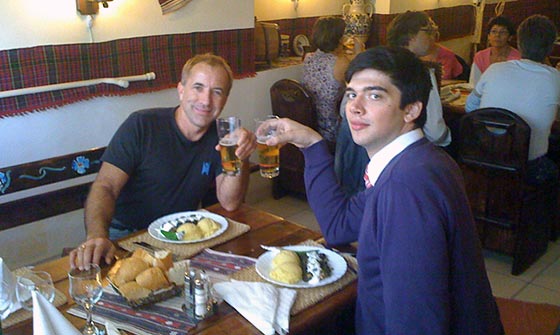
While I was there the Romanian Humanist Association invited me to give a talk in Bucharest, hosted by the organizers of that fine organization with the very Roman names of Ovidiu Covaciu and Remus Cernea, both of whom were exceptionally kind in escorting me about the city and treating me to their local beers and meals, such as here as Ovidiu and I enjoy an Ursus (Bear) beer and lunch consisting of polenta with pork wrapped in grape leaves.

Ovidiu and I enjoy an Ursus (Bear) beer and lunch consisting of polenta with pork wrapped in grape leaves.

Ovidiu and I enjoy an Ursus (Bear) beer and lunch consisting of polenta with pork wrapped in grape leaves.

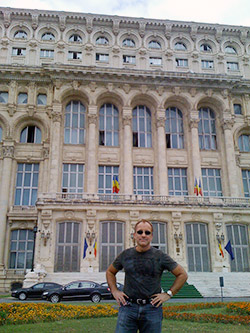
Ceausescu's monument to himself, People's Palace, that Trump tried to buy!

Ceausescu’s monument to himself, People’s Palace, that Trump tried to buy!

Ovidiu and Remus also took me to the infamous “People’s Palace” (now the Palace of the Parliament), constructed by Ceaucescu to be his pyramid-like monument to himself as the largest building in the world. (They claim that the Pentagon is actually the largest by square footage, but that the palace may actually be larger if you don’t count the inner empty unused center courtyard of the Pentagon.) The Palace is unbelievably huge. Inside, the hallways are so wide that you could drive a tank down some of them. The ballrooms are breathtakingly enormous, and of course the exterior exudes strength and power.

Our tour guide told us that after the overthrow of the Communists in 1989, the Palace, still unfinished and bankrupting the country (with the people starving, the streets unlit at night, etc.), that they nearly took an offer of $1 billion from Donald Trump, who wanted to turn the Palace into the world’s largest casino. Somehow that seems fitting. Someone wised up and had the place assessed by an American company, which put the price tag at $22 billion, so The Donald missed what would have been his biggest real estate deal ever.

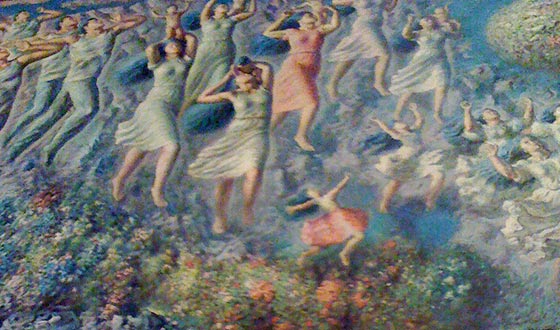
Inside the Palace hangs the propaganda artwork of Sabin Balasa, commissioned to paint idealized happy Romanians under Communist rule. Here are two classic pieces.

Happy communists! by Sabin Balasa

Happy communists! by Sabin Balasa

Idealized peaceful communist woman and man by Sabin Balasa

Idealized peaceful communist woman and man by Sabin Balasa

Most disturbing was the level infusion of religion into science education. (Romanians are overwhelmingly Eastern Orthodox with a level of belief in God approaching 99.9%, an overreaction, my hosts assured me, to the state enforced atheism—you can’t force people to believe.) Here is the 11th grade science textbook featuring the six days of creation, along with a 9th grade biology textbook written by two teams of authors: biologists and theologians, and on whose first page it reads “God Exists.” (Click the thumbnails below to view larger photos in my Flickr photostream.)

photo thumbnail photo thumbnail photo thumbnail photo thumbnail photo thumbnail photo thumbnail

Remus is planning on running for President of Romania on a secular government platform that would enforce the separation of church and state, which at this point in the country’s history is going to be difficult. Nevertheless, I support him in his cause. Here is Remus and I in the beautiful Venezia hotel they hosted me in.

Other impressions: Both of my talks were well received, the Romanian people were exceptionally friendly, almost everyone I met my age and younger spoke quite good English , and the city of Cluj was quite beautiful. On the down side, I was amazed at the number of cars in Bucharest (and remember, I’m from L.A.!), jammed into every nook and cranny (without an SUV to be found). I was also stunned by how many people smoke. Everywhere I went the acrid smell of smoke was in the air, including restaurants, which once again reminded me of the tension I feel between my libertarian tendency to prefer freedom, including the freedom to smoke, and my personal preference for a smoke free environment anywhere I go. I know, second hand smoke has not been proven to cause serious lung illnesses, but it sure does stink and bothers me to no end. One market solution, of course, is to allow, say, restaurants to choose to be smoke free or smoke filled, and then let customers decide. But even in the outdoors second-hand smoke stinks and makes it difficult to appreciate the otherwise clean air (well, okay, not with all those cars, but you get the point).

I also got to visit the spectacular Botanical Garden in Cluj where I got an insider’s tour, as well as walking about town a fair amount and going inside a classic Orthodox cathedral:

Orthodox Cathedral much more austere than Catholics, no seats for services! You stand, like at a Springsteen concert

Orthodox Cathedral much more austere than Catholics, no seats for services! You stand, like at a Springsteen concert

Global warming is real...inside the botanical greenhouse. I was sweating like Bernie Madoff in jail.

Global warming is real…inside the botanical greenhouse. I was sweating like Bernie Madoff in jail.

Botanical Garden in Cluj

Botanical Garden in Cluj

• FOLLOW MICHAEL SHERMER ON TWITTER

topics:
Comments Off on A Romanian Adventure

A Skeptic Among the Paranormalists

September 15, 2009

On Saturday, September 12, after flying 17 hours from Cluj, Romania to Budapest, Hungry to Zurich, Switzerland to L.A.X., I drove straight to the Queen Mary in Long Beach, where there was a big paranormal conference hosted by Dave Schrader of Darkness Radio. Dave is a very open-minded fellow, in the sense that he thought it might behoove his flock to have them hear what scientists think some plausible natural and normal explanations there are for the various supernatural and paranormal phenomena that his members tend to believe in and talk about at such conferences (there was even a ghost hunting expedition on the Queen Mary later that night, but I was wasted from flying for so long and passed on being spooked on the ship).

My keynote talk was Why People Believe Weird Things, a shortened version of which you can see on Ted.com, where I originally delivered this lecture. It includes much discussion about how east it is to fool the brain, perceptual illusions, cognitive missteps such as the confirmation bias, priming effects (where you prime the brain to see or hear the world in a certain way), and especially the power of expectation.

Surprisingly, everyone there was most friendly toward me, even though what I was basically telling them is that pretty much everything they believe about the paranormal is wrong. Many came up after to tell me that they too are skeptical of many of the phony baloney scam artists there are out there who are ripping people off with various flim flams, but of course they added the proviso that not all paranormal phenom are perpetrated hoaxes and that they like science because it can help them to discriminate between the true and false paranormal patterns. Okay, whatever it takes to get people interested in science, however, I did make it clear that to date science has yet to find any conclusive evidence for ESP and the like, so that instead of turning to the paranormal as an explanation for presently unsolved mysteries, why not just leave it as a mystery until science can explain it? In science, I noted, it’s okay to say “I don’t know.”

Here’s some iPhone pics I snapped while waiting for my talk to begin. Included is a pic of Frank Sumption and I. Frank is the inventor of “Frank’s Box,” which I wrote about in the January, 2009 issue of Scientific American. Frank’s Box is also called the “Telephone to the Dead,” and consists of a simplified radio receiver that cycles through the stations at breakneck speed such that one only hears snippets of words and sentence fragments, and it is here where the dead allegedly sneak in their messages to us living (or, where in my explanation, the “patternicity” happens, or the natural tendency to find meaningful patterns in random noise. I also snapped some pics of Bruce Goldberg, with whom I once appeared in the mid 1990s on a television show about past lives. Bruce is still churning out the self-published books, now on how he communicates with time travelers from the future. Finally, I will admit that New Agers have the coolest crystals.

• FOLLOW MICHAEL SHERMER ON TWITTER

topics: , , , , , , ,
Comments Off on A Skeptic Among the Paranormalists

What I Believe — Science & the Power of Humanity

September 8, 2009

I believe in the power of science and humanity. Specifically, I believe that biodiversity is a good thing and that we have been rapacious in our treatment of the environment, although I think the environmental movement has greatly exaggerated our condition and that the environment is a lot more resilient than most environmentalists give it credit for. I don’t mind eating cows and fish, but dolphins and whales have big brains and they’re cool, so I don’t think we should kill them. I drive an SUV because I haul around bicycles, books, and dogs, but as soon as there is a bigger hybrid, I’ll buy it. And although I am a libertarian heterosexual who is about as unpink (in both meanings) as you can get, I believe people should have an equal opportunity to be unequal. As for evolution, it happened. Deal with it.

I don’t know why the God question is so interdigitated with political and economic issues, but it is. It shouldn’t be. It’s okay to be a liberal Christian or a conservative atheist. I am a fiscal conservative and a social liberal. I don’t think there is a God, or any sort of anthropomorphic being who needs to be worshipped, who listens to prayers, who keeps a moral scoreboard that will be settled in the end, or who cares one iota about who wins the Super Bowl.

This is why what we do in this life matters so much — and why how we treat others in the here and now is more important than how they might be treated in some hereafter that may or may not exist. If we knew for certain that there is an afterlife, we wouldn’t have great debates about it, and philosophers wouldn’t have spilled all that ink over the millennia wrangling over it. Since we don’t know, it makes more sense to assume there is no God and no afterlife, and act accordingly. That is, act as if what we do matters now. That way, we’ll think about the consequences of what we are doing.

I am sick and tired of politicians, and just about everyone else, kowtowing to the religious right’s hypersensitivities and politically correct “tolerance” for diversities of belief — as long as one believes in God — any God will do, except the God who promises virgins in the next life to pilots who fly planes into buildings. Those of us who do not believe in god have had enough of this rhetoric. This is America. We are supposed to be good and do the right thing, not because it will make us rich, get us saved, or reward us in the next life, but because people have value in and of themselves, and because it will make us all better off, individually and collectively. It says so, right there in the Declaration of Independence, the Constitution, and the Bill of Rights — products of a secular eighteenth-century Enlightenment movement.

Religion and politics should be treated as separate entities. Religion is private and politics is public. If you want more religion, go to church. If you want more politics, go to the capitol. Don’t go to church to politic, and don’t go to the capitol to preach. That’s a non-overlapping magisterium I can live with.

• FOLLOW MICHAEL SHERMER ON TWITTER

topics: , , , , ,
Comments Off on What I Believe — Science & the Power of Humanity

Thoughts on Prisoner #771782 Science and Criminal Injustice

September 1, 2009

Ever since Skeptic magazine gained widespread distribution in bookstores, newsstands, and libraries in the early 1990s, we have received a steady stream of letters from prisoners (several a week), some to request free magazines and books, others to complain about the religious indoctrination they receive (both Christians and Muslims actively evangelize in prison), and a few to offer their own theories and conjectures about this or that scientific controversy that we covered. We even had a death-row inmate write to request that we devote a special issue of Skeptic to abolishing the death penalty, with his contribution as the lead article of course. After reading about what he did—multiple rapes and murders — we passed on the suggestion in honor of his victims. And in any case, he told me that even after his trial, conviction, and sentencing to death, cuffed and shackled to the seat on the way to prison, all he could think about was bolting out of the van and grabbing the first woman in sight so he could rape and kill her. I was relieved to know that death’s clock was ticking close to midnight for him.

As a libertarian I’m conflicted about the death penalty. On the one hand, from the victims’ families perspective, when it comes to first-degree murder — premeditated and with malice aforethought — my sense is that justice will only be served when the murderer is dead; an eye for an eye. And since the murderers didn’t worry about the humaneness of the death they forced on their victims, then I say fry ‘em ‘til their heads catch on fire and ol’ sparky runs out of juice. On the other hand, from a political perspective, I’m always leery about giving the state even more power, especially that over life and death; plus there is no reason to think that bumbling bureaucrats who run the government will magically transform into competent commissioners when it comes to the allocation of justice, as the Innocence Project has demonstrated in freeing 16 innocent people from death row based on irrefutable DNA evidence. As I said, I’ve not made up my mind on this issue.

Although we have largely avoided political controversies in Skeptic magazine, in our most recent issue (Vol. 15, No. 1) investigative journalist Steve Salerno’s article on the criminal justice system (“Criminal Injustice: The Flaws and Fallacies of the American Justice System”) generated a lot of mail in response to the questions he asked about “whether we’re punishing the right people for the right reasons, and even what constitutes a crime in the first place.” Which is worse, Salerno asks: “stealing a six-pack of beer from a 7-Eleven one time, or verbally abusing your wife, children and friends daily?” As well, given the current economic recession, Salerno argues “that corporate raiders and stock speculators — even when they break no actual laws — cause widespread job loss and severe economic dislocations in their pursuit of personal wealth and/or ‘maximum shareholder value,’” and that perhaps these too should be considered a punishable crimes. Finally, there is the problem of mistrials, planted evidence, coerced confessions, institutional racism in police departments, the criminalization of victimless (and harmless) crimes like prostitution and smoking pot, and the fact that “correctional institutions” are not really designed to “correct” criminal behavior, and one can’t help but be skeptical of the system we have.

Of the many letters from prisoners we received, one in particular stands out for its erudition and literary sophistication. I’ll only identify him by his prison I.D. #771782, incarcerated at the Clallam Bay Corrections Center in Clallam Bay, WA, where he is serving two life sentences plus 205 years for murdering his algebra teacher and two students when he was 14. #771782 fully admits his guilt even while agreeing with Salerno that “emotion and political expediency hold far more sway than facts in every stage of a criminal proceeding.” Nevertheless, when Salerno asks, “Cannot white-collar/financial crime of such disruptive magnitude be construed as a far greater offense against the social contract than any single crime against the person, up to and including homicide?,” #771782 answers no. “For starters, the ideology is ugly. This is a world of individuals, not interchangeable Alphas, Betas and Epsilons. We ascribe value to each individual. The social contract is useful only when it serves those individuals. Living individuals are arguably better served by a social contract riddled with white-collar crime than dead individuals are with one that’s white-collar free. I’ll hazard a guess that most victims of these crimes will agree. Ask Madoff’s victims which they’d prefer: to be bilked by him or killed by me.”

There is also the matter of making amends: “A white-collar criminal can, at least in theory, always redeem himself. Murderers cannot. Someone who’s scammed a billion can earn a billion. I, on the other hand, can never resurrect those I’ve killed. I’m vile enough to take a life, but not smart enough to restore it. Society recognizes this, and incorporates it into the criminal justice system.” Point well made.

A perennial issue in criminal justice is volition and accountability: in order to have a civil society we need to hold people accountable for their actions, and this assumes that people have free will and that their crimes were committed by choice. Despite this presumption, the trend in the social sciences is to look for and find mitigating circumstances, societal determining factors, and causal agents of crime outside of the criminals themselves. #771782 disagrees: “Hardship does not negate free will. Madoff and I could have chosen to be decent human beings rather than what we are.” Salerno noted that Madoff’s scheme led to at least two suicides, thereby justifying the moral equivalency argument between violent crimes and white-collar financial crimes. “That same choice is available for Madoff’s victims, no matter how tragic their loss. There is no need to commit suicide. If you’ve lost only your fortune, you are fortunate indeed compared to those whom I’ve hurt. You may be unemployed; maybe even destitute. But you’re alive, able to make or lose some more.”

What about juveniles? Doesn’t the justice system need overhauling here, as suggested by Salerno? #771782 agrees that “many juveniles are poorly served by declination into the adult system (I cannot honestly claim to be one of them),” yet notes that the argument “‘adult enough for the crime, adult enough for the time’ is far more prevalent among cable-news pundits and vote-lusty politicians than in a courtroom. When deciding whether to try a juvenile as an adult, the court must apply eight factors derived from the Supreme Court’s ruling on Kent v. United States,” and thus the criminal justice system has already nuanced this issue.

As for Gerry Spence’s observation (quoted by Salerno) that “correctional institutions do not correct anything” and that their “only real purpose is to punish people or keep them away from other people,” #771782 notes that this is another false dichotomy: “Punishment is a form of rehabilitation. When you punish your child for playing baseball in the house, it’s not because you get pleasure or a sense of justice from sending him to bed without supper. You simply want to protect your windows. You hope to condition your child to associate unpleasant consequences with the behaviors you’d like to inhibit.”

Many liberals think that conservatives want to just “lock ‘em up and throw away the key,” and that this negates the notion of rehabilitation and correction. Regardless of what liberals and conservatives actually believe and how that differs from what they accuse each other of believing, #771782 runs the thought experiment in a personal way: “I consume around $20,000 every year. I produce nothing. Thus, from a financial perspective, incarcerating me make little sense. To paraphrase Hannibal Lector: Any civilized society would either execute me or put me to some use.” But this isn’t so easy or practical: “Unfortunately, the capability to re-offend increases as we come into contact with more people and resources. What can nourish can kill. How can society calculate the odds of any one individual re-offending? And if I do, the consequences would be irreversible. From the perspective of society and its representatives, it makes sense in cases like mine to play it safe. Throw away the key.”

Taking the thought experiment one step further, #771782 makes this economic calculation with what could be done with the budget currently set aside to feed and house criminals like him: “The world’s resources are limited. Why not allocate them to, say, feed a hundred starving children instead? Would not society be better served? So why not execution? Why not dispose of me and spend the money I consume elsewhere? Posed with this question, I cannot offer any honest defense of my existence.”

So why do we keep murderers like #771782 alive? Emotion. “Rightly or wrongly, people value emotional experiences. One of those experiences is the sense of justice derived from making wrongdoers suffer in proportion to what they’ve made others suffer. Our victims feel good knowing we suffer. The question is what that satisfaction costs.” Consider this economic analogy from #771782:

Compare the complaint over the idleness of inmates to complaints about the inequality of wealth. In a world where wealth is constantly created and destroyed, the income gap is meaningless, provided it’s predicated on consensual trade. However, that matters little, because, as critics point out, unequal wealth promotes social instability. You could view wealth redistribution as the rich paying extortion money to those who have earned less. Likewise, you could classify throwing away the key as a sort of emotional ransom to those who cannot tolerate lighter sentences. Whether these things are logical doesn’t matter. Given our history as a species, we may have to do them simply to maintain social order. You could classify both phenomena as ransoms to our genes.

Ransoming our genes. Whatever else #771782 has been doing in prison, he’s obviously been reading, as these are not the idle scribblings of an uneducated man. But where does it leave us? If we want the perps to suffer as much as their vics, then maybe the death penalty is not the solution since in order to experience suffering you do need to be alive. On the other hand, happiness researches claim that our genetically hard-wired happiness set-point rebounds even after a devastating loss, such as that of a job, marriage, or spouse, and even the loss of freedom through incarceration, so if we abandon the death penalty maybe jail conditions need to be much harsher. Then again, think of the lives that could be saved by investing some of the monies spent on the long-term incarceration of prisoners on AIDS drugs, potable water, food to the starving, or mosquito nets for the malaria infested.

Finally, I think #771782 is on to something important in the notion of restitution. What is the purpose of the criminal justice system? Justice. Whatever else justice is (and it represents a lot of things in our complex society), justice for those who have been wronged should certainly incorporate restitution. The wrongdoer should make restitution for those who have been wronged. The victims of Bernie Madoff may glean some small satisfaction in knowing that he’ll rot away in a tiny cell until he dies, but how does that form of justice help recover their losses from his theft? Surely Madoff could be put to work under tightly controlled conditions doing something useful for society while simultaneously paying back those he wronged. Although the logistics of implementing total restitution for all crimes would be far more complicated than just throwing the wrongdoers in a cell and throwing away the key, it seems to me that at least in principle the goal of total restitution to the wronged is a worthy goal for an advanced civilization like ours.

In the meantime, as I said I remain conflicted on this issue and I’m not sure that science can help us find an answer. It may be a purely political issue that depends on what the majority wants at any given time, which grates on my rationalist sensibilities and our quest for universal principles. Are there any to be found here? Can science at least inform our politics, if not determine them? I invite your comments.

• FOLLOW MICHAEL SHERMER ON TWITTER

topics: , , , , , ,
Comments Off on Thoughts on Prisoner #771782 Science and Criminal Injustice
PREVIOUS
 
NEXT