The official site of bestselling author Michael Shermer The official site of bestselling author Michael Shermer

How to Talk to a UFOlogist (if you must)

August 25, 2009

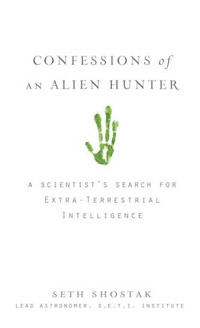
Confessions of an Alien Hunter (cover)

I’m a big fan of SETI (Search for Extra-Terrestrial Intellience) and I think their search program constitutes the best chance we have of making contact. In fact, on a recent Saturday I was rained out of my normal 4-hour bike ride, so I read SETI scientist Seth Shostak’s new book, Confessions of An Alien Hunter (published by National Geographic), a brilliant and fun read. Seth has a fantastic sense of humor and in his book he presents some of great one-liners to use when dealing with UFOlogists, alien abductees, and the saucerites. For example:

Regarding the time it would take to traverse the vast distances between the stars, which would be millions of years (it will take Voyager II 300,000 years to reach a nearby star), Shostak notes: “That’s a long time to be squirming in a coach seat.”

As for the lack of tangible evidence for UFOs: “Physical evidence — a taillight or knob from an alien craft — is in short supply.”

UFOlogists claim that they have tens of thousands of UFO sightings, as if this is a good thing, but Shostak notes that this actually argues against UFOs being ET, because to date not one of these tens of thousands of sightings has materialized into concrete evidence that UFOs = ETIs. It’s counterintuitive, but more sightings equals less certainty because with so many saucers zipping around we would have captured one by now, and we haven’t.

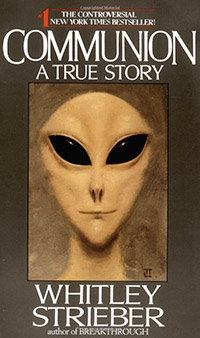
Communion - A True Story (cover)

Shostak notes that crop circles are a very poor means of communication because they represent only a few hundred bits of information, 1,679 bits in the most complex crop circle to date, which is less than a paragraph of text! If ETIs are advanced enough for interstellar space travel, why resort to using wheat fields, which are only ripe a couple of months a year, and then the crop-circle communication is quickly mowed down by angry farmers!

As for alien abductees, Shostak points out that Whitley Strieber’s book, Communion, launched the modern alien abduction movement. And guess what Strieber does for a living? He is a SciFi/fantasy/horror writer! Actually, I knew this already because I met Strieber in the green room at Bill Maher’s ABC show, Politically Incorrect, and Whitley and I were chatting it up over coffee and granola bars in the green room before the show when I asked him what he did when he wasn’t writing about being abducted by aliens. He told me that he writes science fiction, fantasy, and horror novels. The show was over right there in the green room! What else is there to say to a guy who writes this stuff as fiction, then slaps a “nonfiction” label on the book jacket?

topics: , , , ,
Comments Off on How to Talk to a UFOlogist (if you must)

Homo religious

August 18, 2009

Did humans evolve to be religious and believe in God? In the most general sense, yes we did. Here’s what happened.

Long long ago, in an environment far far away from the modern world, humans evolved to find meaningful causal patterns in nature to make sense of the world, and infuse many of those patterns with intentional agency, some of which became animistic spirits and powerful gods. And as a social primate species we also evolved social organizations designed to promote group cohesiveness and enforce moral rules.

People believe in God because we are pattern-seeking primates. We connect A to B to C, and often A really is connected to B, and B really is connected to C. This is called association learning. But we do not have a false-pattern-detection device in our brains to help us discriminate between true and false patterns, and so we make errors in our thinking: a Type I error is believing a pattern is real when it is not (a false positive) and a Type II error is not believing a pattern is real when it is (a false negative). Imagine that you are a hominid on the planes of Africa and you hear a rustle in the grass. Is it a dangerous predator or just the wind? If you assume it is a dangerous predator and it is just the wind, you have made a Type I error, but to no harm. But if you believe the rustle in the grass is just the wind when it is a dangerous predator, there’s a good chance you’ll be lunch and thereby removed from your species’ gene pool. Thus, there would have been a natural selection for those hominids who tended to believe that all patterns are real and potentially dangerous. I call this process patternicity (the tendency to find meaningful patterns in random noise) and agenticity (the tendency to believe that the world is controlled by invisible intentional agents who may mean us harm). This, I believe, is the basis for the belief in souls, spirits, ghosts, gods, demons, angels, aliens, intelligent designers, government conspiracists, and all manner of invisible agents intending to harm us or help us.

People are religious because we are social and we need to get along. The moral sentiments in humans and moral principles in human groups evolved primarily through the force of natural selection operating on individuals and secondarily through the force of group selection operating on populations. The moral sense (the psychological feeling of doing “good” in the form of positive emotions such as righteousness and pride) evolved out of behaviors that were selected for because they were good either for the individual or for the group; an immoral sense (the psychological feeling of doing “bad” in the form of negative emotions such as guilt and shame) evolved out of behaviors that were selected for because they were bad either for the individual or for the group. While cultures may differ on what behaviors are defined as good or bad, the moral sense of feeling good or feeling bad about behavior X (whatever X may be) is an evolved human universal. The codification of moral principles out of the psychology of the moral sentiments evolved as a form of social control to insure the survival of individuals within groups and the survival of human groups themselves. Religion was the first social institution to canonize moral principles, and God as an explanatory pattern for the world took on new powers as the ultimate enforcer of the rules.

Thus it is that people are religious and believe in God.

• FOLLOW MICHAEL SHERMER ON TWITTER

topics: , , , , , , , , ,
Comments Off on Homo religious

The Natural and the Supernatural

August 11, 2009

Cartoonist Sidney Harris once illustrated two scientists at a chalkboard. One has written, among mathematical equations, “Then a miracle occurs,” to which his colleague replies, “I think you need to be more specific here in step two.” This nicely sums up the relationship between science and religion: one deals in the natural while the other deals in the supernatural. And never the twain shall meet.

Were only it were so. Unfortunately, religions routinely make claims about the natural world that are in direct conflict with the scientific evidence. Young-Earth Creationists, for example, believe that the world was created around 6,000 years ago, about the same time that the Babylonians invented beer. These claims cannot both be correct, and anyone who thinks the former is right has relegated all of science (along with brains) to the dumpster of life. Many people of faith believe that prayer can cajole the deity into taking action in our world to do everything from healing cancers to winning wars. Yet a comprehensive controlled scientific study on the efficacy of prayer on healing, funded by the religiously-based Templeton Foundation and conducted at the prestigious Harvard Medical School, found no relationship between the two: subjects in the non-prayed for group did just as well (or poor) as those in the prayed for group. And why is it, scientists want to know, that prayer only seems effective for things that might have happened anyway, such as tumors going into remission. A more dramatic and unmistakably religious miracle that would shock even the most skeptical of scientists would be if prayers for amputees (especially our brave wounded Christian soldiers returning from Iraq and Afghanistan) resulted in renewed whole limbs; i.e., a true miracle.

How, then, can we reconcile the natural and the supernatural? Most people keep them separated in logic-tight compartments, even scientists. Surveys conducted in 1916 and again in 1997 found that 40 percent of American scientists said they believe in God. As well, hundreds of millions of practicing Protestants, Catholics, Jews, and members of other faiths both believe in God and fully embrace science, even evolution: a 2005 Pew Research Center poll found that 68 percent of Protestants and 69 percent of Catholics accept the theory. So, demographically speaking, most people find no conflict between science and religion.

However, the natural world does not bend to the demographics of belief. Millions of people also believe in astrology, ghosts, angels, ESP, and all manner of paranormal piffle, but that does not make them real. The veracity of a proposition is independent of the number of people who believe it.

In conclusion, I go so far as to conclude: There is no such thing as the supernatural or the paranormal. There is only the natural, the normal, and mysteries we have yet to explain. God is a mystery, and the God of Abraham may very well be an eternal mystery for the simple reason that any God explicable through science and the laws of nature would, by definition, lose the status of supernatural and enter the realm of the natural. A God definable by science is not a God at all.

• FOLLOW MICHAEL SHERMER ON TWITTER

topics: , , , , ,
Comments Off on The Natural and the Supernatural

Does Belief Help Us to Survive?

August 10, 2009

I don’t think religious beliefs are different from any other kind of beliefs: political attitudes, commitments to political parties, or economic ideologies, for example. These are all forms of belief. I think at the base of it is this whole idea that we’re pattern-seeking primates. We connect the dots — A connects to B connects to C — and often, they really are connected, and that’s called associative learning. All animals do it. It’s a biological imperative; we grow new synaptic connections when we learn something.

The problem is that there’s no baloney detection module in the brain that says, “That’s a true pattern; that’s a false pattern” with some consistent algorithm that helps us discriminate those. We tend to assume all patterns are real and that they’re infused with intentional agency. And that’s where I think the belief in spirits and ghosts and souls and gods and God and conspiracy theories and so forth comes in. (continue reading…)

topics: , , , , , , , , , ,
read or write comments about this blog (17)

Mixing Science and Politics (and Economics)

July 28, 2009

So many of you have taken the time to respond to my blogs thoughtfully that I feel I should comment in kind. In looking through the many comments, however, I see that most of what I would say has already been said by people who responded to my critics. Nevertheless…

First of all, why is it okay to mix science and religion (with atheists eagerly do in debunking religious claims) but not okay to mix science and politics/economics? Why is it okay for liberal atheists to stick it to religious believers and twist the knife slowly, but when it comes to getting your own (political/economic) beliefs challenged, that’s off limits — NOMA (nonoverlapping magisterial) for science and politics? I don’t see how they are different in principle. Skeptic is a science magazine, not an “atheist” magazine; nevertheless, we routinely deal with religious claims and no one ever complains about that. The closest we have come to political/economic issues is environmentalism (Vol. 9, No. 2 — sold out), overpopulation (Vol. 5, No. 1), and global warming Vol. 14, No. 1). For all three we published several articles; in Vol. 14, No. 1, for example, we published articles both skeptical of global warming and accepting of global warming. So I don’t see what would be wrong with publishing articles pro, con, and neutral on political and economic claims.

One person wrote me a private email that said he thought of me as the next Carl Sagan, but now that I’ve gone to the dark side (turning Right, although I’m as critical of the Right as I am the Left), because Carl was “apolitical.” Carl Sagan was many things, but apolitical was not one of them. Carl was a Liberal and proudly wore his politics on his sleeve, such as when he marched in protest at nuclear sites or testified before Congress about the dangers of nuclear winter. I admire him for having the courage of his convictions, which intimately blended his science and (Left) politics. If you think Sagan was apolitical it is because you happen to agree with his politics and so those ideas seem simply correct, not political. If you don’t share his politics (I share about half of them), then it’s obvious that Sagan was not apolitical.

The liberal bias in the skeptical community was identified by many people in the comments section of my blog, for example by “DR,” “James,” and “Devil’s Advocate”:

… Sadly, there is a lot of hatred toward libertarianism at JREF [he means TAM]. I can be an atheist, believe gay marriage is ok, think nothing of smoking pot, and I won’t get half as much grief from a conservative that I do from an American liberal who reels and squirms when I say that the welfare state is immoral or that free trade and voluntary transactions in capitalism promote fair and just outcomes. It’s like the only reason why I have rationalized this set of morality is because I’m a supremely evil person and must be wrong… —DR

… I’m disappointed, but not surprised by the large group of liberal skeptics. I’ve talked to too many Democrat-card-carrying skeptics that spout the same unoriginal, canned rhetoric and continual spewing hatred of Republicans. For a group that supposedly supports tolerance, they’re anything but tolerant …
—James

I’ve three times over twenty years joined local skeptic groups and all three times there was a presumption that if I was a skeptic, then of course I’m also liberal in my politics. Two times I tried to be what I am but was marginalized, treated like a Goldwater (or Reagan, or Bush) mole. The third time I tried to avoid political discussion, but it was not possible, so, unwilling to lie, I left. My refusal to come over to pure liberalism clearly wasn’t going to be tolerated. All I wanted to do was examine UFO claims and crop circles, but… —Devil’s Advocate

Another critic named John D. Draeger makes a good point that I wish to acknowledge: “He [me] does NOT believe that political persuasions and different economic models for how societies should be run are moral value judgements…. Social services can be paid for in different ways, and in a democratic society it’s up to the majority to define how that is done. Social services can be paid for in different ways, and in a democratic society it’s up to the majority to define how that is done.” That’s true, in a democracy the majority rules how to divvy up public funds for social services, and that tends to be more of a value judgment than a science. But as someone else wrote just below that, quite cleverly I think…

First of all, democratic societies can still be evil, as the famous saying goes: “democracy is two wolves and one lamb voting on what to have for lunch.” And then in another famous quote (attributed to several), “A democracy cannot exist as a permanent form of government. It can only exist until the voters discover that they can vote themselves largesse from the public treasury. From that moment on, the majority always votes for the candidates promising the most benefits from the public treasury with the result that a democracy always collapses over loose fiscal policy, always followed by a dictatorship. Thus our founding fathers gave us a republic … if we can keep it.

Even this is a value judgment, I agree, but surely we can apply some forms of social science to inform our value judgments. For example, we may as a society make the value judgment that it would be good if every child received a basic K–12 education. I agree with this value judgment, and would add to it the value judgment that it would be equally important for every child to have a computer and Internet access because that is the future of education. So we share that value judgment. However, the next question is a pragmatic one: who is going to pay for this education (and computers/Internet)? Parents? Churches? NGOs? Charities? Government? If the latter — the value judgment we have made — then do parents get to choose among the various government schools of where to send their children? (No.) Do parents who choose to send their children to private schools have to also pay for government schools? (Yes.) Is that fair? You make that value judgment. I don’t think that it is fair. To be consistent, if you are pro-choice on abortion you should also be pro-choice on education. The deeper value judgment here is being pro-choice about everything. Choice = freedom.

Some correspondents hated the political diagram because it seems to elevate libertarianism above the traditional left-right spectrum. Okay, then you come up with something other than the left-right linear spectrum to visualize where someone would fall on that line who is socially liberal and fiscally conservative. You draw it and I’ll publish it in a future blog.

Some people hate the word “libertarian.” I’m not crazy about it either, but haven’t thought of a better label. Labels are useful because they enable people to take cognitive shortcuts, but they also lead to shortcuts to nuanced thinking about what someone believes. “Oh, you’re one of those…” full stop. We all do this, of course, but I call myself a libertarian for the same reason I call myself a feminist, an atheist, and a pro-choicer — because it is the accepted language and we have to communicate ideas with language. But I much prefer to be assessed on specific issues.

Several of you said that I am a victim of one of my own central tenets of baloney detection: the confirmation bias, where we look for and find confirmatory evidence for what we already believe and ignore the disconfirmatory evidence. Yes, I will admit, I do this. Everyone does, and we must guard against it, especially when it comes to religion, politics, and economics. To combat this problem, I read the conservative Wall Street Journal and the liberal Los Angeles Times. I listen to such conservative talk radio hosts as Hugh Hewitt and Dennis Praeger as well as the very liberal Bill Maher. I have read Karl Marx’s books as deeply and carefully as I have read Adam Smith’s books. I have read a host of books from liberal and conservative and libertarian authors on the current economic meltdown. And although I have a few libertarian and conservative friends, because I work in the sciences and in publishing, the vast majority of my friends, acquaintances, staff, co-workers, and colleagues are liberals who I can assure you are never shy about letting me know where they think I’ve gone off the political or economic rails.

Finally, let me add that one of the appealing things to me about the libertarian worldview is that it is optimistic, uplifting, and most importantly (to me) anti-elitist. I’m in favor of doing whatever we can to allow the little guy to succeed and to break up power blocs that prevent the average Joe or Jane from reaching their full potential. The Constitutional divisions of power in our Democracy — emulated by many others around the world — are a huge improvement from centuries past that allowed or enabled some to succeed at the expense of others. That was a zero-sum world. Over the past 200 years the spread of democracy and capitalism has done more toward achieving a Nonzero world than anything else — more people in more places more of the time have more power and liberty and wealth than any time in the previous four millennium. Therefore, the more we can spread democracy and capitalism the better off more of us will be more of the time.

• FOLLOW MICHAEL SHERMER ON TWITTER

topics: , , , , , , , ,
Comments Off on Mixing Science and Politics (and Economics)
PREVIOUS
 
NEXT