Science reveals humanity’s heart of darkness
In 1670 English poet John Dryden penned this expression of humans in a state of nature: “I am as free as Nature first made man … /When wild in woods the noble savage ran.” A century later, in 1755, French philosopher Jean-Jacques Rousseau canonized the noble savage in Western culture by proclaiming that “nothing can be more gentle than he in his primitive state, when placed by nature at an equal distance from the stupidity of brutes and the pernicious good sense of civilized man.”
From the Disneyfication of Pocahontas to Kevin Costner’s eco-pacifist Native Americans in Dances with Wolves and from postmodern accusations of corruptive modernity to modern anthropological theories that indigenous people’s wars are just ritualized games, the noble savage remains one of the last epic creation myths of our time. Science reveals a rather different picture of humanity in its natural state. In a 1996 study University of Michigan ecologist Bobbi S. Low analyzed 186 preindustrial societies and discovered that their relatively low environmental impact is the result of low population density, inefficient technology and lack of profitable markets, not conscious efforts at conservation. Anthropologist Shepard Krech III, in his 1999 book The Ecological Indian, shows that in a number of Native American communities, large-scale irrigation practices led to the collapse of their societies. (continue reading…)
Comments Off on The Ignoble Savage
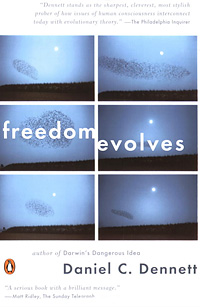
A review of Daniel C. Dennett’s Freedom Evolves.
Next to the question of God’s existence there is arguably no greater conundrum in Western thought than the problem of free will and determinism, and the two are inextricably interdigitated. God’s omniscience and (continue reading…)
read or write comments (8)
The Three Laws of Cloning will protect clones and advance science
In his 1950 science-fiction novel I, Robot, Isaac Asimov presented the Three Laws of Robotics: “1. A robot may not injure a human being, or, through inaction, allow a human being to come to harm. 2. A robot must obey the orders given it by human beings except where such orders would conflict with the First Law. 3. A robot must protect its own existence as long as such protection does not conflict with the First or Second Law.”
The irrational fears people express today about cloning parallel those surrounding robotics half a century ago. So I would like to propose Three Laws of Cloning that also clarify three misunderstandings: 1. A human clone is a human being no less unique in his or her personhood than an identical twin. 2. A human clone has all the rights and privileges that accompany this legal and moral status. 3. A human clone is to be accorded the dignity and respect due any member of our species.
Although such simplifications risk erasing the rich nuances found in ethical debates over pioneering research, they do aid in attenuating risible fears often associated with such advances. It appears that the Raelians have not succeeded in Xeroxing themselves, but it is clear that someone, somewhere, sometime soon is going to generate a human clone. And once one team has succeeded, it will be Katy bar the door for others to bring on the clones. (continue reading…)
Comments Off on I, Clone
The voice of the people reveals why
evolution remains controversial

There is no more contentious subject in science today than evolution. This fact was brought to light for me in the overwhelming response to my February column on evolution and “intelligent design” creationism. I typically receive about a dozen letters a month, but for this one no less than 134 were submitted (117 men, four women and 13 whose identity was not revealed). I found reading the critical letters mildly disconcerting until I hit on the idea that these are a form of data to be mined for additional information on what people believe and why. Conducting a content analysis of all 134 letters, I discovered patterns within the cacophonous chaos. First I read them quickly and then separated them into about two dozen one-line categories that summed up the reader’s main point. I next condensed these into six taxonomic classes and reread all the letters carefully, placing each into one or more of the six (for a total of 163). (continue reading…)
read or write comments (10)
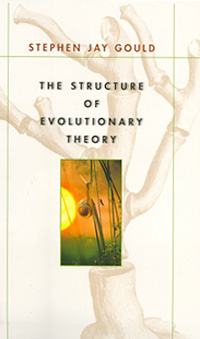
A review of Stephen Jay Gould’s The Structure of Evolutionary Theory.
We live in the Age of Science. Scientism is our worldview, our mythic story about who we are, where we came from, and where we are going. As such, scientists are our preeminent storytellers, the mythmakers of our epoch. (continue reading…)
Comments Off on Darwin’s Duomo and Gould’s Pinnacle