The advance of science, not the demotion of religion, will best counter the influence of creationism
In one of the most existentially penetrating statements ever made by a scientist, Richard Dawkins concluded that “the universe we observe has precisely the properties we should expect if there is, at bottom, no design, no purpose, no evil and no good, nothing but blind, pitiless indifference.”
Facing such a reality, perhaps we should not be surprised at the results of a 2001 Gallup poll confirming that 45 percent of Americans believe “God created human beings pretty much in their present form at one time within the last 10,000 years or so”; 37 percent prefer a blended belief that “human beings have developed over millions of years from less advanced forms of life, but God guided this process”; and a paltry 12 percent accept the standard scientific theory that “human beings have developed over millions of years from less advanced forms of life, but God had no part in this process.” (continue reading…)
read or write comments (2)
To the Citizens of Kansas (along with those from Ohio, Georgia, Michigan, and a dozen other states contemplating the teaching of “Intelligent Design” creationism as a “balance” to the theory of evolution in public school science classes), I present you with a small literary sampling of how the opening chapters of Genesis will have to be revised to accommodate modern scientific theories and data. I call it Genesis Revisited.
In the beginning — specifically on October 23, 4004 B.C., at noon — out of quantum foam fluctuation God created the Big Bang. The bang was followed by cosmological inflation. God saw that the Big Bang was very big, too big for creatures that could worship him, so He created the earth. And darkness was upon the face of the deep, so He commanded hydrogen atoms (which He created out of Quarks and other subatomic goodies) to fuse and become helium atoms and in the process release energy in the form of light. And the light maker he called the sun, and the process He called fusion. And He saw the light was good because now He could see what he was doing. And the evening and the morning were the first day. (continue reading…)
read or write comments (35)
Those three words often separate the scientific pros from the posers
My friend James Randi speculates — with only partial facetiousness — that when one receives a Ph.D., a chemical secreted from the diploma parchment enters the brain and prevents the recipient from ever again saying “I don’t know” and “I was wrong.” As one counterexample I hereby confess that in my column on Chinese science in the July issue I was wrong in my conversion of Chinese yuan as 80 to the dollar (it is eight).
More serious was a statement I made in the June issue about a Fox television program claiming that the moon landing was faked. I said that the lunar lander rocket showed no exhaust because there is no oxygen-rich atmosphere on the moon. I was partially wrong. The lack of an atmosphere plays a minor role; the main reason is that the lander’s engine used hypergolic propellants that burn very cleanly. In both instances, readers were kind enough to provide constructive criticism. (continue reading…)
read or write comments (3)
Seventy-five years ago this month legal and intellectual titans collided in Dayton, Tennessee to begin what would go down in history as the “trial of the century.” Fundamentalist orator and three-time Presidential candidate William Jennings Bryan squared off with defense attorney par excellence Clarence Darrow, over whether high school teacher John T. Scopes had violated the law when he taught his students that they had descended from a common ancestor with modern apes millions of years ago.
Scopes, Bryan charged, was in violation of the 1925 Butler Act that made it “unlawful for any teacher in any of the Universities, Normals and all other public schools of the state … to teach any theory that denies the story of the Divine Creation of man as taught in the Bible, and to teach instead that man has descended from a lower order of animals.” After days of legal wrangling in the sweltering July heat in this, the first trial ever broadcast on radio and covered by every major newspaper in the land, Scopes was found guilty and fined $100 because, of course, he had broken the law. (continue reading…)
read or write comments (2)
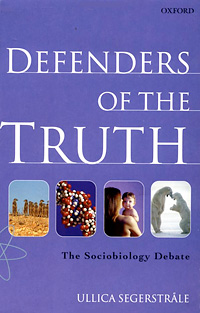
A review of three books: Ullica Segerstråle’s Defenders of the Truth, Robin Marantz Henig’s The Monk in the Garden, and Jeffrey K. McKee’s The Riddled Chain.
Creationism, in some form, will probably be with us as long as biblical fundamentalists continue their misguided efforts to squeeze the square peg of religion into the round hole of science. But the debate over whether evolution happened was (continue reading…)
read or write comments (1)