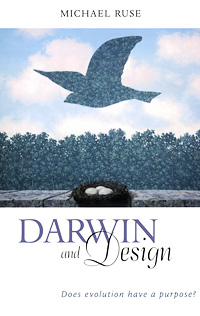
A review of Michael Ruse’s Darwin and Design: Does Evolution have a Purpose?.
Psalms 19:1 declares: “The heavens declare the glory of God; and the firmament showeth his handiwork.” The divine design inference is not confined to the ancient Hebrews. (continue reading…)
read or write comments (7)
At 7:00 pm on a balmy Southern California evening, April 29, 2004, I entered the Physical Sciences Lecture Hall on the campus of the University of California, Irvine, to a jammed house of over 500 people chock-a-block jammed into a 400-seat venue. I was there at the behest of Pastor Jason of the OMC Youth, a campus Christian organization, to debate Kent Hovind, Young Earth Creationist and Defender of the Faith, on: “Creation vs. Evolution. Creation (supernatural action) or Evolution (natural processes) — which is the better explanation?” (continue reading…)
read or write comments (16)
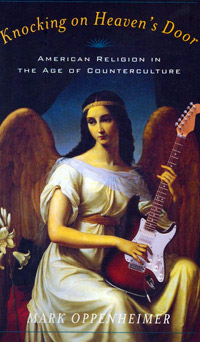
The following book review of Mark Oppenheimer’s Knocking on Heaven’s Door: American Religion in the Age of Counterculture (Yale University Press, 2003), (originally published in the Los Angeles Times) ran in the Los Angeles Times Book Review (4/1/04). I used the book review to further support the group selection thesis proffered by David Sloan Wilson in his book Darwin’s Cathedral, as well as my own analysis in The Science of Good and Evil, to explain the success of religion. It was published as Countering the Counterculture. My original title better describes my thesis and what the book is about. But it is an unalterable law of nature that all book review and opinion editorial editors must change the author’s original title or else they will go to editorial hades.
In April, 1993, in his address to the Pontifical Biblical Commission, Pope John Paul II acquitted Galileo for his heretical belief that the earth goes around the sun, explaining that “the theologian must keep informed about the results (continue reading…)
read or write comments (3)
A new book reexamines the mutiny on the Bounty, but science offers a deeper account of its cause
The most common explanation for the Bounty mutiny pits a humane Fletcher Christian against an oppressive William Bligh. In her 2003 revisionist book, The Bounty, Caroline Alexander recasts Bligh as hero and Christian as coward. After 400 pages of gripping narrative, Alexander hints that the mutiny might have involved “the seductions of Tahiti” and “Bligh’s harsh tongue” but concludes that it was “a night of drinking and a proud man’s pride, a low moment on one gray dawn, a momentary and fatal slip in a gentleman’s code of discipline.”
A skeptic’s explanation may seem less romantic, but it is more intellectually satisfying because it is extrapolated from scientific evidence and reasoning. There are, in fact, two levels of causality to consider: proximate (immediate historical events) and ultimate (deeper evolutionary motives). Both played a role in the Bounty debacle. (continue reading…)
Comments Off on A Bounty of Science
Science reveals a way to rise above our natures
Evolutionary biologist Jared Diamond of the University of California at Los Angeles once classified humans as the “third chimpanzee” (the second being the bonobo). Genetically, we are very similar, and when it comes to high levels of aggression between members of two different groups, as I noted in last month’s column on “The Ignoble Savage,” we also resemble chimpanzees. Although humans have a brutal history, there’s hope that the pessimists who forecast our eventual demise are wrong: recent evidence indicates that, like bonobos, we may be evolving in a more peaceful direction.
One of the most striking features in artificially selecting for docility among wild animals is that, along with far less aggression, you also get a suite of other changes, including a reduction in skull, jaw and tooth size. In genetics, this is called pleiotropy. Selecting for one trait may generate additional, unintended changes. (continue reading…)
Comments Off on The Domesticated Savage