April 14, 2002
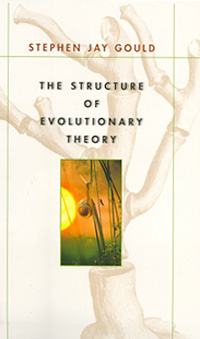
A review of Stephen Jay Gould’s The Structure of Evolutionary Theory.
We live in the Age of Science. Scientism is our worldview, our mythic story about who we are, where we came from, and where we are going. As such, scientists are our preeminent storytellers, the mythmakers of our epoch. (continue reading…)
Comments Off on Darwin’s Duomo and Gould’s Pinnacle
December 1, 2001
To the Citizens of Kansas (along with those from Ohio, Georgia, Michigan, and a dozen other states contemplating the teaching of “Intelligent Design” creationism as a “balance” to the theory of evolution in public school science classes), I present you with a small literary sampling of how the opening chapters of Genesis will have to be revised to accommodate modern scientific theories and data. I call it Genesis Revisited.
In the beginning — specifically on October 23, 4004 B.C., at noon — out of quantum foam fluctuation God created the Big Bang. The bang was followed by cosmological inflation. God saw that the Big Bang was very big, too big for creatures that could worship him, so He created the earth. And darkness was upon the face of the deep, so He commanded hydrogen atoms (which He created out of Quarks and other subatomic goodies) to fuse and become helium atoms and in the process release energy in the form of light. And the light maker he called the sun, and the process He called fusion. And He saw the light was good because now He could see what he was doing. And the evening and the morning were the first day. (continue reading…)
read or write comments about this blog (35)
July 6, 2001
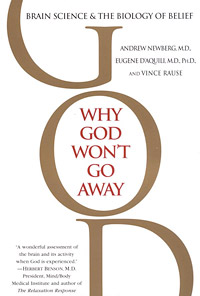
A review of Andrew Newberg, Eugene D’Aquili, and Vince Rause’s Why God Won’t Go Away: Brain Science and the Biology of Belief.
About ten years ago I began research on the question of why people believe in God, I asked a colleague in a religious studies program to recommend the latest path-breaking scientific work in this area. (continue reading…)
read or write comments about this blog (31)
January 31, 2001
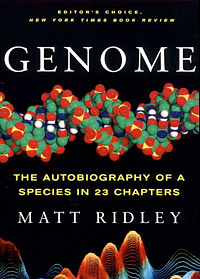
A review of Matt Ridley’s Genome: the Autobiography of a Species in 23 Chapters.
We are at a unique confluence of science and publishing where the results of the former are being dispersed by the latter at such a rate that even the most ardent reader of popular science books can hardly keep up. This is good news for science, of course, since its products are outstripping even Moore’s law of doubling every eighteen months, so updates and revisions are called for just as frequently. Lucky for publishers that readers are willing and able to plunk down a quarter of a hundred bucks to discover the secrets of the cosmos and life, and literary agents specializing in science tomes are demanding — and getting — five- and six-figure advances for their clients. And by most counts publishers are earning out those advances in a matter of months, thereby closing indefinitely the gap between C.P. Snow’s two cultures. (continue reading…)
read or write comments about this blof (1)
January 4, 2001
Whatever your religion or faith (or even lack thereof), there is no doubt that the Bible is a font of wisdom from which we may draw moral homilies. My personal favorite is from the wisdom book of Proverbs, in which Solomon warns those who would look outside themselves to assess blame for their own shortcomings: “He that troubleth his own house shall inherit the wind; and the fool shall be servant to the wise of heart.”
As a long-time public defender of modern scientific medicine, I have commonly labeled medical scientists as wise of mind, and alternative medical practitioners as fools. The wind of quackery we have inherited, I reasoned, is surely the result of an uneducated public duped by the otherwise risible tactics of flimflam artists praying on the unsuspecting masses. I am no longer sure that this is the source of the headlong rush toward these New Age medical alternatives. “The fault,” Shakespeare correctly identified in another context, “is not in our stars, but in ourselves.” (continue reading…)
read or write comments about this blog (4)