June 1, 2003
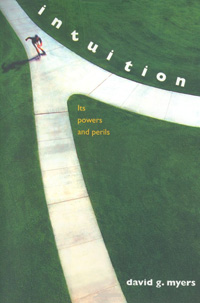
A review of David G. Myers’ Intuition: It’s Powers and Perils.
Imagine yourself a contestant on the classic television game show Let’s Make a Deal. You must choose one of three doors, behind one of which is a brand new automobile (while the other two harbor goats). You choose door number one. Host Monty Hall, who knows what is behind all the doors, shows you what’s behind door number two, a goat, then inquires: would you like keep the door you chose or switch? It’s 50/50 so it doesn’t matter, right? (continue reading…)
read or write comments about this blog (7)
April 4, 2003
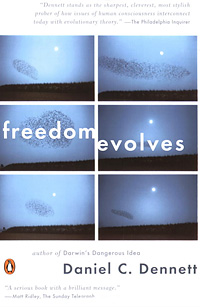
A review of Daniel C. Dennett’s Freedom Evolves.
Next to the question of God’s existence there is arguably no greater conundrum in Western thought than the problem of free will and determinism, and the two are inextricably interdigitated. God’s omniscience and (continue reading…)
read or write comments about this blog (8)
April 1, 2003
Today President George W. Bush announced the government’s plan to implement a smallpox vaccination program within weeks, starting with half a million military personnel and another half million health care and emergency workers, then expanding the program by the end of next year to offer immunization to the entire American public. Officials estimate that at least 10 million doses will need to be created just to handle all public and private health, medical, police, fire, and emergency personnel. Tens of millions more doses would have to be generated if a majority of the public volunteers for the program. (continue reading…)
read or write comments about this blog (3)
August 1, 2002
Stephen Jay Gould as Historian of Science and Scientific Historian, Popular Scientist and Scientific Popularizer
This article appeared in Social Studies of Science 32/4 (August 2002).
Abstract
Science historian Ronald Numbers once remarked that the two most influential historians of science of the 20th century were Thomas Kuhn and Stephen Jay Gould. All historians are deeply familiar with Kuhn’s work and influence, and most know of the remarkable impact Gould has had on evolutionary theory through both his professional and popular works. But little attention has been paid to the depth, scope, and importance of Gould’s role as historian and philosopher of science, and his use of popular science exposition to reinforce old knowledge and generate new. This paper presents the results of an extensive quantitative content analysis of Gould’s 22 books, 101 book reviews, 479 scientific papers, and 300 Natural History essays, in terms of their subject matter (Evolutionary Theory, History and Philosophy of Science, Natural History, Paleontology/Geology, Social Science/Commentary), and thematic dichotomies (Theory–Data, Time’s Arrow–Time’s Cycle, Adaptationism–Nonadaptationism, Punctuationism-Gradualism, Contingency–Necessity). Special emphasis is placed on the interaction between the subjects and themata, how Gould has used the history of science to reinforce his evolutionary theory (and vice versa), and how his philosophy of science has influenced both his evolutionary theory and his historiography. That philosophy can best be summed up in a quotation from Charles Darwin, frequently cited by Gould: ‘All observation must be for or against some view if it is to be of any service’. Gould followed Darwin’s advice throughout his career, including his extensive writings on the history and philosophy of science. (continue reading…)
Comments Off on This View of Science
May 1, 2002
In 1959 astronomers were polled for their opinion on the then undecided debate between two competing cosmological theories. “Did the universe begin with a Big Bang several thousand million years ago?” A third answered yes. “Is matter continuously created in space?” Almost half answered yes. Most telling, to the question “Is a poll of this kind helpful to scientific progress?” all answered no.
The reason for this unanimity is that scientific questions are not settled by consensus opinion. Unfortunately, in complex human and social issues, separating fact from opinion is not so easy, and for no issue is this more apparent than abortion. Setting aside the emotionally charged moral and political aspects of abortion for a moment, how can science inform this debate? (continue reading…)
read or write comments about this blog (16)