February 1, 2008
A torrid tale of quackbusting in 1920s America
sheds light on modern medical scares
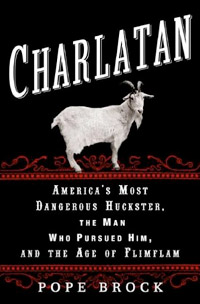
A review of Pope Brock’s Charlatan. America’s Most Dangerous Huckster, the Man Who Pursued Him, and the Age of Flimflam.
Human cognition has a problem — anecdotal thinking comes naturally whereas scientific thinking does not. The recent medical controversy over whether vaccinations cause autism illustrates this barrier. On the one side are scientists who have been unable to find any causal link between the symptoms of autism and the vaccine’s ingredients. On the other are parents who noticed that shortly after having their children vaccinated autistic symptoms appeared. (continue reading…)
read or write comments about this blog (4)
January 29, 2008
The new science of evolutionary economics offers an explanation for capitalism skepticism
In his magnum opus on the power of free markets, Human Action, the Austrian economist Ludwig von Mises noted: “The truth is that capitalism has not only multiplied population figures but at the same time improved the people’s standard of living in an unprecedented way. Neither economic thinking nor historical experience suggest that any other social system could be as beneficial to the masses as capitalism. The results speak for themselves. The market economy needs no apologists and propagandists. It can apply to itself the words of Sir Christopher Wren’s epitaph in St. Paul’s: Si monumentum requires, circumspice.” If you seek his monument, look around. (continue reading…)
read or write comments about this blog (144)
January 23, 2008
The new science of neuroeconomics offers
new insights into old political problems
The 19th-century French economist Frederic Bastiat expressed a principle applicable in the 21st century: “Where goods do not cross frontiers, armies will.”
In my new book, The Mind of the Market, I describe in detail how in the modern world of nation states, economic sanctions are among the first steps taken by one nation against another when political diplomacy fails, as when the United States enforced them on Japan after its invasion of China in the 1930s, and these became a prelude (among other factors) to Japan’s retaliatory bombing of Pearl Harbor in 1941 and our involvement in the greatest war in history. More recently, economic sanctions were imposed by the U.S. and Japan on India following its 1998 nuclear tests, and more recently by the U.S. on Cuba, Iran, and North Korea. (continue reading…)
read or write comments about this blog (5)
January 21, 2008
Two new sciences shed light on an old problem of financial risk
With the stock market off to its worst first week of the year in history, investors are scrambling to decide whether or not to get out of the market. In my new book, The Mind of the Market, I describe the problem this way: our decisions about buying or selling things we value are heavily weighted by three psychological phenomena: the endowment effect, the sunk cost fallacy, and loss aversion. Understanding these will help you decide what to do with your investments. (continue reading…)
read or write comments about this blog (7)
January 14, 2008
The new science of evolutionary economics explains why some candidates, like some products, get ahead in the marketplace
As the presidential candidates bounce from primary to primary, with some surging and others falling back, it is appropriate to ask if there is something going on here more than simply political preferences and perceived positions on issues. There is. In my latest book, The Mind of the Market, I discuss a phenomenon called the Matthew Effect. It is a disturbing disruption of what we think of as democratic fairness. Here’s how it works. (continue reading…)
read or write comments about this blog (4)