
The official site of bestselling author Michael Shermer The official site of bestselling author Michael Shermer

Tag Results

Left, Right & Center

Liberals, Conservatives & Libertarians

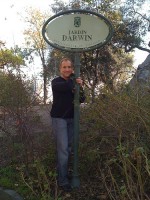
In last week’s post I mentioned my trip to Santiago, Chile, for a conference on evolutionary economics hosted by Alvaro Fischer, in conjunction with the year-long series of celebrations of Darwin’s 200th birthday.

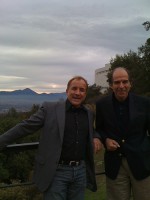
The three main speakers at the conference were Ullrich Witt, a liberal economist from the Max Planck Institute in Jena, Germany (part of the old Iron Curtain East Germany), Kevin McCabe, a conservative economist from George Mason University, known for its free market leanings (unlike most universities and colleges in America), and myself, a “radical for liberty” (pace Ayn Rand’s self-description as a “radical for capitalism”). Our talks were formal, professional, and technical, but the lively action was in the table talk over meals. I very much enjoyed hearing the opinions of these learned economists, even while vehemently disagreeing (mainly with Witt). Since McCabe and I mostly agreed on everything, I’ll briefly summarize Witt’s lecture, which I think explains how he and I differ on the issue of the collective v. the individual.

Witt’s Lecture

Ullrich Witt’s talk was entitled “Animal Instincts and Human Sentiments: On the Origin and Evolution of Economic Institutions.” What is an institution? Do institutions have something in common? How similar/different are the post office, the government, or the law? Does a Darwinian perspective help us understand the origin and evolution of institutions? Yes. Proto institutions arose in early hominids: instinct based and subject to natural selection and adapted to the environment. How do we know? No fossils! Observe higher animals to infer what most likely developed in early hominid bands.

For example, hunting requires cooperation, and many mammals employ joint chasing tactics (conventions), have a set of rules about feeding dominance/subordination, show rules for food sharing, and the like, and these are all examples of proto institutions (genetically fixed, shaped by natural selection, adapted to survival conditions similar to those of early hominids).

The scope of cooperation in social situations is constrained by social structures. Proto institutions in proto humans probably began with coordinating hunts, uniting to fight against rival clans, etc. Observational learning is a way of transmitting knowledge and cultural adaptations in interactions and these proto-institutions. Genetically based forms of proto-institutions emerged in human evolution to ease the coordination (when conflict is absent) through recognizing self in others as well as the intentionality of others.

Cultural success accrued to populations when we needed to settle down and make the transition to agriculture. It was here, during the Neolithic Revolution, that informal institutes spontaneously emerged from our genetic architecture for cooperation. Formal institutions must be purposely created for the coordination of behavior in interactions. Natural domination leads to proto institutions as a way of preventing others from contesting domination (thereby preserving the domination rent from competition).

Thomas Hobbes’ “Leviathan” is an institute grounded in a social contract that legitimizes authority and enforces constitutional constraints on personal power. This governmental leviathan was necessary as populations grew too large for informal institutions to be effective in governing behavior. The concept of human rights is a radically new social model deviating from inherited dispositions and yet presupposes nonetheless formal institutions with coercive power.

At Wit’s End with Witt (and other liberals)

At the core of our disagreement, I think, are several fundamentals: Witt emphasizes the institution, the society, the collective. I emphasize the individual, the person, and the fundamental rights of the individual from abuses and usurpations of the collective—what John Stuart Mill called “the tyranny of the majority” and for which our founding fathers brilliantly constructed the Bill of Rights. The danger of collectives is mob psychology. It is so easy to convince ourselves, especially when we are in a group, that we are right and “they” are wrong.

Most liberals would agree with me on this point (I’m socially liberal myself, agreeing on free speech, separation of church and state, pro-choice, etc.), but would differ on what the individual has a right to. Here I make a distinction between liberty rights and benefits rights. Liberty rights are the rights we have not to have our liberties taken away from us: the right to believe what we want, the right to free speech, the right to protest, the right to practice whatever religion we want (or even not to practice any religion at all!), the right to own private property, the right to a fair trial, etc. At the core of liberty rights is what I call the Principle of Liberty: the freedom to think, believe, and act as we choose so long as our thoughts, beliefs, and actions do not infringe on the equal freedom of others.

Where I (and most conservatives) disagree with liberals is on the issue of benefits rights, that is, the right to have certain things given to individuals by the state: the right to an education, the right to a living wage, the right to paid vacations, the right to three square meals a day and a roof over our heads, the right to retirement pay (Social Security), the right to healthcare (Medicare and Medicaid and whatever is coming next), etc. I think people should have the liberty to procure these benefits themselves without interference from other people or the state, but the problem with the state granting them as “rights” is that someone has to pay for all these benefits, and that someone is all of us, adding the always inefficient government as a middle-man to deliver these goods and services, which can almost always be done more efficiently through the private sector.

A Solution to the Left-Right Dilemma

One conceptual solution to this left-right difference has been nicely outlined by the University of Virginia psychologist Jonathan Haidt through his model of morality that allows us to avoid being trapped by what he calls a “moral matrix.” Haidt argues that there are 5 foundations of morality:

  1. Harm–Care (do not harm others, people should be cared for)
  2. Fairness–Reciprocity (justice for all)
  3. In-group Loyalty (we live in a dangerous tribal world so we need group unity)
  4. Authority–Respect (a free society depends on the rule of law and law-and-order)
  5. Purity–Sanctity (conservatives: sex, drugs, rock’n’roll; liberals: food, environment)

In a study encompassing over 23,000 subjects from countries all over the world, Haidt found:

  • Liberals are high on the Harm-Care and Fairness-Reciprocity dimensions, low on Loyalty, Authority-Respect, Purity-Sanctity.
  • Conservatives are about equal on the 5 dimensions (slightly less on Harm-Care and Fairness-Reciprocity, much higher on Loyalty, Authority-Respect, Purity-Sanctity.
  • Liberals question authority, celebrate diversity, keep your hands off my body. Liberals speak for the weak and oppressed, they want change and justice, even at the risk of chaos.
  • Conservatives emphasize institutions and traditions; they want order even at the cost of those at the bottom. Edmund Burke: “The restraints on men, as well as their liberties, are to be reckoned among their rights.”
  • Liberals and conservatives both bring something to the table. Libs and Cons as yin/yang.
  • Vishnu the Preserver (stability–conservative) and Shiva the Destroyer (change–liberal).

Haidt cites a study by Ernst Fehr and Simon Gachter, (“Altruistic Punishment in Humans,” Nature, 415, 137–140, 2002), employing a cooperation game in which people can give money into a commons. When there is no punishment for “free riding” (not giving but receiving the benefits) they discovered that cooperation decays fairly quickly within the first 6 rounds. But in the 7th round Fehr and Gachter allowed the subjects to allocate some of their money to punish free riders, and this they did, which immediately triggered a rise in the levels of cooperation and giving. Conclusion: it helps to have some sort of punishment to encourage people in big groups to cooperate.

One of these sources of control and authority and punishment is religion. The other is government. Conservatives prefer the former, liberals the latter. The problem we libertarians have with both institutions is that our moral minds evolved to unite us into teams, divide us against other teams, and convince ourselves that we are right and the other group is wrong. And that has dire consequences, from 12/7/41 to 9/11/01.


Comments Off on Left, Right & Center

The 2nd Coolest Observatory in the World (in Chile)

Last week I visited Santiago, Chile, at the behest and invitation of Alvaro Fischer, a mathematical engineer interested in the evolutionary foundation for understanding the social sciences. Alvaro is hosting a series of conferences this year in celebration of Darwin’s 200th birthday called “Ciencia y Evolución” (Science and Evolution).

Because Darwin spent nearly a third of his 5-year voyage around the world in Chile (1/3? Wow, who knew?), Alvaro thought it appropriate to host a conference there on evolutionary everything, with three different events (May on medicine and evolution, June on economics and evolution, July on politics and evolution, and September on everything Darwin with a veritable who’s who of evolutionary theory). Next week I’ll blog about the wickedly interesting conversations between the three of us evolutionary economists: myself (a libertarian atheist), Kevin McCabe (a conservative Catholic from George Mason University who does neuroeconomics), and Ulrich Wit from the Max Planck Institute in Jena, Germany (a socialist economist). Suffice it to say that the dinner conversations, along with the public debate, saw fireworks. More on that later.

Because I had heard that Chile has one of the largest telescope arrays in the world, Alvaro was kind enough to hook me up with Dr. Massimo Terenghi, who orchestrated the design, construction, and implementation of the Paranal observatory, which houses four 8.2 meter telescopes and four smaller meter-size telescopes, plus the architectural-award winning hotel/living quarters for the astronomers and staff, featured in the latest Bond flick, Quantum of Solace. After my talks, Massimo and I flew from Santiago two hours north to Antofagasta, then drove two hours inland through the Atacama desert, one of the driest places on Earth, then made the climb up the mountain to this amazing cluster of buildings and telescopes. (See the photo gallery below that accompanies this commentary.)

When Massimo was 14 he had a thriving stamp collection for which he was so dedicated that his grades collapsed, so his mom put the collection away and gave Massimo a book to read and told him to get serious about learning. The book was on astronomy and he’s never looked back, blasting through his education at the University of Milan with a doctoral degree in theoretical astrophysics, completing his dissertation on gamma radiation from the galactic core. He then moved to Arizona where he participated in the first research on the large-scale distribution of galaxies throughout the universe (that spidery/soap bubbly model of galaxy distribution we’ve all seen on countless science channel shows). Massimo then returned to Europe to co-found the European Organization for Astronomy in the Southern Hemisphere (ESO) and began scouting for a high dry place to look at the heavens. Enter Chile and the Atacama desert, where humidity hovers around 5% and it never rains (unlike Southern California where, despite the song, it rains way too often for astronomers with no time to spare). Seriously, this place is in the middle of nowhere. It looks exactly like Mars, except it has a blue sky and a paved road. Just Google Earth “Paranal Observatory” and you’ll see what I mean.

How sophisticated are these telescopes? The astronomers are not even allowed in the domes at night! These telescopes are so complicated that they are run by engineers trained to do nothing but drive these puppies every night from a control center. Analogy: observing a solar eclipse from a 747 doesn’t mean that you also know how to fly the 747. That’s what these telescopes are like, with hundreds of computers that micro-adjust the mirrors and coordinate 1, 2, 3, or even 4 of the 8.2 meter telescopes at once.

How big are these mirrors? The #1 telescope in the Shermer Telescope Ranking System (STRS) is Mt. Wilson’s 100-inch Hooker telescope, from which Edwin Hubble discovered that the Milky Way galaxy is just one of billions of galaxies that are all expanding away from one another. (That’s how you get a space telescope named after yourself!) The ESO telescopes are 8.2 meters = 26.9028 feet = 322.8 inches, or over three times the size of the Hooker, and there’s four of them!!! Believe me when I tell you, I was not dumb enough to ask where the eyepiece was on these babies. But if they did put an eyepiece on one of them, and you pointed it at the moon where Apollo 11 landed 40 years ago next month, just before you went blind you would be able to see the lunar landing base (the bottom of the LEM). Now that’s a telescope!

So, suffice it to say, I was in good hands for my visit to this cosmic Mecca, and we made good use of the travel time to discuss the Big Questions in life, including God: Massimo is a believer. And not in Einstein’s/Spinoza’s deistic god, but Yahweh, the God of Abraham. Why? After admitting that his beliefs are undoubtedly influenced by his Italian Catholic upbringing, as a professional astronomer he is continually struck by the remarkable beauty and magnificent grandeur of the cosmos, which his reason and intuition tell him could not have come about through natural forces alone. Of course I countered with the multiverse argument, and we reviewed the various points pro-and-con about the likelihood of life evolving elsewhere in the cosmos and what this might mean for religion and theology. (Massimo is convinced that virtually every star we will be studying with the upcoming space-based and ground-based telescopes will have planets, and that surely there is intelligent life elsewhere in the cosmos.)

As such conversations should, this one ended with two friends finding mutual respect for different positions, because life is too short. We had a lively dialogue on our way down the mountain and I feel exceptionally fortunate to have made the acquaintance of Massimo Terenghi, one of the most interesting people I have met in my travels. And I promised him that the next time he comes to Southern California that I would take him to the #1 telescope in the world….

Click any one of the photos below to enlarge it. Then, you can navigate back and forth between the photos using the NEXT and PREVIOUS buttons that appear when you hover your mouse over the photo.


Comments Off on The 2nd Coolest Observatory in the World (in Chile)

Onward Christian Soldiers

An ironic coincidence — on Monday, June 15, I read two articles back-to-back: Andrew Newberg’s op ed piece in USA Today entitled “This is Your Brain on Religion” and Jeff Sharlet’s cover story for the May issue of Harper’s magazine, “Jesus Killed Mohammed: The Crusade for a Christian Military.”

Newberg is a neuroscience specializing in “neurotheology”, or the study of what happens to your brain when you do religious things, like pray, or think spiritual thoughts, or read scripture, or listen to a sermon. Newberg begins by recounting that in high school he had a Christian girlfriend (he is Jewish) whose family called themselves “born-again Christians”. Although they were always pleasant to him, “they were quite clear that in their view I had deeply sinned by not turning to Jesus. Oh, and because of this, I was going to hell.” That’s nice.

What are the consequences of hearing such negative ideas? Newberg concludes:

There seems to be little question that when people view God as loving, forgiving, compassionate and supportive, this more likely results in a very positive view of themselves, and of the world around them. But when God is viewed as dispassionate, vengeful and unforgiving, this can have deleterious effects on one’s physical and mental health. Again, the research is clear: If you ruminate on negative emotions, they activate the areas of the brain that are involved in anger, fear and stress. This can ultimately damage important parts of the brain and the body. What’s worse, negative emotions can spill over into outward behaviors that generate fear, distrust, hatred, animosity and violence toward people who hold different or opposing beliefs. Thus, it becomes more easy to believe that “I, and my religion, is right and you, and your religion, are wrong.”

Newberg goes on to explain that most Christians are not so judgmental and negative. In fact, he says, it is maybe only one percent. “Unfortunately,” he explains, “this minority often attracts the greatest amount of camera time and ink, too. But what is truly frightening is the fact that 1% translates into 3 million potentially violent citizens in our country alone. And this certainly plays out on the global stage, as beliefs conflict and terrorism fosters fear, hatred and ultimately violence.”

Indeed, in Sharlet’s investigative piece we learn that a good number of these 1% are armed and dangerous — they’re in the military. According to Sharlet, there is a movement afoot to Christianize the military, and they are truly soldiers for Christ — the title of his article comes from an inscription in large red letters painted on the side of a Bradley Fighting Vehicle that reads in Arabic script: “Jesus Killed Mohammed.” Yesserie, that should endear our troops to the Muslim countries, whose own signs signaling their attitude toward Americans often feature “Death to” on them.

That is more than a little unfortunate, because the military has actually lagged behind the general population in religiosity, with 20% of the roughly 1.4 million active-duty personnel telling the Department of Defense that they have “no religious preference,” which is higher than the 16.1% of the American public who tick the same box on similar surveys conducted by Gallup and others (although among active military only .5% — one half of one percent — call themselves “atheist” or “agnostic”, whereas around 8% of the general public does). The other 80% identify with evangelical or Pentecostal (22%), Catholic (19%), another 20% as “Christian” (incorporating other Christian sects), and assorted other religions, but next to no Jews (1/300) or Muslims (1/400).

None of this would matter were it not for the fact that soldiers are sworn into the military to protect and defend the Constitution of the United States, not the holy book of their religion. This is what it means to be a secular nation: not that the majority of its citizens are secular, but that its government favors no religion and, in fact, separates church and state. That is not a problem for most religious soldiers, but for evangelicals, by definition they are suppose to evangelize (or else they wouldn’t be evangelicals), and that means trying to convert those around them to evangelical Christianity. And those around them are either fellow soldiers or citizens of an occupied country. Enter the Officers’ Christian Fellowship (OCF), with 15,000 members in 80% of military bases, and growing 3% per annum. Sharlet quotes OCF director Lieutenant General Bruce L. Fister, who equated the “global war on terror” to “a spiritual battle of the highest magnitude.” The Muslims have their jihad and the Christians have their spiritual battle. Onward Christian Soldiers.

In researching his story, Sharlet met with Lieutenant General John Regni, who was brought into the Air Force Academy to straighten out the religious conflict brewing there between evangelicals and others. According to Sharlet:

I began our phone conversation with what I thought was a softball, an opportunity for the general to wax constitutional about First Amendment freedoms. “How do you see the balance between the Free Exercise Clause and the Establishment Clause?” I asked.

There was a long pause. Civilians might reasonably plead ignorance, but not a general who has sworn on his life to defend these words: “Congress shall make no law respecting the establishment of religion or prohibiting the free exercise thereof.”

“I have to write those things down,” Regni finally answered. “What did you say those constitutional things were again?”

If that were not embarrassing enough, Sharlet documents how copies of Pastor Rick Warren’s Purpose Driven Life were distributed to high ranking officers by a superior officer, who instructed them to read it and live it. Why? Because, unbelievably (given the above statistics), the evangelicals in the military believe, according to Air Force Lieutenant Colonel William McCoy, author of Under Orders: A Spiritual Handbook for Military Personnel (endorsed by General David Petraeus when he commanded our troops in Iraq), “Under the rubric of free speech and the twisted idea of separation of church and state, there has evolved more and more an anti-Christian bias in this country.”

The rest of Sharlet’s article focuses on the Military Religious Freedom Foundation, started by Michael “Mikey” Weinstein, whom the three-star General William “Jerry” Boykin called demon possessed, and who was denounced by Ted Haggard, whom Weinstein challenged to a boxing match, never accepted. If Andrew Newberg would like to investigate the brain waves of religious extremists, he need go no further than the evangelical Christians who write Weinstein letters:

“You are costing lives by dividing military personnel and undermining troops,” reads one missive. “Their blood is on your hands.” Much of it is juvenile: “you little bald-headed fag,” reads an email Mikey received after an appearance on CNN, “what the fuck are you doing with an organization of this title when the purpose of your group is not to encourage religious freedom, but to DENY religious freedom?” Quite a bit of it is anti-Semitic: “Once again, the Oy Vey! crowd whines. This jew used to be an Air Force lawyer and got the email” — a solicitation by Air Force General Jack Catton for campaign donations to put “more Christian men” in Congress, which Mikey made public — ”just one more example of why filthy, hook-nosed jews should be purged from our society.”

And that’s just the letters. Weinstein: “We’ve had dead animals on the porch. Beer bottles, feces thrown at the house. I don’t even think about it. I view it as if I was Barry Bonds about to go to bat in Dodger Stadium and people are booing. You want a piece of me? Get in line, buddy. Pack a lunch.”

Newberg is right, of course, when he says that most Christians do not behave this way, but for those who do it is the logic of their beliefs that lead them to condemn those who do not accept Christ as their savior, for according to the New Testament that is the only way into heaven and thus the only path to salvation and eternal life. If you really believe that, you also have to believe that you are right and everyone who believes differently is wrong, and being an evangelical, it is your duty — your mission — to tell them so in no uncertain terms. Now, fortunately, most people are nice and mind their own business, and many Christians also share that temperament, but that’s just the luck of the genetic draw (temperament being roughly 50% heritable). We need a higher moral and legal principle to protect all the rest of us from those who do not happen to believe in the principle of tolerance and “to each his own.”

That higher moral and legal principle is freedom. Freedom is at the core of the Constitution and the Bill of Rights, and it is there to protect the minority from the tyranny of the majority, the deepest flaw in democracy. The freedom to believe whatever you want, and to keep government out of the religion business is, counter-intuitively, the best thing that ever happened to religion. Religions thrive in America because the secular government of these United States allows them to. Of course anyone in the majority religion would like their government to give them special privileges — that’s just human nature. But once you establish a precedent for the government to grant special privileges of the majority religion, how will you feel if, say, in 50 or 100 years from now Islam is the dominant religion of America? (It could happen. It is already happening in Europe.) Still want that special arrangement now that your religion is in the minority? I don’t think so. As Thomas Moore explained in A Man for All Seasons:

Roper: Now you give the Devil benefit of law!
Moore: Yes, what would you do? Cut a road through the law to get after the Devil?
Roper: Yes. I’d cut down every law in England to do that.
Moore: And when the last law was down, and the Devil turned on you … where would you hide? I give the Devil benefit of law for my own safety’s sake.

Amen brother!

Comments Off on Onward Christian Soldiers

Punked! (But who was punked, the skeptics or the psychics?)

Last week Brian Dunning blogged about his experience being filmed testing psychics for a Showtime series called “Versus,” that he strongly suspected was a set up to punk the skeptics. I waited a week to blog about my experience to confirm that this was, indeed, a set up. The verdict is in. We were punked. Or were we? You be the judge. Either way, fortunately Brian and I were both skeptical from the get go so they didn’t “catch us” in any Borat-like socially embarrassing moments.

Here’s what happened: Months ago I got a call from “Stephen Cardozo,” a “Field Producer” for “Little Duke Productions,” to do a talking-heads interview on psychics and how to test them — the usual stuff, so I didn’t think twice about it. I didn’t check up on the production company because I have never been burned and there were no signals of distrust for me to notice. I drove down to “Occidental Studios” in Los Angeles, where I was greeted by Cardozo, who was polite, loquacious, and jovial, and we sat in the green room for two hours talking. I suppose I should have been skeptical by the fact that I was not allowed on the set for the ongoing taping when I found out that it was Brian Dunning (whose skeptical abilities I trust) who was performing the tests of the psychics. I wanted to observe Brian’s protocols, but I was told that no one was “allowed on the set” because it was small and the cameras might see people standing around in the background. When I got on the set I noticed that this was not true, and in fact there were people standing around all over the place. The make-up woman spent about 15 seconds on me, which was also unusual, but it was the end of a long day so I figured she was just burned out.

Brian and I began a conversation about how science works and how to test psychics when one of the psychics he had tested earlier — improbably named “Shirley Ghostman” — burst into the studio wheeling a body bag on a cart and screaming about how he had Lee Majors in it because he predicted earlier that day that the “Six Million Dollar Man” had died, and he wanted Brian to pay up the $50,000 prize money for psychic powers. I unzipped the bag and there was this fat ugly balding guy with electronic gadgets duct-taped to his body (a calculator on his bicep, a computer keyboard on his hairy chest), about which I had a good laugh (not even close to a Lee Majors look alike!) I told him that Lee Majors had not died, at which point “Ghostman” said that Gandhi had lied to him. Right … Just before that I turned to Brian and said “we’re being punked!” But the spectacle went on for a while longer, growing more inane by the minute, so I played along waiting for everyone to break character and burst out laughing. That never happened, and as I was leaving Cardozo wanted to know if I wanted “security” to escort me to my car. I said “sure, why not?” and some little guy who was hanging around walked me out, as if he was going to protect me from a crazed psychic!

Out in the parking lot Brian told me that he thought the entire day was a set up, including phony cameramen, phony directors, phony make-up artist, etc. He was right. I initially thought that it was just Ghostman punking the Showtime people, but it turns out there is no show called “Versus,” the psychic’s real name is Marc Wootton (a British comedian and wannabe Borat character), and that Showtime has a show under production called “Untitled Marc Wootton Project.” (See the IMDB page.)

Here is Wootton’s “Shirley Ghostman” website.

Here are some other Ghostman punkings.

And here are some British skeptics catching on to Wootton’s antics fairly quickly.

Weirdly, I found this guy in real estate who had a similar experience (punking real estate brokers? — only in a housing crisis I suppose): Beware: Little Duke Productions for Showtime. Duping Realtors on camera while actors cause havoc in LA area homes.

The funniest story of all, however, was the punking of the actress and environmental activist Daryl Hannah, who explained in a Guardian article how she was punked by the same people. I have to admit that the image of a miniskirted “research scientist” in a lab coat who told Daryl how she had been fed by condors in the wild is a hellova lot funnier than Lee Majors in a body bag! Here’s the Daryl Hannah punking article.

From the story:

It turns out that, a little way off, Hannah was introduced to a “director” who looked to her to be far too Central Casting to be true. There were three cameras and 15 crew members, which she knew to be too many for a nature documentary. The “director” then took her to meet a “research scientist”, a woman in a miniskirt and lab coat who was peering from under too much blue eye shadow into the distance, supposedly looking for the perfect “condor release spot”. The scientist told Hannah that she herself had been fed by condors in the wild for three days, at which point Hannah started to laugh, and pretended she needed to use the bathroom.

She calls her manager. “I’m telling you, that was a full-on Punk’d-Borat situation,” she says. “The whole thing was a big ‘let’s make fun of celebrities’ show.” (Later, when I Google the production company named on the release forms, Little Duke Productions, all I can find is a random warning on someone’s Twitter feed: “Beware of Little Duke Productions for Showtime. May be dangerous. Please RT.”) The manager promises to look into it.

Now, here’s the other shoe falling: Brian and I figured out it was all a hoax, so I asked Cardozo in several voice mails and emails point blank: “this was a punking, right?” He didn’t return my calls and his only email answer was this generic statement:

“I did get your messages, but I’ve been in and out of the office, so I apologize for the late reply. Thank you again for participating in the show. The segment we filmed with you, the versus segment may or may not make it into the eventual show for Showtime. We obviously film more than we actually use in the series. Like you, we are interested in looking at all the methods and practices of the self-proclaimed psychics including those who participated in the versus segment. We also appreciated your participation in the segment as it goes to show how skeptics approach all types of people who claim to have psychic abilities. Feel free to contact me with any additional thoughts you may have. Best, Stephen”

So, naturally I concluded that it was the skeptics being punked, and I ranted and released the hounds (think Mr. Burns pressing the button) to go disrupt their show (since retracted!). But then the producer of the show, Misha Manson-Smith (whom I initially thought was a pseudonymic play on Sasha Baron-Cohen, the Borat actor/comedian), contacted Brian and explained: “Shirley Ghostman is a satirical dig at psychics” and “In case you and Michael are concerned about how you might appear on the show, I just wanted to let you know that I think you both came across very well and were excellent foils to Shirley’s idiotic outbursts” and that I shouldn’t be upset because “our show so clearly endorses his [the skeptics] position.”

Wow! So it is the psychics being punked, not the skeptics!! That’s a relief. It seems funnier now, of course, because it isn’t my goose being plucked. But since we’re on the topic of punks and hoaxes, I’m really not sure what the point of these Borat-like events are, other than getting a cheap laugh at someone else’s expense. Although Daryl Hannah’s environmental politics are not mine, what was the point of tricking her out to a condor sighting? Had she fallen for the mini-skirted scientist, I suppose, it would be an indictment of her politics beclouding her critical faculties. But she didn’t. So…

In my opinion, a hoax is only interesting if those who are hoaxed should have seen it coming, if they were blinded by their prejudices and presuppositions, and who were given clues but ignored them. In James Randi’s “Alpha Project” hoax he instructed his magician charges to fess up to using magic tricks (to simulate psychic power) if anyone ever asked them; but no one ever did, despite obvious clues they left behind. Alan Sokal’s “deconstruction” hoax of the lit-crit journal was beautiful because he submitted an article that was complete nonsense and was so chockablock full of the sort of jargon that lit-crit folks love to read that the editors of the journal who accepted it just assumed that it must mean something. But if you simply lie to someone and deceive them so well that they could not possibly have known you were setting them up, it only proves that you are a clever liar.

Comments Off on Punked! (But who was punked, the skeptics or the psychics?)

Evolutionary Economics

On Thursday June 4, I attended the Cato Institute half-day conference in Century City, California, which started out with a lecture by U.C. Santa Barbara evolutionary psychologist Leda Cosmides, one of the founders of that science along with her husband John Tooby. Cosmides’ talk was on the evolution of cooperation, but for this audience she tailored her lecture toward politics and economics (Cato is a libertarian think tank in D.C.), by asking “Why do free societies arise so rarely and with such difficulty?”

Unfortunately, Leda tried to squeeze about two hours of material and powerpoint slides into a 35-minute talk, and so she was necessarily brief as she blasted through slide after slide, each up on the screen for only seconds, making note taking impossible. That’s too bad because there was a lot of data slides that I think the audience would have liked to absorb (I know I would have). Nevertheless, Leda’s central point was this: our brains evolved for solving specific problems in the EEA (the Environment of Evolutionary Adaptation — the Paleolithic), and so we have domain specific programs that help organize our experiences. The problem is that the modern world is so different from the EEA that it causes conflicts. For example, most hunter-gatherer societies are egalitarian because they live in relatively resource-poor environments and are often unsure about their safety and nourishment, and so we evolved many cognitive instincts for cooperation, food sharing, and group cohesiveness, because everyone in the group was either related to you or you know very well, so as the political saying goes, we must hang together so that we don’t hang separately. But the modern world is nothing like this.

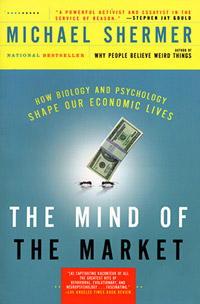
I’ve written about this problem in my book The Mind of the Market, which focuses on evolutionary economics, whereby the world in which we evolved of small bands of egalitarian hunter-gatherers is radically different from today’s world that is resource rich and with vast disparities of wealth between the richest and the poorest. Thus, we have a natural tendency to resent wealthy people, distrust free markets, and misunderstand the bottom-up process of modern economies and try to control them from the top down, usually with disastrous consequences (e.g., Alan Greenspan and the Fed’s constant manipulation of interest rates sent false signals into the market for the price of money, leading to artificially large bubbles that then burst).

Leda noted the difference between hunting and gathering in terms of risk and uncertainty: Hunting meat is highly variable, success is as much due to luck as it is skill, and 4/10 times the hunter comes home empty-handed. Thus, hunter-gatherers must pool risk to deal with frequent reversals of fortune through food sharing. By contrast, gathering foods is a low risk process that depends on effort, not luck, and the results are mostly shared only within the family and trusted partners, but not to the group at large. Cosmides explained that this evolved psychology can be seen today in which we make distinctions between people in need of our help because they were unlucky (as with the hunters who return empty-handed) versus the gatherers who don’t bring home the vegetables because they were lazy and were loafing on the job. We are inclined psychologically to want to help the former but not the latter.

The political and economic consequences of this evolved psychology can be seen today in debates about healthcare, welfare, social security, etc., which are all attempts to pool risk among everyone in society, but without any distinction between those who suffer because of bad luck versus those who suffer because of laziness or lack of ambition. Modern political states are in the business of redistributing wealth from those who have it to those who do not, and since there is no attempt to discriminate between those who were unlucky from those who were just lazy, the people who earn that money through hard work and talent who then have it confiscated by the government and given to people they do not even know, naturally feel resentful, even though statistically the wealthy are extremely generous in giving to private charities that they voluntarily choose.

Cosmides also noted the psychological difference between working land that you own versus working land that the government owns: the agricultural policy of the USSR allowed 3% of land on collective farms to be private, and it turned out that between 45% and 75% of all food in the USSR was the product of that 3% of private farms.

So, in conclusion, Cosmides noted that there is a mismatch between the ancestral and modern worlds, our minds evolved to navigate family and friends and small groups, certain laws and institutions satisfy the moral intuitions these programs generate whereas other laws and institutions regularly fail in the modern world. Cosmides concluded: “Liberty provides the solution to most social problems, but few appreciate it because of our evolved minds.”

The second talk of the day was by Dan Mitchell, the Cato Institute expert on tax reform, supply-side tax policy, the flat tax, and tax competition. His talk was titled: “America’s Looming Fiscal Meltdown.” We are shifting to a European size welfare state, he noted, dolling out blame to both Democrats and Republicans, starting with George W. Bush, who Mitchell noted in his eight year term increased the Federal budget from $1.8 trillion to $3.5 trillion budget, and then noted Obama says he wants change to even more government, adding another trillion dollars to the budget in his first term, if not more. Mitchell also busted the myth that Bush increased the budget for natural security after 9/11. Not true, he said: most of it was for pork projects for his political cronies.

Mitchell then noted that Keynesianism is bad theory: borrow money and then give it to people so they will spend it — but moving money from the right pocket into the left pocket does not produce more wealth; it’s just redistribution. It does not increase wealth. Only free markets can do that. And in any case, where does the government get the money to redistribute? From us! But they take their cut as the middleman, and therein lies the problem. Bigger government did not work for Hoover or Roosevelt, and all that federal spending to get us out of the depression did not work: we did not get back to 1929 GDP levels until WWII. Neither did federal stimulus plans work for Presidents Ford or Bush I during their recessions, and Keynesianism failed utterly in Japan during the 1990s, when its national debt went from 60% of GDP to 150% of GDP. I.e., Keynesianism does not work, and yet politicians on both the right and the left insist that the only reason it doesn’t work is because: “government isn’t spending enough.” Wrong!

We are on the road to serfdom, says Mitchell, as our federal spending is projected to jump from 22% of GDP today to 45%–55% of GDP in the coming years (mostly because of Social Security, Medicare, and Medicaid). Unless our GDP doubles along with federal spending (it won’t) the collapse is coming. Well, not a collapse, per sey: America will not become Argentina or Zimbabwe. But we will become France: instead of growing 2.5–3% a year, we’ll grow 1–1.5%, a difference that has enormous long-run implications, lowering per capita GDP 30–40% below what it otherwise would be. More spending means more taxes: more income taxes, payroll taxes, death taxes, double taxation of dividends and capital gains. And this doesn’t work. In 1980 Ronald Reagan cut the top tax rate from 72% to 28%, and between 1980 and 1988 the number of rich people (millionaires) rose from 116,800 to 723,700, and their share of paying for the federal government rose from $19 billion in income taxes to $99.7 billion in income taxes. In other words, lowering taxes on the rich generates more revenue for the federal government, which is counterintuitive.

In the end, however, there are moral consequences to such economic decisions. Mitchell: “Today there are over 2 million people in America who completely depend on welfare: prisoners; well, the welfare state is a prison for the human soul.”

Comments Off on Evolutionary Economics
PREVIOUS
 
NEXT