The official site of bestselling author Michael Shermer The official site of bestselling author Michael Shermer

Tag Results

Homo religious

Did humans evolve to be religious and believe in God? In the most general sense, yes we did. Here’s what happened.

Long long ago, in an environment far far away from the modern world, humans evolved to find meaningful causal patterns in nature to make sense of the world, and infuse many of those patterns with intentional agency, some of which became animistic spirits and powerful gods. And as a social primate species we also evolved social organizations designed to promote group cohesiveness and enforce moral rules.

People believe in God because we are pattern-seeking primates. We connect A to B to C, and often A really is connected to B, and B really is connected to C. This is called association learning. But we do not have a false-pattern-detection device in our brains to help us discriminate between true and false patterns, and so we make errors in our thinking: a Type I error is believing a pattern is real when it is not (a false positive) and a Type II error is not believing a pattern is real when it is (a false negative). Imagine that you are a hominid on the planes of Africa and you hear a rustle in the grass. Is it a dangerous predator or just the wind? If you assume it is a dangerous predator and it is just the wind, you have made a Type I error, but to no harm. But if you believe the rustle in the grass is just the wind when it is a dangerous predator, there’s a good chance you’ll be lunch and thereby removed from your species’ gene pool. Thus, there would have been a natural selection for those hominids who tended to believe that all patterns are real and potentially dangerous. I call this process patternicity (the tendency to find meaningful patterns in random noise) and agenticity (the tendency to believe that the world is controlled by invisible intentional agents who may mean us harm). This, I believe, is the basis for the belief in souls, spirits, ghosts, gods, demons, angels, aliens, intelligent designers, government conspiracists, and all manner of invisible agents intending to harm us or help us.

People are religious because we are social and we need to get along. The moral sentiments in humans and moral principles in human groups evolved primarily through the force of natural selection operating on individuals and secondarily through the force of group selection operating on populations. The moral sense (the psychological feeling of doing “good” in the form of positive emotions such as righteousness and pride) evolved out of behaviors that were selected for because they were good either for the individual or for the group; an immoral sense (the psychological feeling of doing “bad” in the form of negative emotions such as guilt and shame) evolved out of behaviors that were selected for because they were bad either for the individual or for the group. While cultures may differ on what behaviors are defined as good or bad, the moral sense of feeling good or feeling bad about behavior X (whatever X may be) is an evolved human universal. The codification of moral principles out of the psychology of the moral sentiments evolved as a form of social control to insure the survival of individuals within groups and the survival of human groups themselves. Religion was the first social institution to canonize moral principles, and God as an explanatory pattern for the world took on new powers as the ultimate enforcer of the rules.

Thus it is that people are religious and believe in God.

• FOLLOW MICHAEL SHERMER ON TWITTER

Comments Off on Homo religious

The Natural and the Supernatural

Cartoonist Sidney Harris once illustrated two scientists at a chalkboard. One has written, among mathematical equations, “Then a miracle occurs,” to which his colleague replies, “I think you need to be more specific here in step two.” This nicely sums up the relationship between science and religion: one deals in the natural while the other deals in the supernatural. And never the twain shall meet.

Were only it were so. Unfortunately, religions routinely make claims about the natural world that are in direct conflict with the scientific evidence. Young-Earth Creationists, for example, believe that the world was created around 6,000 years ago, about the same time that the Babylonians invented beer. These claims cannot both be correct, and anyone who thinks the former is right has relegated all of science (along with brains) to the dumpster of life. Many people of faith believe that prayer can cajole the deity into taking action in our world to do everything from healing cancers to winning wars. Yet a comprehensive controlled scientific study on the efficacy of prayer on healing, funded by the religiously-based Templeton Foundation and conducted at the prestigious Harvard Medical School, found no relationship between the two: subjects in the non-prayed for group did just as well (or poor) as those in the prayed for group. And why is it, scientists want to know, that prayer only seems effective for things that might have happened anyway, such as tumors going into remission. A more dramatic and unmistakably religious miracle that would shock even the most skeptical of scientists would be if prayers for amputees (especially our brave wounded Christian soldiers returning from Iraq and Afghanistan) resulted in renewed whole limbs; i.e., a true miracle.

How, then, can we reconcile the natural and the supernatural? Most people keep them separated in logic-tight compartments, even scientists. Surveys conducted in 1916 and again in 1997 found that 40 percent of American scientists said they believe in God. As well, hundreds of millions of practicing Protestants, Catholics, Jews, and members of other faiths both believe in God and fully embrace science, even evolution: a 2005 Pew Research Center poll found that 68 percent of Protestants and 69 percent of Catholics accept the theory. So, demographically speaking, most people find no conflict between science and religion.

However, the natural world does not bend to the demographics of belief. Millions of people also believe in astrology, ghosts, angels, ESP, and all manner of paranormal piffle, but that does not make them real. The veracity of a proposition is independent of the number of people who believe it.

In conclusion, I go so far as to conclude: There is no such thing as the supernatural or the paranormal. There is only the natural, the normal, and mysteries we have yet to explain. God is a mystery, and the God of Abraham may very well be an eternal mystery for the simple reason that any God explicable through science and the laws of nature would, by definition, lose the status of supernatural and enter the realm of the natural. A God definable by science is not a God at all.

• FOLLOW MICHAEL SHERMER ON TWITTER

Comments Off on The Natural and the Supernatural

Mixing Science and Politics (and Economics)

So many of you have taken the time to respond to my blogs thoughtfully that I feel I should comment in kind. In looking through the many comments, however, I see that most of what I would say has already been said by people who responded to my critics. Nevertheless…

First of all, why is it okay to mix science and religion (with atheists eagerly do in debunking religious claims) but not okay to mix science and politics/economics? Why is it okay for liberal atheists to stick it to religious believers and twist the knife slowly, but when it comes to getting your own (political/economic) beliefs challenged, that’s off limits — NOMA (nonoverlapping magisterial) for science and politics? I don’t see how they are different in principle. Skeptic is a science magazine, not an “atheist” magazine; nevertheless, we routinely deal with religious claims and no one ever complains about that. The closest we have come to political/economic issues is environmentalism (Vol. 9, No. 2 — sold out), overpopulation (Vol. 5, No. 1), and global warming Vol. 14, No. 1). For all three we published several articles; in Vol. 14, No. 1, for example, we published articles both skeptical of global warming and accepting of global warming. So I don’t see what would be wrong with publishing articles pro, con, and neutral on political and economic claims.

One person wrote me a private email that said he thought of me as the next Carl Sagan, but now that I’ve gone to the dark side (turning Right, although I’m as critical of the Right as I am the Left), because Carl was “apolitical.” Carl Sagan was many things, but apolitical was not one of them. Carl was a Liberal and proudly wore his politics on his sleeve, such as when he marched in protest at nuclear sites or testified before Congress about the dangers of nuclear winter. I admire him for having the courage of his convictions, which intimately blended his science and (Left) politics. If you think Sagan was apolitical it is because you happen to agree with his politics and so those ideas seem simply correct, not political. If you don’t share his politics (I share about half of them), then it’s obvious that Sagan was not apolitical.

The liberal bias in the skeptical community was identified by many people in the comments section of my blog, for example by “DR,” “James,” and “Devil’s Advocate”:

… Sadly, there is a lot of hatred toward libertarianism at JREF [he means TAM]. I can be an atheist, believe gay marriage is ok, think nothing of smoking pot, and I won’t get half as much grief from a conservative that I do from an American liberal who reels and squirms when I say that the welfare state is immoral or that free trade and voluntary transactions in capitalism promote fair and just outcomes. It’s like the only reason why I have rationalized this set of morality is because I’m a supremely evil person and must be wrong… —DR

… I’m disappointed, but not surprised by the large group of liberal skeptics. I’ve talked to too many Democrat-card-carrying skeptics that spout the same unoriginal, canned rhetoric and continual spewing hatred of Republicans. For a group that supposedly supports tolerance, they’re anything but tolerant …
—James

I’ve three times over twenty years joined local skeptic groups and all three times there was a presumption that if I was a skeptic, then of course I’m also liberal in my politics. Two times I tried to be what I am but was marginalized, treated like a Goldwater (or Reagan, or Bush) mole. The third time I tried to avoid political discussion, but it was not possible, so, unwilling to lie, I left. My refusal to come over to pure liberalism clearly wasn’t going to be tolerated. All I wanted to do was examine UFO claims and crop circles, but… —Devil’s Advocate

Another critic named John D. Draeger makes a good point that I wish to acknowledge: “He [me] does NOT believe that political persuasions and different economic models for how societies should be run are moral value judgements…. Social services can be paid for in different ways, and in a democratic society it’s up to the majority to define how that is done. Social services can be paid for in different ways, and in a democratic society it’s up to the majority to define how that is done.” That’s true, in a democracy the majority rules how to divvy up public funds for social services, and that tends to be more of a value judgment than a science. But as someone else wrote just below that, quite cleverly I think…

First of all, democratic societies can still be evil, as the famous saying goes: “democracy is two wolves and one lamb voting on what to have for lunch.” And then in another famous quote (attributed to several), “A democracy cannot exist as a permanent form of government. It can only exist until the voters discover that they can vote themselves largesse from the public treasury. From that moment on, the majority always votes for the candidates promising the most benefits from the public treasury with the result that a democracy always collapses over loose fiscal policy, always followed by a dictatorship. Thus our founding fathers gave us a republic … if we can keep it.

Even this is a value judgment, I agree, but surely we can apply some forms of social science to inform our value judgments. For example, we may as a society make the value judgment that it would be good if every child received a basic K–12 education. I agree with this value judgment, and would add to it the value judgment that it would be equally important for every child to have a computer and Internet access because that is the future of education. So we share that value judgment. However, the next question is a pragmatic one: who is going to pay for this education (and computers/Internet)? Parents? Churches? NGOs? Charities? Government? If the latter — the value judgment we have made — then do parents get to choose among the various government schools of where to send their children? (No.) Do parents who choose to send their children to private schools have to also pay for government schools? (Yes.) Is that fair? You make that value judgment. I don’t think that it is fair. To be consistent, if you are pro-choice on abortion you should also be pro-choice on education. The deeper value judgment here is being pro-choice about everything. Choice = freedom.

Some correspondents hated the political diagram because it seems to elevate libertarianism above the traditional left-right spectrum. Okay, then you come up with something other than the left-right linear spectrum to visualize where someone would fall on that line who is socially liberal and fiscally conservative. You draw it and I’ll publish it in a future blog.

Some people hate the word “libertarian.” I’m not crazy about it either, but haven’t thought of a better label. Labels are useful because they enable people to take cognitive shortcuts, but they also lead to shortcuts to nuanced thinking about what someone believes. “Oh, you’re one of those…” full stop. We all do this, of course, but I call myself a libertarian for the same reason I call myself a feminist, an atheist, and a pro-choicer — because it is the accepted language and we have to communicate ideas with language. But I much prefer to be assessed on specific issues.

Several of you said that I am a victim of one of my own central tenets of baloney detection: the confirmation bias, where we look for and find confirmatory evidence for what we already believe and ignore the disconfirmatory evidence. Yes, I will admit, I do this. Everyone does, and we must guard against it, especially when it comes to religion, politics, and economics. To combat this problem, I read the conservative Wall Street Journal and the liberal Los Angeles Times. I listen to such conservative talk radio hosts as Hugh Hewitt and Dennis Praeger as well as the very liberal Bill Maher. I have read Karl Marx’s books as deeply and carefully as I have read Adam Smith’s books. I have read a host of books from liberal and conservative and libertarian authors on the current economic meltdown. And although I have a few libertarian and conservative friends, because I work in the sciences and in publishing, the vast majority of my friends, acquaintances, staff, co-workers, and colleagues are liberals who I can assure you are never shy about letting me know where they think I’ve gone off the political or economic rails.

Finally, let me add that one of the appealing things to me about the libertarian worldview is that it is optimistic, uplifting, and most importantly (to me) anti-elitist. I’m in favor of doing whatever we can to allow the little guy to succeed and to break up power blocs that prevent the average Joe or Jane from reaching their full potential. The Constitutional divisions of power in our Democracy — emulated by many others around the world — are a huge improvement from centuries past that allowed or enabled some to succeed at the expense of others. That was a zero-sum world. Over the past 200 years the spread of democracy and capitalism has done more toward achieving a Nonzero world than anything else — more people in more places more of the time have more power and liberty and wealth than any time in the previous four millennium. Therefore, the more we can spread democracy and capitalism the better off more of us will be more of the time.

• FOLLOW MICHAEL SHERMER ON TWITTER

Comments Off on Mixing Science and Politics (and Economics)

Toward a Type I Civilization

To solve our energy problems we need more than new technologies,
we need a new type of civilization

Last week I reviewed the first half of my lecture at TAM 7 (The Amazing Meeting 7) on rising above traditional left-right politics. The second half of my lecture was based on my belief that in order for our species to survive we need to make the transition to a Type I civilization. This visage of our future is based on some work I did last year, that resulted in an opinion editorial in the Los Angeles Times:

Our civilization is fast approaching a tipping point whereby we will need to make the transition from nonrenewable fossil fuels as the primary source of our energy to renewable energy sources that will allow us to flourish indefinitely into the future. Failure to make that transformation will doom us to the endless political machinations and economic conflicts that have plagued our civilization for the past half millennium. We need new technologies, but without new politics and economics we cannot make the transition. The transition to what? To a Type I civilization. Let me explain.

In a 1964 article on searching for extra-terrestrial civilizations, the Soviet astronomer Nikolai Kardashev suggested using radio telescopes to detect energy signals from other solar systems in which there might be three different types of civilization: Type I can harness all of the energy of its home planet, Type II can harvest all of the power of its sun, and Type III can master the energy from its entire galaxy. Based on our energy efficiency at the time, in 1973 the astronomer Carl Sagan estimated that we are a Type 0.70 civilization. Current estimates put us at 0.72. As the Kardashevian scale is logarithmic — where each increase in power consumption requires a huge leap in production — we have a ways to go to make the transition.

Fossil fuels won’t get us there. Renewable sources such as solar, wind, and geothermal are a good start, and coupled to nuclear power could eventually get us there, once the technologies are developed. But the problem is not just a technological one. We have a proven track record of remarkable technological solutions to survival problems, as long as the political will and economic opportunities allow them to flourish. We need a Type I polity and economy, along with the technology, in order to become a Type I civilization. What is a Type I polity and economy? Global democracy and capitalism. We are close. Consider how far we’ve come in the long history of our species from Type 0:

Type 0.1:
Fusion-fission groups of hominids living in Africa, where group membership is fluid, technology consists of primitive stone tools, within-group conflicts are resolved through dominance hierarchy, and between-group violence is common.
Type 0.2:
Bands of roaming hunter-gatherers who are related to one another as a kinship group, with a mostly horizontal political system and an egalitarian economy.
Type 0.3:
Tribes of individuals linked together through kinship but with a more settled and agrarian lifestyle than bands, with the beginnings of a political hierarchy and a primitive economic division of labor.
Type 0.4:
Chiefdoms consisting of a coalition of tribes into a single hierarchical political unit with a chief or big man at the top and with the beginnings of significant economic inequalities and a division of labor in which lower class members produce food and other products consumed by nonproducing upper class members.
Type 0.5:
States as a political coalition with jurisdiction over a well-defined geographical territory with its corresponding inhabitants over which it rules, with a mercantile economy that seeks a favorable balance of trade in a win-lose game against other states.
Type 0.6:
Empires as states that extend their control over peoples who are not culturally, ethnically, or geographically within its normal jurisdiction, with a goal of economic dominance over other empires through colonies.
Type 0.7:
Democracies that divide the sources of power over several institutions that are run by elected officials voted for by some citizens, with the beginnings of a market economy.
Type 0.8:
Liberal democracies and free markets that gave the vote to all citizens and began to embrace a nonzero win-win economic game through free trade with other states.
Type 0.9:
Democratic-Capitalism, now spreading across the globe through democratic movements and free trade agreements.
Type 1.0:
Globalism that includes worldwide wireless internet access, all knowledge digitized and available to everyone anywhere any time, a global economy with complete open economic borders and free markets where anyone can trade with anyone else without interference from states or governments, and where all states are democracies in which everyone on the planet has the franchise.

The forces at work that could prevent us from making the Great Leap Forward to a Type I civilization are primarily political and economic. The resistance by non-democratic states to turning power over to the people is considerable, especially in theocracies whose leaders would prefer we all revert to Type 0.4 chiefdom status. The opposition toward a global economy is substantial, even in the Industrial West, where economic tribalism still dominates the thinking of most politicians, intellectuals, and citizens.

For thousands of years we lived in a zero-sum tribal world where the gain of one tribe, state, or nation meant the loss of another tribe, state, or nation, and our political and economic systems have been designed to live in that win-lose world. But now we have the opportunity to live in a win-win world and become a Type I civilization by spreading liberal democracy and free trade.

I am optimistic because in the evolutionist’s deep time and the historian’s long view, the trend-lines toward achieving Type I status are inexorably upward. That is change we can believe in.

• FOLLOW MICHAEL SHERMER ON TWITTER

Comments Off on Toward a Type I Civilization

Fear & Loathing (and Freedom & Skepticism) in Las Vegas

photo by Daniel Loxton

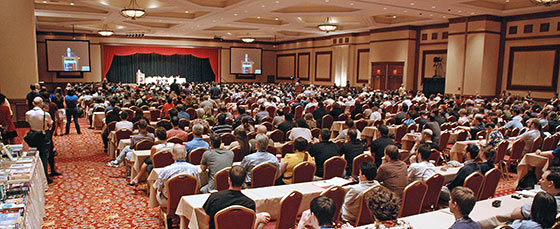
TAM7 boasted over 1000 attendees.

The Amazing Meeting 7 and Freedom Fest were both held over the same weekend in Las Vegas, the former at the new and beautiful South Point Hotel and the latter at the classic old Bally’s hotel and casino. I spoke at both and attended as many talks as I could fit in while shuttling back and forth between events. Some impressions:

Business is definitely down in Vegas. Every taxi driver I asked put the downturn at about 35% lower than normal, and between the two casinos we passed the new MGM-backed casino under construction but now abandoned due to lack of funding to complete construction. There were never any taxi lines and room rates at both hotels were well below the normal too-high rates. Nevertheless, there seemed to be plenty of folks at the slots and tables, trying to recover their 401K losses, obviously having never taken a basic course in probabilities (my system: I give the casino $500 and ask if I can play for a couple of hours: “you’re going to get the money anyway and I just want to have some fun.” I’ve never had success with this sytem.).

TAM had about 1000 people in attendance, while FreedomFest had about 1500. Shortly after I arrived I was called up for a private meeting with Randi, who later announced to the group that he had recently undergone a serious medical procedure to rid his body of something that wasn’t suppose to be there, and it looks like they got it all but just in case he’ll have to undergo chemo treatment after TAM, just to insure that there are no renegade cells floating about. When I saw Randi in his hotel room, his voice was a little weak and he seemed frail, yet the next morning when he stood at the podium to address his fans, he came to life, energized by the standing O he received, and suddenly his voice switched to his rich sonorous self as he regaled the audience with tales of his latest exploits among medics and psychics. Randi is such an experienced and professional entertainer that he just comes to life when there’s an audience. At age 80, I know that Randi is going to have a tough time of it (chemo is nasty business indeed), but he’s one of the toughest guys I know so I’m confident that we’ll have Randi around for many more years.
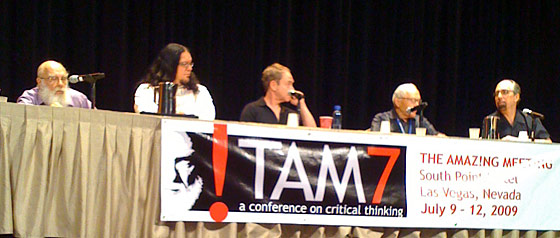
Randi, Penn, Teller, Ray Hyman, Jamy Ian Swiss. Only the scientist has two names; the magicians have either one or three names. Um…

Randi, Penn, Teller, Ray Hyman, Jamy Ian Swiss. Only the scientist has two names; the magicians have either one or three names. Um…

On Friday afternoon I spoke at FreedomFest on myths about Darwin, including: that Darwin was an atheist (he was an agnostic); that acceptance of evolution theory leads to atheism (obviously not since 40% of American scientists — all of whom accept evolution — believe in God); that Darwin was always an evolutionist and got that from his grandfather Erasmus (Darwin was a creationist before and during the voyage of the Beagle and didn’t become an evolutionist until nearly a year after his return); that Darwin was a racial egalitarian (he was against slavery, and although he was very progressive in his social attitudes about race compared to his contemporaries, compared to people today Darwin, like his birthday twin Abraham Lincoln, did not believe that the races were biologically equal); that evolution is progressive and is “leading” somewhere (it isn’t leading anywhere — there are certain convergences in evolution, such as locomotion, hearing, seeing, etc., but there is nothing inevitable about, say, human intelligence); that evolution is “red in tooth and claw” and is nothing more than nasty, competitive, brutish, and bloody (a successful strategy for survival among social animals is pro-social, cooperative, and involves mutual aid among members of a group); and that conservatives should not accept evolution because it doesn’t explain human nature as Christians see it (in fact, as I argued in Why Darwin Matters, the Christian view of human nature is very similar to that of a Darwinian human nature). My talk seemed to go over well, perhaps because I share similar political and economic beliefs as the conservatives and libertarians at FreedomFest, so to have “one of their own” explain why it’s okay to accept evolutionary theory perhaps makes it all easier to swallow.
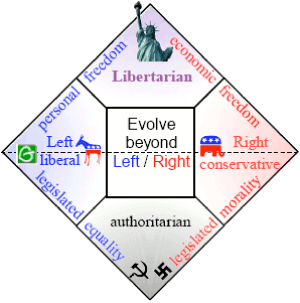
diagram by David Nolan

diagram by David Nolan

Likewise, I think that my talk at TAM Saturday morning, entitled “Rise Above: Toward a Type I Civilization,” was equally well received. At least everyone who said something to me afterwards seemed positive about it (perhaps my critics will just email me later). Even the famed magician Jamy Ian Swiss, who is most definitely not a libertarian, said he liked my talk. When I said “really?”, he responded, “yes, absolutely; of course, I still disagree with you on many points,” which I took as a compliment. During my talk I put up a side of a well-known heuristic diagram for classifying yourself politically, that moves beyond the traditional left — right spectrum.

I then asked for a show of hands among the 1,007 people in the audience of who identifies themselves as left of center (I estimated about 80%), libertarian (I estimated about 20%), and right of center (a grand total of 4 people raised their hands!). I then reviewed the standard left-right stereotypes of what liberals think of conservatives, and vice versa:

Conservatives are a bunch of gun-totting, Hummer-driving, hard-drinking, Bible-thumping, black-and-white-thinking, fist-pounding, shoe-stomping, morally-hypocritical blowhards.

Naturally, this received a huge round of applause, along with hooting and hollering in agreement. But, to my surprise, so too did my characterization of what conservatives think of liberals:

Liberals are a bunch of tree-hugging, whale-saving, hybrid-driving, sandle-wearing, bottled-water-drinking, ACLU-supporting, flip-flopping, wishy-washy, Namby Pamby bedwetters.

I then suggested that we need to “rise above” such stereotypes, and proposed a solution based on the research by the University of Virginia psychologist Jonathan Haidt and his model of morality that allows us to avoid being trapped by such linear left-right thinking in which one side is right and the other side is wrong. You can read my summary of Jonathan’s research in last week’s blog, but recall that Haidt argues that there are 5 foundations of morality:

  1. Harm-Care (do not harm others, people should be cared for)
  2. Fairness-Reciprocity (justice for all)
  3. In-group Loyalty (we live in a dangerous tribal world so we need group unity)
  4. Authority-Respect (a free society depends on the rule of law and law-and-order)
  5. Purity-Sanctity (conservatives: sex, drugs, rock’n’roll; liberals: food, environment)

Instead of one side being right and the other wrong, I think we would all be better served if we recognize that liberals and conservatives emphasize different moral values: Liberals are high on the Harm-Care and Fairness-Reciprocity dimensions, but low on Loyalty, Authority-Respect, Purity-Sanctity; whereas conservatives are about equal on the 5 dimensions (although slightly less on Harm-Care and Fairness-Reciprocity, slightly higher on Loyalty, Authority-Respect, Purity-Sanctity).
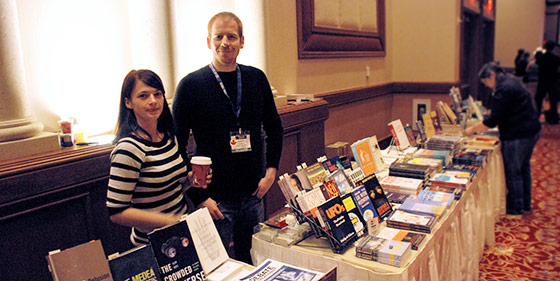
photo by Daniel Loxton

Volunteers Jason Loxton and Jillian Baker staff the Skeptics Society table.

As an example of this difference between emphasizing individual v. group morality, I showed a clip from one of my favorite films, Rob Reiner’s 1992 A Few Good Men, in which Jack Nicholson’s character — the battle-hardened Marine Colonel Nathan R. Jessup — is being cross-examined by Tom Cruise’s naive rookie Navy lawyer Lieutenant Daniel Kaffee. In the context of Haidt’s moral dimensions, I think of Kaffee as the liberal and Jessup as the conservative. Kaffee is defending two Marines accused of killing a fellow soldier named Santiago at Guantanamo base on Cuba. He thinks Jessup ordered a “code red,” an off-the-books command to rough up a lazy Marine trainee in need of discipline, and that matters got tragically out of hand. Kaffee wants answers to specific questions about the incident. Jessup wants to lecture him on the meaning of freedom and the need to defend it. The ensuing dialogue includes Jessup’s penetrating testimony about the true nature of human nature:

Jessup: You want answers?!

Kaffee: I want the truth.

Jessup: You can’t handle the truth!

Jessup (continuing): Son, we live in a world that has walls. And those walls have to be guarded by men with guns. Who’s gonna do it? You? I have a greater responsibility than you can possibly fathom. You weep for Santiago and you curse the Marines. You have that luxury. You have the luxury of not knowing what I know: That Santiago’s death, while tragic, probably saved lives. And my existence, while grotesque and incomprehensible to you, saves lives.

You don’t want the truth. Because deep down, in places you don’t talk about at parties, you want me on that wall. You need me on that wall. We use words like honor, code, loyalty … we use these words as the backbone to a life spent defending something. You use ’em as a punchline. I have neither the time nor the inclination to explain myself to a man who rises and sleeps under the blanket of the very freedom I provide, then questions the manner in which I provide it. I’d prefer you just said thank you and went on your way. Otherwise, I suggest you pick up a weapon and stand a post. Either way, I don’t give a damn what you think you’re entitled to.
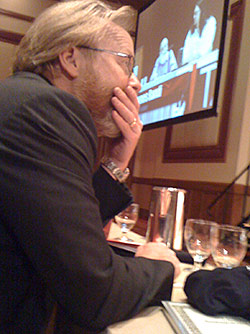
Who is the man and what is he thinking? Write your answer in the comments section.

Who is the man and what is he thinking? Write your answer in the comments section.

The fact is we need all five moral dimensions. Personally, I tend more toward the liberal emphasis on individual fairness and justice and freedom, and I think our inner tribalisms are divisive and set people against one another, and so overemphasizing loyalty to group and nation can be dangerous. But ever since 9/11 I’ve come to see that we do live in a world with walls, and that those walls need to be guarded by men with guns. And when it comes to religious tribal fundamentalisms I think liberals agree with me on this point (certainly Sam Harris in The End of Faith and Richard Dawkins in The God Delusion make the point that fundamentalist religions are dangerous, and both are liberals).

In the long run, however, we need to rise above all this tribalism, and that’s what I mean by my lecture subtitle: “toward a Type I Civilization.” Next week I’ll outline the Kardashev scale of typing civilizations and suggest how we can move from where we are now to a global Type I civilization.

Comments Off on Fear & Loathing (and Freedom & Skepticism) in Las Vegas
PREVIOUS
 
NEXT