May 8, 2012
Where in the world are the atheists? That is, in what part of the globe will one find the most people who do not believe in God? Answer: East Germany at 52.1%. The least? The Philippines at less than 1%. Predictably, strong belief shows a reverse pattern: 84% in the Philippines to 4% in Japan, with East Germany at the second lowest in strong belief at 8%. Not surprising, those who believe in a personal God “who concerns himself with every human being personally” is lowest in East Germany at 8% and highest in the Philippines at 92%.
These numbers, and others, were collected and crunched by Tom W. Smith of the National Opinion Research Center (NORC) at the University of Chicago, in a paper entitled “Beliefs About God Across Time and Countries,” produced for the International Social Survey Programme (ISSP) and released on April 18, 2012. Smith writes: “Countries with high atheism (and low strong belief) tend to be ex-Socialist states and countries in northwest Europe. Countries with low atheism and high strong belief tend to be Catholic societies, especially in the developing world, plus the United States, Israel, and Orthodox Cyprus.”
Many religious scholars invoke the “secularization thesis” to explain lower religiosity in Northern European countries (compared to the United States) in which mass education, especially in the sciences, coupled to the fact that governments do what religions traditionally did in the past in taking care of the poor and needy. With a tight social safety net religions simply fall into disuse; with a porous social safety net people fall through the cracks and are picked up by religions. Other scholars have suggested a “supply side” explanation for the difference between the U.S. and Europe, in which churches and religions in America must compete for limited resources and customers and thus have ratcheted up the quality of religious products and services: mega churches with rock music, baby sitting, BBQs, and even free parking! Smith seems to find evidence of both forces at work, noting that “In the case of Poland, it appears that its strong Catholicism trumps the secularizing influence of Socialism,” whereas elsewhere in the world “there is also evidence that religious competition and/or religious conflict may stimulate higher belief.” (continue reading…)
Comments Off on Atheist Nation
April 24, 2012
My weekend at the New Orleans Baptist Seminary discussing God, religion, and the afterlife
On Friday, April 13, 2012 in the chapel of the New Orleans Baptist Seminary I debated the Liberty University philosopher and theologian Gary Habermas on the question: “Is There Life After Death?” I went first. I stated that since Gary is taking the affirmative I’m suppose to defend the negative, but in fact when it comes to the afterlife, “I’m for it!” Tellingly, that line didn’t get the usual laugh it engenders in audiences, but then in seminary school the afterlife is a deadly serious subject. I began with this thought experiment:
Imagine yourself dead. What picture comes to mind? Your funeral with a casket surrounded by family and friends? Complete darkness and void? In either case you are still conscious and observing the scene.
I then outlined the problem we all have in thinking about life after death: we cannot envision what it is like to be dead any more than we can visualize ourselves before we were born, and yet everyone who ever lived has died so death is inevitable. This leads to either depression or humor. I prefer the latter. For example, Steven Wright: “I intend to live forever—so far, so good.” Or Woody Allen: “It’s not that I’m afraid to die. I just don’t want to be there when it happens.”
Of course, you won’t be there when it happens because to experience anything you must be conscious, and you are not conscious when you are dead. I then outlined four theories of life after death, gleaned from my recent Scientific American column based on Stephen Cave’s marvelous new book, Immortality, which I highly recommend reading. (continue reading…)
Comments Off on Shermer in Seminary School
April 10, 2012
Recently my friend and colleague in science and skepticism Neil deGrasse Tyson, issued a public statement via BigThink.com in which he stated that he dislikes labels because they carry with them all the baggage that the person thinks they already know about that particular label, and thus he prefers no label at all when it comes to the god question and simply calls himself an agnostic.
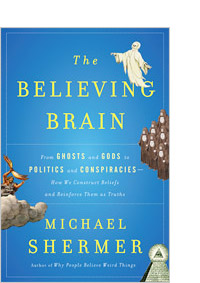
The Believing Brain
by Michael Shermer
In this book, I present my theory on how beliefs are born, formed, nourished, reinforced, challenged, changed, and extinguished. Sam Harris calls The Believing Brain “a wonderfully lucid, accessible, and wide-ranging account of the boundary between justified and unjustified belief.” Leonard Mlodinow calls it “a tour de force integrating neuroscience and the social sciences.”
(continue reading…)
Comments Off on Are you an Atheist or Agnostic?
April 3, 2012
A foreword to Stephen Cave’s Immortality: The Quest to Live Forever and How it Drives Civilization (Crown, 2012, ISBN 978-0307884916), now available in paperback.
On Friday, April 13, 2012 in the chapel of the New Orleans Baptist Seminary I debated a Liberty University philosopher and theologian named Gary Habermas on the question: “Is There Life After Death?” I went first. I began with this thought experiment:
Imagine yourself dead. What picture comes to mind? Your funeral with a casket surrounded by family and friends? Complete darkness and void? In either case you are still conscious and observing the scene.
I then outlined the problem we all have in thinking about life after death: we cannot envision what it is like to be dead any more than we can visualize ourselves before we were born, and yet everyone who ever lived has died so death is inevitable. This leads to either depression or humor. I prefer the latter. For example, Steven Wright: “I intend to live forever—so far, so good.” Or Woody Allen: “It’s not that I’m afraid to die. I just don’t want to be there when it happens.” Of course, you won’t be there when it happens because to experience anything you must be conscious, and you are not conscious when you are dead.
(continue reading…)
Comments Off on A Skeptic Considers Immortality
March 27, 2012
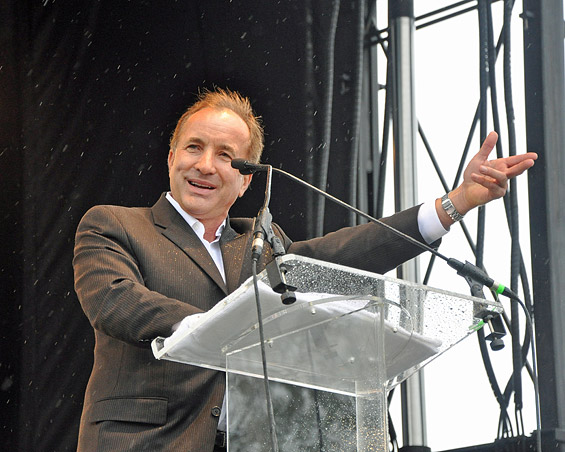
Yours truly, leading the Reason Rally Cheer (photo by John Welte)
March 24, 2012 marked the largest gathering of skeptics, atheists, humanists, nonbelievers, and “nones” (those who tick the “no religion” box on surveys) of all stripes on the Mall in Washington, D.C., across from the original Smithsonian museum. Crowd estimates vary from 15,000 to 25,000. However many it was, it was one rockin’ huge crowd that voiced its support for reason, science, and skepticism louder than any I have ever heard. Anywhere. Any time. Any place. It started raining just as the festivities gathered steam late morning, but the weather seemed to have no effect whatsoever on the enthusiasm and energy of the crowd…or the speakers and performers. The organizer and host David Silverman and his posse of tireless staff and volunteers pulled it off without a hitch. Organizing big events can be an organizational nightmare, but they did it, marking what I hope is the first of many consciousness raising events in the civil rights movement for equal treatment for us nonbelievers and skeptics. (continue reading…)
Comments Off on Reason Rally Rocks