This is a brief video introduction to the power of belief through the three books of my trilogy: Why People Believe Weird Things, How We Believe, The Science of Good and Evil, and (pace Douglas Adams) volume 4 of the trilogy, The Mind of the Market. The first volume is on science and pseudoscience and, as the title says, why people believe weird things. Vol. 2, How We Believe, is on why people believe in God (but the publisher didn’t want to call it that so they went with the more generic title on belief). Vol. 3 is on why we are moral, but since the book deals more than with the evolutionary origins of morality, they once again went with the broader title. Vol. 4, then, expands on the theme of belief in the realm of economics, and why people believe weird things about money and why markets seem to have a mind of their own.
I visited the Creation Museum in Petersburg, Kentucky, run by Answers in Genesis, the young-earth creationist organization run by Ken Ham, an Old Testament looking figure if ever there was one. I will be writing more about my experience in my monthly column in Scientific American (May 2009), but the highlight (also discussed in the column) was my interview with Dr. Georgia Purdom, the museum’s “research scientist” who explained what type of research one can do at a young-earth creationist organization, and why she thinks Francis Collins is wrong in his evolutionary understanding of the human genome.
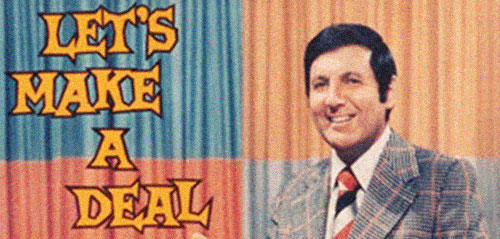
The following letter was sent to me in response to my column in Scientific American (which generated hundreds of letters in response, so I penned the following response) in which I discussed the now-infamous (and infuriatingly counter-intuitive) probability problem called the Monty Hall Problem, or the Three Door Problem, in which a contestant chooses one of three doors, behind one of which is a car and the other two goats. Monty then reveals what’s behind one of the other doors (only ever showing a goat and never showing you your own door pick), which is always a goat, then asks if you want to change doors. Most people say it doesn’t matter because now it’s 50/50, but the correct answer is that you should always switch, which will give you a two-thirds chance of winning. There are simulations of the game online, but my correspondent took it upon himself to test the game with his own computer program. Here are his very interesting results, which also nicely show the scientific method at work: (continue reading…)
Comments Off on Monty Hall Problem Put to the Test
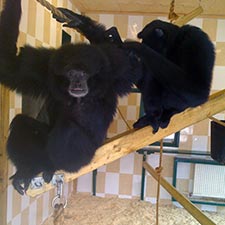
Two Gibbons on Noah’s Ark, bearing no resemblance whatsoever to humans.
Evolution and Creationism in England
During the first week of February, 2009, on the occasion of Charles Darwin’s 200th birthday celebrations at various locals around England (including his birthplace city of Shrewsbury — see photo montage below), my hosts Andrew Kelly (a science writer who authored a gorgeous coffee-table book entitled Darwin: For the Love of Science) and Bruce Hood (a University of Bristol cognitive psychologist and author of the forthcoming book Supersense), arranged for a visit to Noah’s Ark Zoo Farm in Bristol, run by a kindly creationist gentleman named Anthony Bush. (Yes, in addition to being a zoo for the public to tour, it is a working farm.) (continue reading…)
On this, the 200th anniversary week of Charles Darwin’s birthday (12 February, 1809), we celebrate the power of deep time and nature’s processes to produce dramatic change, as Michael Shermer demonstrates how a solid hunk of lava rock can be ground down to fine grains of black sand, given enough time under nature’s power of erosion.
Comments Off on Evolution Rocks! The Power of Deep Time & Change