According to Intelligent Design Theory (IDT), life is too specifically complex (complex structures with specific functions, like DNA) and irreducibly complex (reduce a complex structure by one part and it loses its function, like eyes) to have evolved by natural forces. Therefore, life must have been created by a supernatural force – an Intelligent Designer (ID). (continue reading…)
read or write comments (22)
Scientific experiments claiming that distant intercessory prayer produces salubrious effects are deeply flawed
In late 1944, as he cajoled his flagging troops to defeat the Germans in the Battle of the Bulge, General George S. Patton turned to his chief chaplain for help.
Patton: Chaplain, I want you to publish a prayer for good weather. I’m tired of these soldiers having to fight mood and floods as well as Germans. See if we can’t get God to work on our side.
Chaplain: Sir, it’s going to take a pretty thick rug for that kind of praying.
Patton: I don’t care if it takes the flying carpet. I want the praying done.
Although few attribute Patton’s subsequent success to a divine miracle, a number of papers have been published in peer-reviewed scientific journals in recent years claiming that distant intercessory prayer leads to health and healing. These studies are fraught with methodological problems.
Fraud. In 2001 the Journal of Reproductive Medicine published a study by three Columbia University researchers claiming that prayer for women undergoing in vitro fertilization resulted in a pregnancy rate of 50 percent, double that of women who did not receive prayer. ABC News medical correspondent Timothy Johnson, cautiously enthused, “A new study on the power of prayer over pregnancy reports surprising results, but many physicians remain skeptical.” One of those skeptics was from the University of California at Irvine, a clinical professor of gynecology and obstetrics named Bruce Flamm, who not only found numerous methodological errors in the experiment but also discovered that one of the study’s authors, Daniel Wirth, a.k.a. John Wayne Truelove, is not an M.D. but an M.S. in parapsychology who has since been indicted on felony charges for mail fraud and theft, to which he has pled guilty. The other two authors have refused to comment, and after three years of inquires from Flamm, the journal removed the study from its Web site and Columbia University launched an investigation. (continue reading…)
Comments Off on Flying Carpets & Scientific Prayer
The dualist belief that body and soul are separate entities is natural, intuitive and with us from infancy. It is also very probably wrong
When I was 17 in 1971, I purchased my dream car — a 1966 Ford Mustang — blue with a white vinyl roof, bucket seats and a powerful eight-cylinder 289-cubic-inch engine that could peg the speedometer at 140 miles per hour. As testosterone-overloaded young men are wont to do, however, over the course of the next 15 years I systematically wrecked and replaced nearly every part of that car, to the extent that by the time I sold it in 1986 there was hardly an original piece remaining. Nevertheless, I turned a tidy profit because my “1966” Mustang was now a collector’s classic. Even though the physical components were not original, the essence of its being — its “Mustangness” — was that model’s complete form. My Mustang’s essence — its “soul” — was more than a pile of parts; it was a pattern of information arranged in a particular way.
The analogy applies to humans and souls. The actual atoms and molecules that make up my brain and body today are not the same ones that I was born with on September 8, 1954, a half-century ago this month. Still, I am “Michael Shermer,” the sum of the information coded in my DNA and neural memories. My friends and family do not treat me any differently from moment to moment, even though atoms and molecules are cycling in and out of my body and brain, because these people assume that the basic pattern remains unchanged. My soul is a pattern of information. (continue reading…)
Comments Off on Mustangs, Monists & Meaning
Among a heap of books claiming that science proves God’s existence emerges one that computes a probability of 67 percent
In his 1916 poem “A Coat,” William Butler Yeats rhymed: “I made my song a coat/Covered with embroideries/Out of old mythologies/From heel to throat.”
Read “religion” for “song,” and “science” for “coat,” and we have a close approximation of the deepest flaw in the science and religion movement, as revealed in Yeats’s denouement: “But the fools caught it,/Wore it in the world’s eyes/As though they’d wrought it./ Song, let them take it / For there’s more enterprise/In walking naked.”
Naked faith is what religious enterprise was always about, until science became the preeminent system of natural verisimilitude, tempting the faithful to employ its wares in the practice of preternatural belief. Although most efforts in this genre offer little more than scientistic cant and religious blather, a few require a response from the magisterium of science, if for no other reason than to protect that of religion; if faith is tethered to science, what happens when the science changes? One of the most innovative works in this genre is The Probability of God (Crown Forum, 2003), by Stephen D. Unwin, a risk management consultant in Ohio, whose early physics work on quantum gravity showed him that the universe is probabilistic and whose later research in risk analysis led him to this ultimate computation. (continue reading…)
Comments Off on God’s Number Is Up
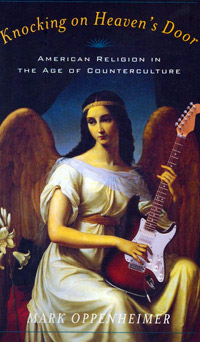
The following book review of Mark Oppenheimer’s Knocking on Heaven’s Door: American Religion in the Age of Counterculture (Yale University Press, 2003), (originally published in the Los Angeles Times) ran in the Los Angeles Times Book Review (4/1/04). I used the book review to further support the group selection thesis proffered by David Sloan Wilson in his book Darwin’s Cathedral, as well as my own analysis in The Science of Good and Evil, to explain the success of religion. It was published as Countering the Counterculture. My original title better describes my thesis and what the book is about. But it is an unalterable law of nature that all book review and opinion editorial editors must change the author’s original title or else they will go to editorial hades.
In April, 1993, in his address to the Pontifical Biblical Commission, Pope John Paul II acquitted Galileo for his heretical belief that the earth goes around the sun, explaining that “the theologian must keep informed about the results (continue reading…)
read or write comments (3)