Charles Darwin … the Movie
A review of Creation: The True Story of Charles Darwin. Starring Paul Bettany and Jennifer Connelly. Jon Amiel Director, Jeremy Thomas Producer, John Collee writer. Recorded Picture Company with BBC Films and Ocean Pictures. Based on Randal Keynes’s book Annie’s Box. In general release January 22, 2010.
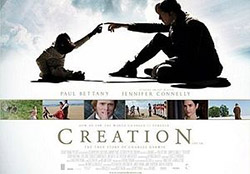
Creation is one of the most beautifully produced, artfully directed, factually accurate, and powerfully acted biopic films ever made. Full stop. It stars Paul Bettany as the Charles Darwin almost no one knows (and looking almost eerily similar if you match him to portraits of Darwin at that time), and Jennifer Connelly as the Emma Darwin almost invisible to history (and whose stunning Hollywood beauty is forgotten as she morphs into a realistic portrayal of a 19th century Englishwoman). The script is based on Randal Keynes’s biographical work, Annie’s Box, a moving portrait of the middle-aged Darwin—after the five-year voyage of the Beagle and before the white-bearded sage of Down basked in scientific triumph—as he struggled intellectually and emotionally to put the pieces of natural history together into a cogent theory. It is also about Charles Darwin the man, husband and father, besieged by health problems that curtailed his work days to only a few hours, stressed by the normal strains of marriage, and agonizing over the death from a mysterious disease of his beloved 10-year old daughter.
The film opens with the capture and return of indigenous natives of Tierra del Fuego, in the hopes that such “savages” could be saved by culture (British of course) and seeded to their native lands to spread the Queen’s English (and manners) and save their souls for God and country. (Of course, the Fuegians promptly ripped their clothes off and returned to the lifestyle appropriate for their culture.) Thankfully, the film wisely steers wide of the myth that Darwin discovered natural selection in the Galapagos Islands, and instead reveals what really happened (and what almost always happens in science) in Darwin’s halting and desultory steps to putting all the pieces of his theory together over many years after his return to England.
The hindsight bias that dictates so much of historical reconstruction—where every step along the way is pregnant with meaning for what we know is coming—is mercifully absent in Creation. Instead we find a Darwin unsure of himself. He doesn’t know what we know, and the films takes us on the intellectual journey of discovery with Darwin, as he also tries to balance work with family life and his incessant physical problems that finds him on regular visits to the town of Malvern to undergo James Manby Gully’s water cure therapy—what we would today call quack science—involving a naked Darwin standing in a shower-like stall being bombarded by waves of water. Presumably the shock to the system would shake up his innards enough to cure him. It didn’t.
The leitmotif of Creation, however, is not evolution so much as it is life and death and love. The love of a man and a woman, the love of a father and a child, and the life and death of an idea (God) and a child (Annie). Darwin has many children (almost everyone did in his time), but he was especially fond of his eldest daughter Annie, and one part of the leitmotif is Darwin’s recounting to her of the story of the death of Jenny, a young orangutan captured in Borneo and transported to the London Zoo, where it subsequently died of pneumonia in the arms of her caretaker. It’s a metaphor, of course, for Annie dying in the arms of her father, in a hotel room in Malvern when Darwin took her there for a worthless water cure therapy treatment. Since I have a daughter about whom I feel the same way Darwin did for his beloved Annie, the scene where Darwin subsequently returns to the Malvern hotel room and sobs uncontrollably on the bed where Annie died was so empathically painful that I could barely sit through it. And the portrayal of the strain Annie’s death puts the Darwin marriage through is surely not an exaggeration.
The other stress in Darwin’s marriage was his science and Emma’s religion. Darwin knew that people would think that his theory, in Thomas Huxley’s words, “killed god,” and he also knew that this fact would pain his wife, who worried for her husband’s soul to the point that she wrote him letters to that effect. It is, in fact, the likeliest reason why Darwin avoided the growing conflict between science and religion. Toward the end of his life he received many letters querying him on his religious attitudes. Darwin’s long-silence gave way to a few revelations. In one letter penned in 1879, just three years before he died, Darwin explained: “In my most extreme fluctuations I have never been an Atheist in the sense of denying the existence of God. I think that generally (and more and more as I grow older), but not always, that an Agnostic would be the more correct description of my state of mind.”
A year later, in 1880, Darwin clarified his reasoning to the British socialist Edward Aveling, who solicited Darwin’s endorsement of a group of radical atheists. Darwin declined the offer, elaborating his reason: “It appears to me (whether rightly or wrongly) that direct arguments against christianity & theism produce hardly any effect on the public; & freedom of thought is best promoted by the gradual illumination of men’s minds which follow[s] from the advance of science. It has, therefore, been always my object to avoid writing on religion, & I have confined myself to science. I may, however, have been unduly biased by the pain which it would give some members of my family, if I aided in any way direct attacks on religion.” Emma was a deeply religious woman, so out of love and respect for her, Darwin kept the public side of his religious skepticism in check, an admirable feat of self-discipline by a man of high moral character.
Go see this beautiful film about such an estimable man, an honorable woman, and an enduring love.